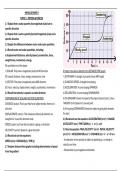
PHYSICS PAPER 1
TOPIC 2 – MOTION & FORCES
2.1 Explain that a scalar quantity has magnitude (size) but no
specific direction
2.2 Explain that a vector quantity has both magnitude (size) and a
specific direction
2.3 Explain the difference between vector and scalar quantities
2.4 Recall vector and scalar quantities, including:
a displacement/distance, velocity/speed, acceleration, force,
weight/mass, momentum, energy
All quantities are of two types:
1) SCALAR: They have a magnitude (size) but NO direction 6 things to be able to identify from DISTANCE/TIME graph:
EG: speed, distance, mass, energy, temperature, time 1) STATIONARY: A straight, horizontal line at ANY height
2) VECTOR: They have a magnitude (size) AND direction 2) CONSTANT SPEED: A straight line sloping
EG: force, velocity, displacement, weight, acceleration, momentum 3) ACCELERATION: A curve sloping UPWARDS
2.5 Recall that velocity is speed in a stated direction 4) DECLERATION: A curve sloping DOWNWARDS
COMPARISONS OF SCALAR & VECTOR QUANTITIES 5) The GRADIENT shows the speed of the object (rise/run [y/x] ). Use a
DISTANCE (scalar): This is just how far an object travels, there is no TANGENT to find speed of a curved point.
direction 6) A line going DOWNWARDS shows the object is going back towards
DISPLACEMENT (vector): This measures distance & direction in a the start
straight line. It uses the shortest route. 2.8 Recall and use the equation: ACCELERATION (m/s2) = CHANGE
SPEED (scalar): Just how fast an object is going, no direction IN VELCOITY (m/s) / TIME TAKEN (s) -> a = (v – u)/t
VELCOCITY (vector): Speed in a given direction 2.9 Use the equation: FINAL VELCOITY 2 (m/s2) - INITIAL VELOCITY2
2.6 Recall and use the equations: (m/s2) = 2 × ACCELERATION (m/s 2) × DISTANCE (m) > v2 − u2 = 2×a×x
SPEED (m/s) = DISTANCE(m) / TIME (s) - Acceleration is how quickly an object is speeding up, ie change in
velocity over time.
2.7 Analyse distance/time graphs including determination of speed
from the gradient - Deceleration is just negative acceleration
, - This equation is used to estimate the 6 Things to know about VELOCITY/TIME Graph:
average acceleration 1) CONSTANT SPEED: Straight, horizontal line (not on x-axis)
- (v - u) represents CHANGE IN
2) STATIONARY: Horizontal line on the x-axis
VELOCITY: v = final velocity
u = initial velocity 3) UNIFORM ACCELERATION: Straight slanted line
- Use this equation when the TIME is - To calculate the acceleration, find the gradient
given/involved
4) NON-UNIFORM ACCELERATION: Curved line sloping up
- This is the equation for UNIFORM/
CONSTANT ACCELERATION & is used 5) The GRADIENT is the ACCELERATION
when an object is increasing at a 6) DISTANCE: Area (/no. of boxes) under the graph
constant rate 2.11 Describe a range of laboratory methods for determining the
- a = acceleration , x = distance
speeds of objects such as the use of light gates
- Acceleration in free fall is always 9.8
(m/s)2 (~10) due to gravity To determine the speed of an object we need the DISTANCE & TIME:
- Use this equation when DISTANCE is 1) A RULER (distance) & STOPWACTH (time) can be used
given/involved 2) LIGHT GATES sends a beam of light from one side of the gate to the
2.10 Analyse velocity/time graphs to:
other side. When something passes through the gate, the beam of light
a compare acceleration from gradients qualitatively is interrupted. The light gate measure how long the beam was
b calculate the acceleration from the gradient (for uniform interrupted for.
acceleration only) - Light gates can be used to measure both SPEED & ACCELERATION:
c determine the distance travelled using the area between the a) SPEED: A full card is attached to the moving object, so it interrupts
graph line and the time axis (for uniform acceleration only) the signal once. The length of the card is used as the distance. Divide
this distance by the time recorded by the light gate to find the speed.
b) ACCELERATION: For this either a notch card is used (card with a
gap) or 2 separate light gates. Find the speed at each light gate/section
of notch using above method.
- acceleration = (final velocity – initial velocity)/time
- INITIAL SPEED is at the first light gate/notch of card.
- FINAL SPEED is the speed at the second light gate/notch of card.
- TIME is the time taken for object to travel between both light gates
, 2.12 Recall some typical speeds encountered in everyday 2.15 Recall and use Newton’s second law as: force (N) = mass (kg) ×
experience for wind and sound, and for walking, running, cycling acceleration (m/s2) --> F = m× a
and other transportation systems NETWONS SECOND LAW (II)
Typical speeds: 1) The larger the resultant force, the more the object accelerates.
OBJECT SPEED (m/s) OBJECT SPEED (m/s) - Thus, the ACCELERATION of an object is PROPORTIONAL to the
WIND speed 12 (5-20) WALKING 1.4 RESULTANT FORCE.
SOUND 340 RUNNING 3
2) The larger the mass, the less the object accelerates (with same
CYCLING 5 TRAIN 50
resultant force)
2.13 Recall that the acceleration, g, in free fall is 10 m/s2 and be
- This means if x force was applied on an object with larger mass it
able to estimate the magnitudes of everyday accelerations
would accelerate LESS than if x force was applied to an object with a
2.14 Recall Newton’s first law and use it in the following situations:
smaller mass
1) where the resultant force on a body is zero, i.e. the body is
- Thus, the ACCELERATION of an object is INVERSELY PROPORTIONAL
moving at a constant velocity/at rest 2) where the resultant force is
to the MASS.
not zero, i.e. the speed and/or direction of the body change(s)
3) This law can be explained by the following formula:
NEWTONS FIRST LAW (I)
- This law shows that a resultant force is required to make something
change velocity (accelerate). It is applied in 2 situations, when the
resultant force is ZERO & when it is NON-ZERO:
1) When resultant force is ZERO:
I) If the resultant force on a STATIONARY object is 0, the object will
remain stationary
II) If the resultant force on a MOVING object is 0, the object will
continue to move at the same velocity (same speed & direction)
2) When resultant force is NON-ZERO
I) A (non-zero) resultant force will always produce ACCELERATION (or 2.16 Define weight, recall and use the equation: weight (N) = mass
deceleration) in the direction of the force (kg) × gravitational field strength (N/kg) W = m× g
II) This ‘acceleration’ can be a change in SPEED (starting, stopping, 2.17 Describe how weight is measured
speeding up, slowing down), change in DIRECTION or BOTH.
2.18 Describe the relationship between the weight of a body and
the gravitational field strength
TOPIC 2 – MOTION & FORCES
2.1 Explain that a scalar quantity has magnitude (size) but no
specific direction
2.2 Explain that a vector quantity has both magnitude (size) and a
specific direction
2.3 Explain the difference between vector and scalar quantities
2.4 Recall vector and scalar quantities, including:
a displacement/distance, velocity/speed, acceleration, force,
weight/mass, momentum, energy
All quantities are of two types:
1) SCALAR: They have a magnitude (size) but NO direction 6 things to be able to identify from DISTANCE/TIME graph:
EG: speed, distance, mass, energy, temperature, time 1) STATIONARY: A straight, horizontal line at ANY height
2) VECTOR: They have a magnitude (size) AND direction 2) CONSTANT SPEED: A straight line sloping
EG: force, velocity, displacement, weight, acceleration, momentum 3) ACCELERATION: A curve sloping UPWARDS
2.5 Recall that velocity is speed in a stated direction 4) DECLERATION: A curve sloping DOWNWARDS
COMPARISONS OF SCALAR & VECTOR QUANTITIES 5) The GRADIENT shows the speed of the object (rise/run [y/x] ). Use a
DISTANCE (scalar): This is just how far an object travels, there is no TANGENT to find speed of a curved point.
direction 6) A line going DOWNWARDS shows the object is going back towards
DISPLACEMENT (vector): This measures distance & direction in a the start
straight line. It uses the shortest route. 2.8 Recall and use the equation: ACCELERATION (m/s2) = CHANGE
SPEED (scalar): Just how fast an object is going, no direction IN VELCOITY (m/s) / TIME TAKEN (s) -> a = (v – u)/t
VELCOCITY (vector): Speed in a given direction 2.9 Use the equation: FINAL VELCOITY 2 (m/s2) - INITIAL VELOCITY2
2.6 Recall and use the equations: (m/s2) = 2 × ACCELERATION (m/s 2) × DISTANCE (m) > v2 − u2 = 2×a×x
SPEED (m/s) = DISTANCE(m) / TIME (s) - Acceleration is how quickly an object is speeding up, ie change in
velocity over time.
2.7 Analyse distance/time graphs including determination of speed
from the gradient - Deceleration is just negative acceleration
, - This equation is used to estimate the 6 Things to know about VELOCITY/TIME Graph:
average acceleration 1) CONSTANT SPEED: Straight, horizontal line (not on x-axis)
- (v - u) represents CHANGE IN
2) STATIONARY: Horizontal line on the x-axis
VELOCITY: v = final velocity
u = initial velocity 3) UNIFORM ACCELERATION: Straight slanted line
- Use this equation when the TIME is - To calculate the acceleration, find the gradient
given/involved
4) NON-UNIFORM ACCELERATION: Curved line sloping up
- This is the equation for UNIFORM/
CONSTANT ACCELERATION & is used 5) The GRADIENT is the ACCELERATION
when an object is increasing at a 6) DISTANCE: Area (/no. of boxes) under the graph
constant rate 2.11 Describe a range of laboratory methods for determining the
- a = acceleration , x = distance
speeds of objects such as the use of light gates
- Acceleration in free fall is always 9.8
(m/s)2 (~10) due to gravity To determine the speed of an object we need the DISTANCE & TIME:
- Use this equation when DISTANCE is 1) A RULER (distance) & STOPWACTH (time) can be used
given/involved 2) LIGHT GATES sends a beam of light from one side of the gate to the
2.10 Analyse velocity/time graphs to:
other side. When something passes through the gate, the beam of light
a compare acceleration from gradients qualitatively is interrupted. The light gate measure how long the beam was
b calculate the acceleration from the gradient (for uniform interrupted for.
acceleration only) - Light gates can be used to measure both SPEED & ACCELERATION:
c determine the distance travelled using the area between the a) SPEED: A full card is attached to the moving object, so it interrupts
graph line and the time axis (for uniform acceleration only) the signal once. The length of the card is used as the distance. Divide
this distance by the time recorded by the light gate to find the speed.
b) ACCELERATION: For this either a notch card is used (card with a
gap) or 2 separate light gates. Find the speed at each light gate/section
of notch using above method.
- acceleration = (final velocity – initial velocity)/time
- INITIAL SPEED is at the first light gate/notch of card.
- FINAL SPEED is the speed at the second light gate/notch of card.
- TIME is the time taken for object to travel between both light gates
, 2.12 Recall some typical speeds encountered in everyday 2.15 Recall and use Newton’s second law as: force (N) = mass (kg) ×
experience for wind and sound, and for walking, running, cycling acceleration (m/s2) --> F = m× a
and other transportation systems NETWONS SECOND LAW (II)
Typical speeds: 1) The larger the resultant force, the more the object accelerates.
OBJECT SPEED (m/s) OBJECT SPEED (m/s) - Thus, the ACCELERATION of an object is PROPORTIONAL to the
WIND speed 12 (5-20) WALKING 1.4 RESULTANT FORCE.
SOUND 340 RUNNING 3
2) The larger the mass, the less the object accelerates (with same
CYCLING 5 TRAIN 50
resultant force)
2.13 Recall that the acceleration, g, in free fall is 10 m/s2 and be
- This means if x force was applied on an object with larger mass it
able to estimate the magnitudes of everyday accelerations
would accelerate LESS than if x force was applied to an object with a
2.14 Recall Newton’s first law and use it in the following situations:
smaller mass
1) where the resultant force on a body is zero, i.e. the body is
- Thus, the ACCELERATION of an object is INVERSELY PROPORTIONAL
moving at a constant velocity/at rest 2) where the resultant force is
to the MASS.
not zero, i.e. the speed and/or direction of the body change(s)
3) This law can be explained by the following formula:
NEWTONS FIRST LAW (I)
- This law shows that a resultant force is required to make something
change velocity (accelerate). It is applied in 2 situations, when the
resultant force is ZERO & when it is NON-ZERO:
1) When resultant force is ZERO:
I) If the resultant force on a STATIONARY object is 0, the object will
remain stationary
II) If the resultant force on a MOVING object is 0, the object will
continue to move at the same velocity (same speed & direction)
2) When resultant force is NON-ZERO
I) A (non-zero) resultant force will always produce ACCELERATION (or 2.16 Define weight, recall and use the equation: weight (N) = mass
deceleration) in the direction of the force (kg) × gravitational field strength (N/kg) W = m× g
II) This ‘acceleration’ can be a change in SPEED (starting, stopping, 2.17 Describe how weight is measured
speeding up, slowing down), change in DIRECTION or BOTH.
2.18 Describe the relationship between the weight of a body and
the gravitational field strength