Geneeskunde leerstof
Chapter 4: Abdomen
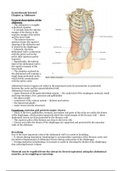
General description of the
abdomen
— The abdomen is a roughly
cylindrical chamber
— It extends from the inferior
margin of the thorax to the
superior margin of the pelvis
and the lower limb
— The inferior thoracic
aperture forms the superior
opening of the abdomen and
is closed by the diaphragm
— Inferiorly, the deep
abdominal wall is continuous
with the pelvic wall at the
pelvic inlet (apertura pelvis
superior)
— Superficially, the inferior
limit of the abdominal wall is
the superior margin of the
lower limb
— The chamber enclosed by
the abdominal wall contains a
single large peritoneal cavity,
which freely communicates
with the pelvic cavity
Abdominal viscera (organs) are either in the peritoneal cavity by mesenteries or positioned
between the cavity and the musculoskeletal wall.
Abdominal viscera include:
— major elements of the gastrointestinal system — the caudal end of the esophagus, stomach, small
and large intestines, liver, pancreas and gallbladder
— the spleen (milt)
— component of the urinary system — kidneys and ureters
— the suprarenal glands
— major neurovascular structures
Functions: contains and protects major viscera
— Much of the liver, gallbladder, stomach, and spleen and parts of the colon are under the domes
of the diaphragm, which project superiorly above the costal margin of the thoracic wall — these
abdominal viscera are thus protected by the thoracic wall
— The superior poles of the kidneys are deep to the lower ribs
— Viscera not under the domes of the diaphragm are supported and protected by the muscular
walls of the abdomen
Breathing
One of the most important roles of the abdominal wall is to assist in breathing.
— It relaxes during inspiration (inademing) to accommodate expansion of the thoracic cavity and
the inferior displacement of abdominal viscera during contraction of the diaphragm
— During expiration (uitademing), it contracts to assist in elevating the domes of the diaphragm,
thus reducing thoracic volume
Material can be expelled from the airway by forced expiration using the abdominal
muscles, as in coughing or sneezing!
,Changes in intra-abdominal pressure
Contraction of abdominal wall muscles can
dramatically increase intra-abdominal pressure when
the diaphragm is in a fixed position. Air is retained in
the lungs by closing valves in the larynx in the neck.
Increased intra-abdominal pressure assists in voiding
the contents of the bladder and rectum and in giving
birth.
Component parts
Wall
The abdominal wall consists partly of bone but
mainly of muscle.
The skeletal elements of the wall are:
— The five lumbar vertebrae and their intervening
intervetebral discs (tussenwervelschijven)
— The superior expanded parts of the pelvic bones
— Bony components of the inferior thoracic wall,
including the costal margin, rib XII, the end of rib XI, and the xiphoid process
Muscle make up the rest of the abdominal wall:
— Lateral to the vertebral column, the quadratus lumborum, psoas major, and iliacus muscles
reinforce the posterior aspect of the wall. The distal ends of the psoas major and iliacus muscles
pass into the thigh and are major flexors of the hip joint
— Lateral parts of the abdominal wall are predominantly formed by three layers of muscles, which
are similar in orientation to the intercostal muscles of the thorax — transversus abdominis, internal
oblique, and external oblique
— Anteriorly, a segmented muscle (m. rectus abdominis muscle) on each side spans the distance
between the inferior thoracic wall and the pelvis
, Structural continuity between posterior, lateral and anterior parts of the abdominal wall is
provided by thick fascia posteriorly and by flat tendinous sheets (aponeuroses) derived from
muscles of the lateral wall. A fascial layer of varying thickness separates the abdominal wall from
the peritoneum, which lines the abdominal cavity.
Chapter 4: Abdomen
General description of the
abdomen
— The abdomen is a roughly
cylindrical chamber
— It extends from the inferior
margin of the thorax to the
superior margin of the pelvis
and the lower limb
— The inferior thoracic
aperture forms the superior
opening of the abdomen and
is closed by the diaphragm
— Inferiorly, the deep
abdominal wall is continuous
with the pelvic wall at the
pelvic inlet (apertura pelvis
superior)
— Superficially, the inferior
limit of the abdominal wall is
the superior margin of the
lower limb
— The chamber enclosed by
the abdominal wall contains a
single large peritoneal cavity,
which freely communicates
with the pelvic cavity
Abdominal viscera (organs) are either in the peritoneal cavity by mesenteries or positioned
between the cavity and the musculoskeletal wall.
Abdominal viscera include:
— major elements of the gastrointestinal system — the caudal end of the esophagus, stomach, small
and large intestines, liver, pancreas and gallbladder
— the spleen (milt)
— component of the urinary system — kidneys and ureters
— the suprarenal glands
— major neurovascular structures
Functions: contains and protects major viscera
— Much of the liver, gallbladder, stomach, and spleen and parts of the colon are under the domes
of the diaphragm, which project superiorly above the costal margin of the thoracic wall — these
abdominal viscera are thus protected by the thoracic wall
— The superior poles of the kidneys are deep to the lower ribs
— Viscera not under the domes of the diaphragm are supported and protected by the muscular
walls of the abdomen
Breathing
One of the most important roles of the abdominal wall is to assist in breathing.
— It relaxes during inspiration (inademing) to accommodate expansion of the thoracic cavity and
the inferior displacement of abdominal viscera during contraction of the diaphragm
— During expiration (uitademing), it contracts to assist in elevating the domes of the diaphragm,
thus reducing thoracic volume
Material can be expelled from the airway by forced expiration using the abdominal
muscles, as in coughing or sneezing!
,Changes in intra-abdominal pressure
Contraction of abdominal wall muscles can
dramatically increase intra-abdominal pressure when
the diaphragm is in a fixed position. Air is retained in
the lungs by closing valves in the larynx in the neck.
Increased intra-abdominal pressure assists in voiding
the contents of the bladder and rectum and in giving
birth.
Component parts
Wall
The abdominal wall consists partly of bone but
mainly of muscle.
The skeletal elements of the wall are:
— The five lumbar vertebrae and their intervening
intervetebral discs (tussenwervelschijven)
— The superior expanded parts of the pelvic bones
— Bony components of the inferior thoracic wall,
including the costal margin, rib XII, the end of rib XI, and the xiphoid process
Muscle make up the rest of the abdominal wall:
— Lateral to the vertebral column, the quadratus lumborum, psoas major, and iliacus muscles
reinforce the posterior aspect of the wall. The distal ends of the psoas major and iliacus muscles
pass into the thigh and are major flexors of the hip joint
— Lateral parts of the abdominal wall are predominantly formed by three layers of muscles, which
are similar in orientation to the intercostal muscles of the thorax — transversus abdominis, internal
oblique, and external oblique
— Anteriorly, a segmented muscle (m. rectus abdominis muscle) on each side spans the distance
between the inferior thoracic wall and the pelvis
, Structural continuity between posterior, lateral and anterior parts of the abdominal wall is
provided by thick fascia posteriorly and by flat tendinous sheets (aponeuroses) derived from
muscles of the lateral wall. A fascial layer of varying thickness separates the abdominal wall from
the peritoneum, which lines the abdominal cavity.