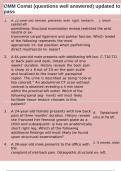
OMM Comat (questions well answered) updated to
pass
1. A 22-year-old female presents with right forearm E. Forearm
supinated with
paresthesia. Structural examination reveals restricted the wrist
neutral or ex-
transverse carpal ligament and palmar fasciae. Which tended
of the following represents the most
appropriate ini- tial position when performing
direct myofascial re- lease?
2. A 44-year-old male presents with debilitating left low- C. T10-T11
er back pain and dark, tinted urine of one
weeks' duration. History reveals the back pain
is sharp at a 8 out of 10 on the pain scale
and localized to the lower left paraspinal
region. The urine is described as being "cola or
tea colored." An abdominal CT scan without
contrast is obtained revealing a 4 mm stone
within the proximal left ureter. Which of the
following spinal seg- ments will most likely
facilitate tissue texture changes in this
patient?
3. A 24-year-old female presents with low back A. Cephalad sacral
pain of three months' duration. History reveals sulcus on the left
she fractured her femoral growth plate as a
child and subsequent- ly has an anatomically
short right leg. Which of the following
additional findings will most likely be found
upon structural examination?
D. T9 extended, rotated
4. A 39-year-old male presents to the office with
the
complaint of mid-back pain. Osteopathic structural ex- left,
,OMM Comat (questions well answered) updated to
pass
sidebend left
amination reveals the left transverse process
immedi- ately lateral to the T8 spinous process is
more difficult to push anteriorly than the
right when performing intersegmental
motion testing. This is more appar- ent when
you induce flexion but becomes more even
,OMM Comat (questions well answered) updated to
pass
when you induce extension. The most likely
diagnosis is
5. A 19-year-old football player presents after D. MRI
twisting his right knee during a game.
Physical examination reveals joint line
tenderness and mild swelling in the area of
injury. A clicking and popping sound is ap-
preciated during passive flexion and extension
of the right knee. The initial modality most
appropriate for confirming the diagnosis is
6. A 22-year-old female presents with anxiety and obses- A. Anterior and
inferior
sive-compulsive disorder. Structural
examination with the vault hold reveals the
sphenoid and occiput to be in extension.
Under normal craniosacral mechanics, you
suspect the sacral base to be
7. A 21-year-old female who is 1 week post-partum A. inferior AIIS
pre- sents with pelvic pain. History reveals pressing cephalad
she had an unremarkable vaginal delivery
without complications. Structural examination
reveals multiple pelvic tender points with an
anterior lumbar tender point corre- sponding
to L4 on the right. Where and how is this
tender point located?
8. A 29-year-old male presents to the doctor's office with B. Cervical
extension with
an occipital headache after he sustained a rear-end intermitten
collision in his car. His headache is t,
, OMM Comat (questions well answered) updated to
pass
non-radiating, non-pulsatile, and without the occiput sidebent right,
photopho- bia. On palpation of his occipito- rotated left
atlantal joint, there is restriction in translation
to the left, which improves with upper cervical
flexion. Which of the following is
pass
1. A 22-year-old female presents with right forearm E. Forearm
supinated with
paresthesia. Structural examination reveals restricted the wrist
neutral or ex-
transverse carpal ligament and palmar fasciae. Which tended
of the following represents the most
appropriate ini- tial position when performing
direct myofascial re- lease?
2. A 44-year-old male presents with debilitating left low- C. T10-T11
er back pain and dark, tinted urine of one
weeks' duration. History reveals the back pain
is sharp at a 8 out of 10 on the pain scale
and localized to the lower left paraspinal
region. The urine is described as being "cola or
tea colored." An abdominal CT scan without
contrast is obtained revealing a 4 mm stone
within the proximal left ureter. Which of the
following spinal seg- ments will most likely
facilitate tissue texture changes in this
patient?
3. A 24-year-old female presents with low back A. Cephalad sacral
pain of three months' duration. History reveals sulcus on the left
she fractured her femoral growth plate as a
child and subsequent- ly has an anatomically
short right leg. Which of the following
additional findings will most likely be found
upon structural examination?
D. T9 extended, rotated
4. A 39-year-old male presents to the office with
the
complaint of mid-back pain. Osteopathic structural ex- left,
,OMM Comat (questions well answered) updated to
pass
sidebend left
amination reveals the left transverse process
immedi- ately lateral to the T8 spinous process is
more difficult to push anteriorly than the
right when performing intersegmental
motion testing. This is more appar- ent when
you induce flexion but becomes more even
,OMM Comat (questions well answered) updated to
pass
when you induce extension. The most likely
diagnosis is
5. A 19-year-old football player presents after D. MRI
twisting his right knee during a game.
Physical examination reveals joint line
tenderness and mild swelling in the area of
injury. A clicking and popping sound is ap-
preciated during passive flexion and extension
of the right knee. The initial modality most
appropriate for confirming the diagnosis is
6. A 22-year-old female presents with anxiety and obses- A. Anterior and
inferior
sive-compulsive disorder. Structural
examination with the vault hold reveals the
sphenoid and occiput to be in extension.
Under normal craniosacral mechanics, you
suspect the sacral base to be
7. A 21-year-old female who is 1 week post-partum A. inferior AIIS
pre- sents with pelvic pain. History reveals pressing cephalad
she had an unremarkable vaginal delivery
without complications. Structural examination
reveals multiple pelvic tender points with an
anterior lumbar tender point corre- sponding
to L4 on the right. Where and how is this
tender point located?
8. A 29-year-old male presents to the doctor's office with B. Cervical
extension with
an occipital headache after he sustained a rear-end intermitten
collision in his car. His headache is t,
, OMM Comat (questions well answered) updated to
pass
non-radiating, non-pulsatile, and without the occiput sidebent right,
photopho- bia. On palpation of his occipito- rotated left
atlantal joint, there is restriction in translation
to the left, which improves with upper cervical
flexion. Which of the following is