Fiscal and supply side policies
Fiscal policy
The manipulation of government spending, taxation + budget balance.
The government could influence the size of the circular flow by changing
the government budget, spending and taxes can be targeted in areas which
need stimulating. Fiscal policy aims to stimulate economic growth +
stabilise the economy. In the UK, most of the government budget is on
pensions and welfare benefits, followed by health and education. Income tax
is the biggest source of tax revenue in the UK.
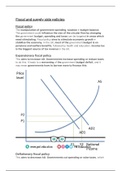
Expansionary fiscal policy
This aims to increase AD. Governments increase spending or reduce taxes
to do this. It leads to a worsening of the government budget deficit, and it
may mean governments have to borrow more to finance this.
Deflationary fiscal policy
This aims to decrease AD. Governments cut spending or raise taxes, which
, reduces consumer spending. It leads to an improvement of the government
budget deficit.
How fiscal policy can be used to influence AS:
The government could reduce income and corporation tax to encourage
spending and investment. The government could subsidise training or
spend more on education. This lowers costs for firms - less training.
Spending more on healthcare helps improve the quality of the labour force
productivity.
Governments could spend more on infrastructure.
The government budget (fiscal) surplus and deficit:
A government has a budget deficit when expenditure exceeds tax receipts
in a
financial year. A government has a budget surplus when tax receipts exceed
expenditure. Government debt is the accumulation of the government
deficit over time - the amount
the government owes.
Direct taxes
Fiscal policy
The manipulation of government spending, taxation + budget balance.
The government could influence the size of the circular flow by changing
the government budget, spending and taxes can be targeted in areas which
need stimulating. Fiscal policy aims to stimulate economic growth +
stabilise the economy. In the UK, most of the government budget is on
pensions and welfare benefits, followed by health and education. Income tax
is the biggest source of tax revenue in the UK.
Expansionary fiscal policy
This aims to increase AD. Governments increase spending or reduce taxes
to do this. It leads to a worsening of the government budget deficit, and it
may mean governments have to borrow more to finance this.
Deflationary fiscal policy
This aims to decrease AD. Governments cut spending or raise taxes, which
, reduces consumer spending. It leads to an improvement of the government
budget deficit.
How fiscal policy can be used to influence AS:
The government could reduce income and corporation tax to encourage
spending and investment. The government could subsidise training or
spend more on education. This lowers costs for firms - less training.
Spending more on healthcare helps improve the quality of the labour force
productivity.
Governments could spend more on infrastructure.
The government budget (fiscal) surplus and deficit:
A government has a budget deficit when expenditure exceeds tax receipts
in a
financial year. A government has a budget surplus when tax receipts exceed
expenditure. Government debt is the accumulation of the government
deficit over time - the amount
the government owes.
Direct taxes