
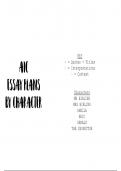
AIC ·
In KEY
~ = Quotes + Titles
~ = Interpretations
~ = Context
ESSAY PLANS Characters
BY CHARACTER
MR BIRLING
MRS BIRLING
SHEILA
ERIC
GERALD
THE INSPECTOR
·
,CONTEXT
- The play was written in 1945
- Both World Wars were watershed moments, they changed the economic, political and social landscape irreversibly
- Labour landslide victory in 1945: The Labour Party represented the interests of the working man as they fought for
social justice. After the war where rich and poor struggled alike, socialist views
↑
became a prominent part of society. ·
- Suffragette movement: This was a movement led by women to earn the right to vote in the public elections, during the late
18th and 19th century.
- Welfare state: A system of government where the state protects and promotes individuals social and economic wellbeing,
following the principal that the public have a responsibility for those who cannot provide for themselves.
It ensured a minimum standard of living.
- Capitalism: An economic system where trade and industry are owned privately, rather than by the state, where the goal is
to make and increase profits
- Socialism: Their goal was to ensure equal distribution of goods and a fairer society. They focused on the collective.
- Priestley was a socialist and wanted to make people aware of the “harsh economics realities of our time”
- “Politically charged post-World War II play”
- The play was first performed in Russia as they related to Priestley’s socialist ideologies
- The play is set in 1912, Edwardian England
, CONTEXT
- Disenfranchisement: Not having the right to vote.
- Generational divide: The perceived difference in opinions and views between people of different ages, typically as a
result of different life experiences and circumstances.
- Hierarchy/Class System: When members of a society are ranked according to their status and wealth, with the
↑
wealthy having more power than the poor. ·
- Labour party: The main centre-left political party in the United Kingdom, promoting workers’ rights and social
justice, who won in a landslide victory in the 1945 election.
- Patriarchy: A form of government or society where power is given to and possessed by men, but kept from women.
- Social class: A way to divide society into groups through social status and wealth, often where those in each group
are assumed to possess certain characteristics.
- After the first performance of AIC in Britain, there was a landslide victory for the Labour Party (socialist).
- There was a very rigid class system in 1912
- Women’s lives were controlled by men and families.
- Labour party represented the interests of the working man
- Priestley's play was to show that we can never go back to how 1912 was.
- In 1928, women and the working class man got the right to vote.
In KEY
~ = Quotes + Titles
~ = Interpretations
~ = Context
ESSAY PLANS Characters
BY CHARACTER
MR BIRLING
MRS BIRLING
SHEILA
ERIC
GERALD
THE INSPECTOR
·
,CONTEXT
- The play was written in 1945
- Both World Wars were watershed moments, they changed the economic, political and social landscape irreversibly
- Labour landslide victory in 1945: The Labour Party represented the interests of the working man as they fought for
social justice. After the war where rich and poor struggled alike, socialist views
↑
became a prominent part of society. ·
- Suffragette movement: This was a movement led by women to earn the right to vote in the public elections, during the late
18th and 19th century.
- Welfare state: A system of government where the state protects and promotes individuals social and economic wellbeing,
following the principal that the public have a responsibility for those who cannot provide for themselves.
It ensured a minimum standard of living.
- Capitalism: An economic system where trade and industry are owned privately, rather than by the state, where the goal is
to make and increase profits
- Socialism: Their goal was to ensure equal distribution of goods and a fairer society. They focused on the collective.
- Priestley was a socialist and wanted to make people aware of the “harsh economics realities of our time”
- “Politically charged post-World War II play”
- The play was first performed in Russia as they related to Priestley’s socialist ideologies
- The play is set in 1912, Edwardian England
, CONTEXT
- Disenfranchisement: Not having the right to vote.
- Generational divide: The perceived difference in opinions and views between people of different ages, typically as a
result of different life experiences and circumstances.
- Hierarchy/Class System: When members of a society are ranked according to their status and wealth, with the
↑
wealthy having more power than the poor. ·
- Labour party: The main centre-left political party in the United Kingdom, promoting workers’ rights and social
justice, who won in a landslide victory in the 1945 election.
- Patriarchy: A form of government or society where power is given to and possessed by men, but kept from women.
- Social class: A way to divide society into groups through social status and wealth, often where those in each group
are assumed to possess certain characteristics.
- After the first performance of AIC in Britain, there was a landslide victory for the Labour Party (socialist).
- There was a very rigid class system in 1912
- Women’s lives were controlled by men and families.
- Labour party represented the interests of the working man
- Priestley's play was to show that we can never go back to how 1912 was.
- In 1928, women and the working class man got the right to vote.


