lOMoARcPSD|11232395
Case Study 56 End-Stage Renal Disease
K.B. is a 32-year-old woman being admitted to the medical floor for complaints of fatigue and
dehydration. While taking her history, you discover that she has diabetes mellitus (dM) and has been
insulin dependent since the age of 8. She has undergone hemodialysis (Hd) for the past 2 years because
of end- stage renal disease (ESRd). Your initial assessment of K.B. reveals a pale, thin, slightly drowsy
woman. Her skin is warm and dry to the touch with poor skin turgor, and her mucous membranes are
dry. Her vital signs are 140/88, 116, 18, 99.9 ° F (37.7 ° C). She tells you she has been nauseated for 2
days so she has not been eating or drinking. She reports severe diarrhea. The following blood chemistry
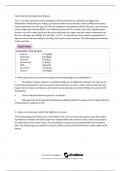
results are back.
1. What aspects of your assessment support her admitting diagnosis of dehydration?
• The patient's history supports an admitting diagnosis of dehydration because she told you she
has not been drinking for 2 days and reports severe diarrhea. Her skin is warm and dry with poor skin
turgor and dry mucous membranes, all of which can be physical assessment findings of a patient with
dehydration.
• Fluid is restricted when the person is on dialysis.
• Although most of her laboratory findings are elevated, laboratory values are not a good indicator
of dehydration in patients on HD.
2. Explain any laboratory results that might be of concern.
The elevated potassium reflects K.B.'s renal failure and is of most concern because of possible cardiac
dysrhythmias. Patients with ESRD might have elevated BUN and creatinine levels, which are caused by
the renal failure and not the dialysis, but HD patients routinely have an elevated BUN and creatinine
level. The elevated glucose reflects her history of DM, but keep in mind that these results might not be
fasting.
Downloaded by Purity Kimani ()
, lOMoARcPSD|11232395
3. Identify two possible causes for K.B.'s low-grade fever.
• Dehydration
• Viral illness, which could also explain her complaint of nausea
• Urinary tract infection (UTI)
• Sepsis
Case Study Progress
The rest of K.B.'s physical assessment is within normal limits. You note that she has an arteriovenous
(AV) fistula in her left arm.
4. What is an AV fistula? Why does K.B. have one?
Fistula is a term used to describe the connection of two separate body parts. K.B. has an AV fistula. This
fistula is surgically created by connecting an artery with a vein and allows access for her HD.
5. What steps do you take to assess K.B.'s AV fistula, and what physical findings are expected? Explain.
You would use observation, palpation, and auscultation. Observe for any signs of bleeding or infection. A
functioning AV fistula has a "thrill" evident by palpation and a bruit present with auscultation. The thrill
and bruit are present because of the turbulence caused by the mixing of blood between the artery and
vein and are considered within normal limits for an AV fistula.
6. As you continue the assessment, you notice that a nursing assistive personnel (NAP) comes in to take
K.B.'s blood pressure (BP). The NAP places the BP cuff on K.B.'s left arm. What, if anything, do you do?
Discretely stop the NAP from taking the BP on the left arm. Doing so could cause damage to the AV
fistula and alter the circulation of that arm. Point out that the BP can be taken in K.B.'s right arm.
Ensure that a sign specifying "NO BP/VENIPUNCTURE IN LEFT ARM" is placed over K.B.'s bed; some
facilities place a special armband over the restricted extremity. Outside of the patient's room, in private,
review the reason you asked the NAP to change arms for the BP.
Downloaded by Purity Kimani ()
Case Study 56 End-Stage Renal Disease
K.B. is a 32-year-old woman being admitted to the medical floor for complaints of fatigue and
dehydration. While taking her history, you discover that she has diabetes mellitus (dM) and has been
insulin dependent since the age of 8. She has undergone hemodialysis (Hd) for the past 2 years because
of end- stage renal disease (ESRd). Your initial assessment of K.B. reveals a pale, thin, slightly drowsy
woman. Her skin is warm and dry to the touch with poor skin turgor, and her mucous membranes are
dry. Her vital signs are 140/88, 116, 18, 99.9 ° F (37.7 ° C). She tells you she has been nauseated for 2
days so she has not been eating or drinking. She reports severe diarrhea. The following blood chemistry
results are back.
1. What aspects of your assessment support her admitting diagnosis of dehydration?
• The patient's history supports an admitting diagnosis of dehydration because she told you she
has not been drinking for 2 days and reports severe diarrhea. Her skin is warm and dry with poor skin
turgor and dry mucous membranes, all of which can be physical assessment findings of a patient with
dehydration.
• Fluid is restricted when the person is on dialysis.
• Although most of her laboratory findings are elevated, laboratory values are not a good indicator
of dehydration in patients on HD.
2. Explain any laboratory results that might be of concern.
The elevated potassium reflects K.B.'s renal failure and is of most concern because of possible cardiac
dysrhythmias. Patients with ESRD might have elevated BUN and creatinine levels, which are caused by
the renal failure and not the dialysis, but HD patients routinely have an elevated BUN and creatinine
level. The elevated glucose reflects her history of DM, but keep in mind that these results might not be
fasting.
Downloaded by Purity Kimani ()
, lOMoARcPSD|11232395
3. Identify two possible causes for K.B.'s low-grade fever.
• Dehydration
• Viral illness, which could also explain her complaint of nausea
• Urinary tract infection (UTI)
• Sepsis
Case Study Progress
The rest of K.B.'s physical assessment is within normal limits. You note that she has an arteriovenous
(AV) fistula in her left arm.
4. What is an AV fistula? Why does K.B. have one?
Fistula is a term used to describe the connection of two separate body parts. K.B. has an AV fistula. This
fistula is surgically created by connecting an artery with a vein and allows access for her HD.
5. What steps do you take to assess K.B.'s AV fistula, and what physical findings are expected? Explain.
You would use observation, palpation, and auscultation. Observe for any signs of bleeding or infection. A
functioning AV fistula has a "thrill" evident by palpation and a bruit present with auscultation. The thrill
and bruit are present because of the turbulence caused by the mixing of blood between the artery and
vein and are considered within normal limits for an AV fistula.
6. As you continue the assessment, you notice that a nursing assistive personnel (NAP) comes in to take
K.B.'s blood pressure (BP). The NAP places the BP cuff on K.B.'s left arm. What, if anything, do you do?
Discretely stop the NAP from taking the BP on the left arm. Doing so could cause damage to the AV
fistula and alter the circulation of that arm. Point out that the BP can be taken in K.B.'s right arm.
Ensure that a sign specifying "NO BP/VENIPUNCTURE IN LEFT ARM" is placed over K.B.'s bed; some
facilities place a special armband over the restricted extremity. Outside of the patient's room, in private,
review the reason you asked the NAP to change arms for the BP.
Downloaded by Purity Kimani ()