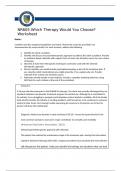
NR605 Which Therapy Would You Choose?
Worksheet
Name:
Carefully read the assignment guidelines and rubric. Review the scenarios provided in an
announcement by course faculty. For each scenario, address the following.
1. Identify the client’s problem.
2. Identify and discuss one psychotherapeutic approach to address the client’s problem. Provide
an evidence-based rationale with support from at least one scholarly source for your choice
of therapy.
3. Describe at least three therapeutic techniques commonly used with the selected
therapeutic approach.
4. Discuss whether you would include psychopharmacology as part of the treatment plan. If
yes, describe which medication(s) you might prescribe. If no, explain why not. Provide
rationale from at least one scholarly source.
5. Rationales should include in-text citations. Include a complete matching reference using
APA Style for each citation at the end of the worksheet.
Scenario 1
A 26-year-old client presents to the PMHNP for therapy. The client was recently discharged from an
inpatient substance use disorder treatment program for alcohol use. Although he is committed to
his sobriety, he is struggling to navigate social situations where alcohol is available. All of his friends
drink alcohol socially. His sobriety is creating problems with his partner as he continues to consume
alcohol in their home. He is having trouble expressing his concerns to his partner out of fear his
partner will leave the relationship.
Diagnosis: Alcohol use disorder in early remission (F10.20) - Across the board alcohol in the
most common substance used and is major contributor to mortality and morbidity
(American Psychiatric Association, 2022).
Selected psychotherapeutic approach with rationale:
This patient has entered the maintenance stage of his treatment plan. Having this information
Cognitive behavioral therapy (CBT) with a relapse prevention focus would be the most effective
talk therapy for this patient. helps you identify the feelings and situations that can lead
, to heavy drinking. “Over the past 30 years, numerous meta-analyses and systematic
reviews have demonstrated that CBT is an effective treatment for AUD” (Flanagan et
al., 2018).
The focus of therapy should be to teach this patient to recognize negative effects of
alcohol use, positive effects of abstinence and constructive alternatives including
techniques that produce the results sought in becoming intoxicated without the use of
alcohol.
Therapeutic techniques to employ:
Treatment for an individual with an alcohol use disorder treatment may last their entire life
because of the difficulty in abstaining from substances and this means that the treatment
will need to change to meet their changing needs. Relaxed breathing is a CBT
technique, which resembles mindfulness, that would be used to allow this patient
to approach his problems in a balanced manner leading to rational decision
making. Secondly, Journaling would be effective for this patient. Journaling
involves data collections concerning one`s mood and thoughts (Ludgate, 2019).
Journaling will also allow this patient to keep track of positive thoughts and behaviors.
put into practice. keeping a personal journal and using it as an escape can help the
patient see how far he has come. Another technique that would be beneficial for this
patient is
Successive Approximation Taking tasks that seem overwhelming and breaking them
into smaller more achievable steps. Each step builds from the previous, so you gain
confidence as you go. This technique works well for people who have difficulty completing a
task because it feels overwhelming (Crisp & Gabbard, 2022). This will allow this patient to
Worksheet
Name:
Carefully read the assignment guidelines and rubric. Review the scenarios provided in an
announcement by course faculty. For each scenario, address the following.
1. Identify the client’s problem.
2. Identify and discuss one psychotherapeutic approach to address the client’s problem. Provide
an evidence-based rationale with support from at least one scholarly source for your choice
of therapy.
3. Describe at least three therapeutic techniques commonly used with the selected
therapeutic approach.
4. Discuss whether you would include psychopharmacology as part of the treatment plan. If
yes, describe which medication(s) you might prescribe. If no, explain why not. Provide
rationale from at least one scholarly source.
5. Rationales should include in-text citations. Include a complete matching reference using
APA Style for each citation at the end of the worksheet.
Scenario 1
A 26-year-old client presents to the PMHNP for therapy. The client was recently discharged from an
inpatient substance use disorder treatment program for alcohol use. Although he is committed to
his sobriety, he is struggling to navigate social situations where alcohol is available. All of his friends
drink alcohol socially. His sobriety is creating problems with his partner as he continues to consume
alcohol in their home. He is having trouble expressing his concerns to his partner out of fear his
partner will leave the relationship.
Diagnosis: Alcohol use disorder in early remission (F10.20) - Across the board alcohol in the
most common substance used and is major contributor to mortality and morbidity
(American Psychiatric Association, 2022).
Selected psychotherapeutic approach with rationale:
This patient has entered the maintenance stage of his treatment plan. Having this information
Cognitive behavioral therapy (CBT) with a relapse prevention focus would be the most effective
talk therapy for this patient. helps you identify the feelings and situations that can lead
, to heavy drinking. “Over the past 30 years, numerous meta-analyses and systematic
reviews have demonstrated that CBT is an effective treatment for AUD” (Flanagan et
al., 2018).
The focus of therapy should be to teach this patient to recognize negative effects of
alcohol use, positive effects of abstinence and constructive alternatives including
techniques that produce the results sought in becoming intoxicated without the use of
alcohol.
Therapeutic techniques to employ:
Treatment for an individual with an alcohol use disorder treatment may last their entire life
because of the difficulty in abstaining from substances and this means that the treatment
will need to change to meet their changing needs. Relaxed breathing is a CBT
technique, which resembles mindfulness, that would be used to allow this patient
to approach his problems in a balanced manner leading to rational decision
making. Secondly, Journaling would be effective for this patient. Journaling
involves data collections concerning one`s mood and thoughts (Ludgate, 2019).
Journaling will also allow this patient to keep track of positive thoughts and behaviors.
put into practice. keeping a personal journal and using it as an escape can help the
patient see how far he has come. Another technique that would be beneficial for this
patient is
Successive Approximation Taking tasks that seem overwhelming and breaking them
into smaller more achievable steps. Each step builds from the previous, so you gain
confidence as you go. This technique works well for people who have difficulty completing a
task because it feels overwhelming (Crisp & Gabbard, 2022). This will allow this patient to