

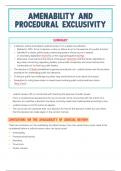
amenability and
procedural exclusivity
summary
• A decision will be amenable to judicial review if it is a public law decision
– Defined in CPR r. 54 as ‘a decision, action or failure to act in the exercise of a public function’
– Satisfied if a classic public body is exercising powers whose source is statute
or secondary legislation (Datafin), or the royal prerogative (GCHQ)
– Otherwise, must examine the nature of the power (Datafin), and the factors identified in
key cases concerning regulatory bodies, and private companies who have had services
‘contracted out’ to them by public bodies.
• The decision in O’Reilly established a general procedural rule – judicial review was the exclusive
procedure for challenging public law decisions.
• To bring a public law challenge any other way would amount to an abuse of process.
• Exceptions to ruling have arisen in mixed cases involving public and private law claims
(Roy; Clark).
• Judicial review (‘JR’) is concerned with checking the exercise of public power.
• From a constitutional perspective the courts should not be concerned with the merits of a
decision, but whether a decision has been correctly made and implemented according to law.
• Judicial review is not the same as appeal.
• The courts do not substitute their own decision for that of the decision-maker but can direct
that the decision be made again in the correct manner.
Limitations on the availability of judicial review
There are limitations on the availability of judicial review. Five main preliminary issues need to be
considered before a judicial review claim can be pursued:
• Amenability
• Procedural exclusivity
• Standing
• Time limits
• Ouster clauses
,Amenability
• First necessary to determine whether the decision or action being challenged is appropriate for
the judicial review process.
• General rule = only ‘public law decisions’ are amenable to judicial review.
The Civil Procedure Rules Part 54.1(2)(a)(ii) defines judicial review in terms of:
‘a claim to review the lawfulness of…a decision, action or failure to act in relation to the exercise
of a public function’.
• The usual situation, in which judicial review is appropriate = when the decision relates to
a public body carrying out a public function, almost always through the exercise of
some form of statutory power.
• Such bodies include central government departments, local authorities, inferior courts,
statutory tribunals, and statutory bodies such as the Highway Agency.
• Since the decision in GCHQ, decisions taken in the exercise of prerogative powers are also
amenable to judicial review.
Broadened scope
There are other situations in which judicial review can be the appropriate route for a legal challenge.
• A considerable amount of case law has built up, dealing with decisions of non-public bodies
that contain a ‘public’ element.
• Historically, the courts looked at the source of a body’s power when deciding whether it would
be subject to judicial review.
– If the body was created by or exercised power under statute (same as classic public bodies)
its decisions would normally be amenable to judicial review.
– The potential scope of judicial review has expanded, following R v Panel on Take-overs
and Mergers, ex parte Datafin. Predates the Civil Procedure Rules, but remains a very
important authority in understanding the courts’ approach to amenability.
Datafin
Facts: The Panel on Take-overs and Mergers was a self-regulatory body created by the financial
services industry in the City of London. It was an unincorporated association with no legal
personality and had no direct statutory powers.
Held: The Panel’s decision should be subject to judicial review.
• The court’s approach was that decisions, taken by bodies performing ‘public law functions’, could
be subject to judicial review.
• Lloyd LJ pointed to the fact that the Panel regulated an important aspect of national, economic
life and so deemed it to be exercising a governmental-type function. He stated: ‘If the source of
power is a statute, or subordinate legislation under a statute, then clearly the body in question
will be subject to judicial review ... if the body is exercising a public law function, or if the exercise
of its functions have public law consequences, then that may be sufficient to bring the body
within the reach of judicial review’.
,Regulatory authorities
• Decisions of regulatory authorities are generally found to be amenable to JR if the functions
they are carrying out have a sufficiently public and governmental character.
• One way in which this issue is addressed is by the courts applying a form of ‘but for’ test.
A decision of the Advertising Standards Authority (R v Advertising Standards Authority Ltd,
ex parte Insurance Services plc) was deemed to be amenable to JR.
– The court considered that, had there not been a self-regulatory authority already in
existence, Parliament would almost certainly have needed to intervene and regulate
the activity in question.
– The function played by the ASA was therefore sufficiently public in nature.
Similarly, in R v Bar Council ex parte Percival a decision of the Bar Council was found
to be subject to review.
However, the decisions of some regulatory authorities have been found not to be amenable
to judicial review, particularly in the field of sporting and religious regulation.
R v Disciplinary Committee of the Jockey Club, ex parte Aga Khan
• Sir Thomas Bingham MR: ‘While the Jockey Club’s powers may be described as public they
are in no sense governmental… the powers which the Jockey Club exercises over those who
agree to be bound by the Rules of Racing give rise to private rights on which action can
be based without resort to judicial review’.
Similarly R v Chief Rabbi of the United Hebrew Congregation of GB and Commonwealth,
ex parte Wachmann the court was of the opinion that internal matters within a religion were
of a private nature and therefore could not be subject to judicial review.
‘Contracting out’
‘Contracting out’ services to private service providers has complicated the amenability question.
R v Servite Houses & London Borough of Wandsworth, ex parte Goldsmith
• Housing association was found not to be exercising a public function in the provision
of residential care to the elderly.
• The court reasoned that Wandsworth had discharged its statutory duties once it had arranged
for the provision of accommodation by the housing association.
• The source of the association’s power was purely contractual, deriving from the commercial
relationship it had with Wandsworth, and they were not subject to statutory controls.
R (on the application of A) v Partnerships In Care
• The managers of a private psychiatric hospital were deemed to be exercising a public
function when they changed the focus of one of its wards from providing psychotherapeutic
services to one primarily designed to treat patients with mental illness.
• The court noted that the private hospital’s services were subject to specific ‘statutory
underpinning’. It was under a direct on-going statutory duty to provide adequate
professional staff and treatment facilities.
• Its decision was therefore amenable to JR.
, Procedural exclusivity
O’Reilly v Mackman and Cocks v Thanet DC established a general procedural rule.
The Lords determined that:
• Judicial review was the exclusive procedure for challenging public law decisions
• Private law matters were to be dealt with by ordinary action
• To bring a public law challenge in any other way than by JR would amount to an abuse
of process of the court.
Exceptions to the procedural exclusivity rule
In O’Reilly, Lord Diplock stated that two exceptions to the principle could apply:
1. When neither party objected to the use of private law procedure
2. When the contested decision was collateral, i.e., it arose out of or was incidental to some
other legal claim.
Decision in O’Reilly has been widely criticised because potentially ‘genuine’ cases could be struck
out if incorrect procedure was used.
A body of case law has built up around mixed claims - Claims where the applicant’s public and
private law rights are affected.
Mixed claims
If a claim involves both public and private law rights the courts are willing to be flexible.
Roy v Kensington and Chelsea and Westminster Family Practitioner Committee (FPC)
• A private law claim brought by an NHS doctor was not struck out for abuse of process even
though his case involved public law rights concerning the statutory framework for NHS pay.
• This was because there were private law elements to his case as well.
The Civil Procedure Rules have further diluted the strictness of the courts’ initial approach to
procedural exclusivity:
Clark v University of Lincolnshire and Humberside
• The applicant was permitted to pursue her private claim even though it involved public law
issues as well as private ones.
• The court identified that a key question was not so much strict adherence to procedural
technicalities but rather whether the proceedings were being conducted justly in accordance
with the general principles contained in Part 1 of the Civil Procedure Rules.
Public law grounds can also potentially be used as a defence in private law proceedings:
Wandsworth London BC v Winder
procedural exclusivity
summary
• A decision will be amenable to judicial review if it is a public law decision
– Defined in CPR r. 54 as ‘a decision, action or failure to act in the exercise of a public function’
– Satisfied if a classic public body is exercising powers whose source is statute
or secondary legislation (Datafin), or the royal prerogative (GCHQ)
– Otherwise, must examine the nature of the power (Datafin), and the factors identified in
key cases concerning regulatory bodies, and private companies who have had services
‘contracted out’ to them by public bodies.
• The decision in O’Reilly established a general procedural rule – judicial review was the exclusive
procedure for challenging public law decisions.
• To bring a public law challenge any other way would amount to an abuse of process.
• Exceptions to ruling have arisen in mixed cases involving public and private law claims
(Roy; Clark).
• Judicial review (‘JR’) is concerned with checking the exercise of public power.
• From a constitutional perspective the courts should not be concerned with the merits of a
decision, but whether a decision has been correctly made and implemented according to law.
• Judicial review is not the same as appeal.
• The courts do not substitute their own decision for that of the decision-maker but can direct
that the decision be made again in the correct manner.
Limitations on the availability of judicial review
There are limitations on the availability of judicial review. Five main preliminary issues need to be
considered before a judicial review claim can be pursued:
• Amenability
• Procedural exclusivity
• Standing
• Time limits
• Ouster clauses
,Amenability
• First necessary to determine whether the decision or action being challenged is appropriate for
the judicial review process.
• General rule = only ‘public law decisions’ are amenable to judicial review.
The Civil Procedure Rules Part 54.1(2)(a)(ii) defines judicial review in terms of:
‘a claim to review the lawfulness of…a decision, action or failure to act in relation to the exercise
of a public function’.
• The usual situation, in which judicial review is appropriate = when the decision relates to
a public body carrying out a public function, almost always through the exercise of
some form of statutory power.
• Such bodies include central government departments, local authorities, inferior courts,
statutory tribunals, and statutory bodies such as the Highway Agency.
• Since the decision in GCHQ, decisions taken in the exercise of prerogative powers are also
amenable to judicial review.
Broadened scope
There are other situations in which judicial review can be the appropriate route for a legal challenge.
• A considerable amount of case law has built up, dealing with decisions of non-public bodies
that contain a ‘public’ element.
• Historically, the courts looked at the source of a body’s power when deciding whether it would
be subject to judicial review.
– If the body was created by or exercised power under statute (same as classic public bodies)
its decisions would normally be amenable to judicial review.
– The potential scope of judicial review has expanded, following R v Panel on Take-overs
and Mergers, ex parte Datafin. Predates the Civil Procedure Rules, but remains a very
important authority in understanding the courts’ approach to amenability.
Datafin
Facts: The Panel on Take-overs and Mergers was a self-regulatory body created by the financial
services industry in the City of London. It was an unincorporated association with no legal
personality and had no direct statutory powers.
Held: The Panel’s decision should be subject to judicial review.
• The court’s approach was that decisions, taken by bodies performing ‘public law functions’, could
be subject to judicial review.
• Lloyd LJ pointed to the fact that the Panel regulated an important aspect of national, economic
life and so deemed it to be exercising a governmental-type function. He stated: ‘If the source of
power is a statute, or subordinate legislation under a statute, then clearly the body in question
will be subject to judicial review ... if the body is exercising a public law function, or if the exercise
of its functions have public law consequences, then that may be sufficient to bring the body
within the reach of judicial review’.
,Regulatory authorities
• Decisions of regulatory authorities are generally found to be amenable to JR if the functions
they are carrying out have a sufficiently public and governmental character.
• One way in which this issue is addressed is by the courts applying a form of ‘but for’ test.
A decision of the Advertising Standards Authority (R v Advertising Standards Authority Ltd,
ex parte Insurance Services plc) was deemed to be amenable to JR.
– The court considered that, had there not been a self-regulatory authority already in
existence, Parliament would almost certainly have needed to intervene and regulate
the activity in question.
– The function played by the ASA was therefore sufficiently public in nature.
Similarly, in R v Bar Council ex parte Percival a decision of the Bar Council was found
to be subject to review.
However, the decisions of some regulatory authorities have been found not to be amenable
to judicial review, particularly in the field of sporting and religious regulation.
R v Disciplinary Committee of the Jockey Club, ex parte Aga Khan
• Sir Thomas Bingham MR: ‘While the Jockey Club’s powers may be described as public they
are in no sense governmental… the powers which the Jockey Club exercises over those who
agree to be bound by the Rules of Racing give rise to private rights on which action can
be based without resort to judicial review’.
Similarly R v Chief Rabbi of the United Hebrew Congregation of GB and Commonwealth,
ex parte Wachmann the court was of the opinion that internal matters within a religion were
of a private nature and therefore could not be subject to judicial review.
‘Contracting out’
‘Contracting out’ services to private service providers has complicated the amenability question.
R v Servite Houses & London Borough of Wandsworth, ex parte Goldsmith
• Housing association was found not to be exercising a public function in the provision
of residential care to the elderly.
• The court reasoned that Wandsworth had discharged its statutory duties once it had arranged
for the provision of accommodation by the housing association.
• The source of the association’s power was purely contractual, deriving from the commercial
relationship it had with Wandsworth, and they were not subject to statutory controls.
R (on the application of A) v Partnerships In Care
• The managers of a private psychiatric hospital were deemed to be exercising a public
function when they changed the focus of one of its wards from providing psychotherapeutic
services to one primarily designed to treat patients with mental illness.
• The court noted that the private hospital’s services were subject to specific ‘statutory
underpinning’. It was under a direct on-going statutory duty to provide adequate
professional staff and treatment facilities.
• Its decision was therefore amenable to JR.
, Procedural exclusivity
O’Reilly v Mackman and Cocks v Thanet DC established a general procedural rule.
The Lords determined that:
• Judicial review was the exclusive procedure for challenging public law decisions
• Private law matters were to be dealt with by ordinary action
• To bring a public law challenge in any other way than by JR would amount to an abuse
of process of the court.
Exceptions to the procedural exclusivity rule
In O’Reilly, Lord Diplock stated that two exceptions to the principle could apply:
1. When neither party objected to the use of private law procedure
2. When the contested decision was collateral, i.e., it arose out of or was incidental to some
other legal claim.
Decision in O’Reilly has been widely criticised because potentially ‘genuine’ cases could be struck
out if incorrect procedure was used.
A body of case law has built up around mixed claims - Claims where the applicant’s public and
private law rights are affected.
Mixed claims
If a claim involves both public and private law rights the courts are willing to be flexible.
Roy v Kensington and Chelsea and Westminster Family Practitioner Committee (FPC)
• A private law claim brought by an NHS doctor was not struck out for abuse of process even
though his case involved public law rights concerning the statutory framework for NHS pay.
• This was because there were private law elements to his case as well.
The Civil Procedure Rules have further diluted the strictness of the courts’ initial approach to
procedural exclusivity:
Clark v University of Lincolnshire and Humberside
• The applicant was permitted to pursue her private claim even though it involved public law
issues as well as private ones.
• The court identified that a key question was not so much strict adherence to procedural
technicalities but rather whether the proceedings were being conducted justly in accordance
with the general principles contained in Part 1 of the Civil Procedure Rules.
Public law grounds can also potentially be used as a defence in private law proceedings:
Wandsworth London BC v Winder


