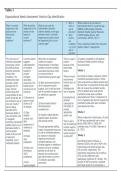
Table 1
Organizational Needs Assessment: Practice Gap Identification
1. Why is What evidence do you have to
What is currently What should be What do you and the there a demonstrate there is a practice gap
happening in the happening in the stakeholders (decision- gap in (NDNQI, AHRQ Quality Indicators,
practicum site practicum site makers) identify as the gap practice? National Hospital Quality Measures,
that causes based on between what is currently 2. What CAHPS Hospital Survey, Joint
clinical current happening and what should factors Commission, ORYX®, etc.)? *
problems? evidence*? be happening (this is your are
practice gap)? contributi *Use a reference citation from the Johns
n g to the Hopkins Table 2 if appropriate.
gap in
practice?
The root cause of Current evidence While there is substantial There is a gap in All studies completed by the National
ventilator associated suggests evidence to support practice Institute of Health and their findings
pneumonia is when implementation implementation of ventilator because of the discussed below:
an artificial airway of ventilator bundles to prevent ventilator below listed
becomes colonized bundles to associated pneumonia, there factors: Study 1
shortly after prevent are many barriers to
intubation. The ventilator implementation (practice gap): There are work According to Hassan & Elsaman (2022),
endotracheal tube associated environment ventilator associated events in those
provides a direct pneumonia. This (1) Work environment barriers barriers such as who received the ventilator bundle were
passage into the bundle should (lack of equipment and/or staffing far less than in comparison to those who
lungs. Practice include but is not supplies, lack of staff and time, shortages and did not receive the ventilator bundle.
shortcomings that limited to: lack of educational support, and lack of supplies 15% of patients who received the
could attribute to this an ineffective supportive ventilator bundle were ventilator
could include but are (1) Elevation of system) Educational and associated event free in comparison to
not limited to: lack of patient’s head personal 2.1% of patients who did not receive the
oral care, head of of bed to 30- (2) Nurse-related barriers competencies ventilator bundle who were ventilator
bed not being 45 degrees (limited personal limit ability to associated event free.
elevated which competencies) provide
decreases ability to (2) Daily appropriate Study 2
clear secretions, lack sedation (3) Situation-related barriers patient care
vacation and (patient health, discomfort, When compared to control group, the rate
of subglottic
daily and adverse events) There is also a of VAP was considerably low in cohort
suctioning, decreased
assessment of lack of healthcare group (0.88/1,000 vs. 6.84/1,000
staffing which in turn
readiness to Through appropriate staffing, provider support ventilator days, P=0.036) (Triamvisit et
decreases ability to
extubate supply of appropriate resources which decrease al., 2021).
tend to patient
to care for ventilated patients, overall morale of
needs, and even lack Study 3
(3) Peptic an increase in education nursing staff
of education
ulcer regarding mechanically
regarding care of According to Karimi, Kolyaei, &
prophylaxis ventilated patients, and
ventilated patients. Rahmani (2023), the rate of VAP in the
showing support for healthcare
(4) Deep vein workers caring for ventilated intervention and control groups was
thrombosis patients we can work to 5% and 64%, respectively. The
(DVT) dissolve the overall practice intervention reduced the risk of VAP by
prophylaxis gap and decrease occurrence 97% and this difference was
of ventilator associated statistically significant (P <0.001). The
(5) Oral pneumonia. chance of VAP occurrence in patients
hygiene/subglott with lower levels of consciousness in
Organizational Needs Assessment: Practice Gap Identification
1. Why is What evidence do you have to
What is currently What should be What do you and the there a demonstrate there is a practice gap
happening in the happening in the stakeholders (decision- gap in (NDNQI, AHRQ Quality Indicators,
practicum site practicum site makers) identify as the gap practice? National Hospital Quality Measures,
that causes based on between what is currently 2. What CAHPS Hospital Survey, Joint
clinical current happening and what should factors Commission, ORYX®, etc.)? *
problems? evidence*? be happening (this is your are
practice gap)? contributi *Use a reference citation from the Johns
n g to the Hopkins Table 2 if appropriate.
gap in
practice?
The root cause of Current evidence While there is substantial There is a gap in All studies completed by the National
ventilator associated suggests evidence to support practice Institute of Health and their findings
pneumonia is when implementation implementation of ventilator because of the discussed below:
an artificial airway of ventilator bundles to prevent ventilator below listed
becomes colonized bundles to associated pneumonia, there factors: Study 1
shortly after prevent are many barriers to
intubation. The ventilator implementation (practice gap): There are work According to Hassan & Elsaman (2022),
endotracheal tube associated environment ventilator associated events in those
provides a direct pneumonia. This (1) Work environment barriers barriers such as who received the ventilator bundle were
passage into the bundle should (lack of equipment and/or staffing far less than in comparison to those who
lungs. Practice include but is not supplies, lack of staff and time, shortages and did not receive the ventilator bundle.
shortcomings that limited to: lack of educational support, and lack of supplies 15% of patients who received the
could attribute to this an ineffective supportive ventilator bundle were ventilator
could include but are (1) Elevation of system) Educational and associated event free in comparison to
not limited to: lack of patient’s head personal 2.1% of patients who did not receive the
oral care, head of of bed to 30- (2) Nurse-related barriers competencies ventilator bundle who were ventilator
bed not being 45 degrees (limited personal limit ability to associated event free.
elevated which competencies) provide
decreases ability to (2) Daily appropriate Study 2
clear secretions, lack sedation (3) Situation-related barriers patient care
vacation and (patient health, discomfort, When compared to control group, the rate
of subglottic
daily and adverse events) There is also a of VAP was considerably low in cohort
suctioning, decreased
assessment of lack of healthcare group (0.88/1,000 vs. 6.84/1,000
staffing which in turn
readiness to Through appropriate staffing, provider support ventilator days, P=0.036) (Triamvisit et
decreases ability to
extubate supply of appropriate resources which decrease al., 2021).
tend to patient
to care for ventilated patients, overall morale of
needs, and even lack Study 3
(3) Peptic an increase in education nursing staff
of education
ulcer regarding mechanically
regarding care of According to Karimi, Kolyaei, &
prophylaxis ventilated patients, and
ventilated patients. Rahmani (2023), the rate of VAP in the
showing support for healthcare
(4) Deep vein workers caring for ventilated intervention and control groups was
thrombosis patients we can work to 5% and 64%, respectively. The
(DVT) dissolve the overall practice intervention reduced the risk of VAP by
prophylaxis gap and decrease occurrence 97% and this difference was
of ventilator associated statistically significant (P <0.001). The
(5) Oral pneumonia. chance of VAP occurrence in patients
hygiene/subglott with lower levels of consciousness in