

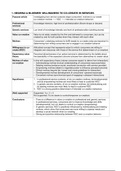
1. NEGHINA & BLOEMER: WILLINGNESS TO CO-CREATE IN SERVICES
Purpose article Investigating how service contexts shape consumers’ motives to co-create
(co-creation motives —> W2C —> intended co-creation behavior)
Professional Knowledge intensive, high level of professionalism (flower shops or lawyers)
services
Generic services Low level of knowledge intensity and level of professionalism (clothing stores)
Value co-creation Value is not solely created by the firm and delivered to consumers, but can be
created by and for both parties when they interact with each other
Motives Consumers’ underlying motives (to fulfill needs) to co-create value are important in
determining how willing consumers are to engage in co-creation behavior
Willingness to co- Attitudinal concept that represents extent to which consumers are willing to
create (W2C) integrate own resources with those of the service firm (determinant of co-creation)
Expectancy value Perceived attractiveness of an option (service) is determined by the beliefs about
theory the desirability of the expected outcome (choose from alternatives to create value)
Motives of value In line with expectancy theory (values consumer expect to derive from interaction):
co-creation - Individualizing motives (mutual understanding of consumers resources/roles)
- Relating motives (enhance social, emotional connection with service provider)
- Empowering motives (desire to negotiate power to influence process/outcome)
- Ethical motives (require fair, honest and moral guidelines for interaction)
- Developmental motives (development of consumers’ operand resources)
- Concerted motives (synchronized goal of engaging in pleasant interactions)
Hypotheses 1. In professional service contexts, of six co-creation motives, (a) developmental
and (b) empowering motives are most likely to lead to customer W2C
2. In generic service contexts, of six co-creation motives, (a) individualizing and
(b) relating motives are most likely to lead to customer W2C
3. W2C is a strong positive determinant of intended co-creation behaviors
(Not) supported Supported: 1a + 2 + 3
Not supported: 1b (no desire to control/empower co-creation)
Conclusions - There is a difference in value co-creation in professional and generic services
- In professional services, consumers aim to improve knowledge and skills
(developmental), but not desire to control co-creation (empowering)
- In generic services, W2C is positively influenced by individualizing and relating
motives, which show that consumers are more willing to express needs and
develop a social network when co-creating
- Strong and positive relationship between W2C and co-creation behavior
, 2. ZHANG & BLOEMER: IMPACT OF VALUE CONGRUENCE
Purpose article How value congruence influences key components of consumer-service brand
relationship quality and outcome (satisfaction/trust/affective commitment/loyalty)
Value congruence Similarity consumer’s own personal values and perception of service brand values
Personal values An enduring belief that a specific mode of conduct or end-state of existence is
personally of socially preferable to an opposite or converse mode of conduct or
end-state of existence (psychological core of the ‘self’)
Similarity-attraction People have greater intentions to create and retain their relationships with those
theory who are similar to themselves
Satisfaction Overall evaluation based on consumer’s total purchase and consumption
experience with the offerings of the service brand over time
Trust Willingness of the consumer to rely on a service brand because he/she has
confidence in the reliability and integrity of the brand
Affective Consumer’s enduring desire to maintain a valued relationship with a service brand,
commitment based on psychological attachment to that brand
Loyalty Consumer’s behavioral intention to continue buying/using service brand in future,
and a deep commitment to service brand: positive word-of-mouth communication
(WOM), willingness to pay more (WPM) and repurchase intention (RPIN)
Direct hypotheses 1. Value congruence has a positive influence on consumer satisfaction
2. Value congruence has a positive influence on consumer trust
3. Value congruence has a positive influence on consumer affective commitment
4. Value congruence has a positive influence on consumer loyalty
Indirect hypotheses 5. Satisfaction has a positive influence on trust
6. Trust has a positive influence on affective commitment
7. Affective commitment has a positive influence on loyalty in the form of (a)
WOM, (b) WPM and (c) RPIN
8. Satisfaction has a positive influence on affective commitment
9. Satisfaction has a positive influence on loyalty in the form of (a) WOM, (b)
WPM and (c) RPIN
10. Trust has a positive influence on loyalty in the form of (a) WOM, (b) WPM and
(c) RPIN
(Not) supported Supported: 1 + 2 + 3 + 4 + 5 + 6 + 7 + 9 + 10c
Not supported: 8 + 10ab
Conclusions - Value congruence has greater effect/impact on affective commitment than on
satisfaction, trust and loyalty
- Value congruence has significant, direct, positive effects on key components of
relationship quality and outcome
- Value congruence has an indirect effect on loyalty intentions, mediated through
satisfaction, trust and affective commitment
- Consumer’s trust, commitment and loyalty toward a service brand might be
enhanced by value congruence, in the absence of satisfaction (not satisfied
consumers or never used it, can still trust, committed to and have loyalty if the
values of the brand are the same as theirs)
Clothing stores Tangible, minimal contact, directed to person’s property, low switching costs
Bank brands Intangible, more contact, individually customized solutions, high switching costs
Implications - Long-term relationship between consumers and service brand
- Identify values that are important to target customers
- Build clear brand values through promotions or WOM communication
- Value congruence has significant effects in both service- and goods industry
Purpose article Investigating how service contexts shape consumers’ motives to co-create
(co-creation motives —> W2C —> intended co-creation behavior)
Professional Knowledge intensive, high level of professionalism (flower shops or lawyers)
services
Generic services Low level of knowledge intensity and level of professionalism (clothing stores)
Value co-creation Value is not solely created by the firm and delivered to consumers, but can be
created by and for both parties when they interact with each other
Motives Consumers’ underlying motives (to fulfill needs) to co-create value are important in
determining how willing consumers are to engage in co-creation behavior
Willingness to co- Attitudinal concept that represents extent to which consumers are willing to
create (W2C) integrate own resources with those of the service firm (determinant of co-creation)
Expectancy value Perceived attractiveness of an option (service) is determined by the beliefs about
theory the desirability of the expected outcome (choose from alternatives to create value)
Motives of value In line with expectancy theory (values consumer expect to derive from interaction):
co-creation - Individualizing motives (mutual understanding of consumers resources/roles)
- Relating motives (enhance social, emotional connection with service provider)
- Empowering motives (desire to negotiate power to influence process/outcome)
- Ethical motives (require fair, honest and moral guidelines for interaction)
- Developmental motives (development of consumers’ operand resources)
- Concerted motives (synchronized goal of engaging in pleasant interactions)
Hypotheses 1. In professional service contexts, of six co-creation motives, (a) developmental
and (b) empowering motives are most likely to lead to customer W2C
2. In generic service contexts, of six co-creation motives, (a) individualizing and
(b) relating motives are most likely to lead to customer W2C
3. W2C is a strong positive determinant of intended co-creation behaviors
(Not) supported Supported: 1a + 2 + 3
Not supported: 1b (no desire to control/empower co-creation)
Conclusions - There is a difference in value co-creation in professional and generic services
- In professional services, consumers aim to improve knowledge and skills
(developmental), but not desire to control co-creation (empowering)
- In generic services, W2C is positively influenced by individualizing and relating
motives, which show that consumers are more willing to express needs and
develop a social network when co-creating
- Strong and positive relationship between W2C and co-creation behavior
, 2. ZHANG & BLOEMER: IMPACT OF VALUE CONGRUENCE
Purpose article How value congruence influences key components of consumer-service brand
relationship quality and outcome (satisfaction/trust/affective commitment/loyalty)
Value congruence Similarity consumer’s own personal values and perception of service brand values
Personal values An enduring belief that a specific mode of conduct or end-state of existence is
personally of socially preferable to an opposite or converse mode of conduct or
end-state of existence (psychological core of the ‘self’)
Similarity-attraction People have greater intentions to create and retain their relationships with those
theory who are similar to themselves
Satisfaction Overall evaluation based on consumer’s total purchase and consumption
experience with the offerings of the service brand over time
Trust Willingness of the consumer to rely on a service brand because he/she has
confidence in the reliability and integrity of the brand
Affective Consumer’s enduring desire to maintain a valued relationship with a service brand,
commitment based on psychological attachment to that brand
Loyalty Consumer’s behavioral intention to continue buying/using service brand in future,
and a deep commitment to service brand: positive word-of-mouth communication
(WOM), willingness to pay more (WPM) and repurchase intention (RPIN)
Direct hypotheses 1. Value congruence has a positive influence on consumer satisfaction
2. Value congruence has a positive influence on consumer trust
3. Value congruence has a positive influence on consumer affective commitment
4. Value congruence has a positive influence on consumer loyalty
Indirect hypotheses 5. Satisfaction has a positive influence on trust
6. Trust has a positive influence on affective commitment
7. Affective commitment has a positive influence on loyalty in the form of (a)
WOM, (b) WPM and (c) RPIN
8. Satisfaction has a positive influence on affective commitment
9. Satisfaction has a positive influence on loyalty in the form of (a) WOM, (b)
WPM and (c) RPIN
10. Trust has a positive influence on loyalty in the form of (a) WOM, (b) WPM and
(c) RPIN
(Not) supported Supported: 1 + 2 + 3 + 4 + 5 + 6 + 7 + 9 + 10c
Not supported: 8 + 10ab
Conclusions - Value congruence has greater effect/impact on affective commitment than on
satisfaction, trust and loyalty
- Value congruence has significant, direct, positive effects on key components of
relationship quality and outcome
- Value congruence has an indirect effect on loyalty intentions, mediated through
satisfaction, trust and affective commitment
- Consumer’s trust, commitment and loyalty toward a service brand might be
enhanced by value congruence, in the absence of satisfaction (not satisfied
consumers or never used it, can still trust, committed to and have loyalty if the
values of the brand are the same as theirs)
Clothing stores Tangible, minimal contact, directed to person’s property, low switching costs
Bank brands Intangible, more contact, individually customized solutions, high switching costs
Implications - Long-term relationship between consumers and service brand
- Identify values that are important to target customers
- Build clear brand values through promotions or WOM communication
- Value congruence has significant effects in both service- and goods industry


