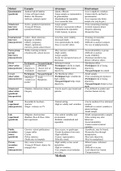
Method Examples Advantages Disadvantages
Questionnaire -Jackson lads & ladettes -Quick, efficient. -Low in depth & verstehen.
(positivist) -Crime self report study -Large sample so representative -Cannot clarify and hard to
-Barker- the Moonies & generalisable. operationalise.
-Sullivan- cultural capital -Standardised & repeatable. -Low response rate limits
-Low researcher bias. sample size (rep & gen.)
Structured -Eccles- gendered expectations -Large sample. -Time consuming (training).
interview -Young & Wilmott- -Formative assessment method. -Limited response detail.
(positivist) symmetrical family -Standardised & repeatable. -Requires planning.
-Valid- honesty in person. -Researcher bias.
Unstructured -Labov- black American -Less bias, more validity. -Training of researcher.
interview language in children -Increased depth. -Time consuming.
(interpretivist) -Oakley- pregnancy -Can operationalise & clarify. -Difficult to analyse/compare.
-Sharpe- aspirations -Easy to record (video). -No way of judging honesty.
-Gerwitz- parent school choice
Focus group -Willis- learning to labour -May increase confidence. -Social desirability in group.
(group -Charlesworth- school leavers -High validity. -Difficult to analyse.
interview) -Larger sample. -Lacks reliability.
(interpretivist) -Scope for unexpected areas of -Dominant members may
discussion. dictate/ influence others.
Overt Participant- Non-participant -Informed consent. -Hawthorne effect.
observation -Lacey -OFSTED -Participant valid & in depth. -Participant risk of losing
(interpretivist) -Hargreaves -‘Secret Life of -Non-participant retains objectivity.
-Vantakesh classroom’ objectivity. -Non-participant less depth.
Covert Participant- Non-participant -No Hawthorne effect. -Small sample.
observation -MacIntyre -Laud -Participant high verstehen & -Time consuming & expensive.
(interpretivist) -‘undercover Humphries high validity. -Participant risk of losing
teacher’ -Non-participant helps retain objectivity.
objectivity. -Non-participant distant so less
depth.
Structured -Flanders- Interaction Analysis -Can be used to spot trends and -Very difficult to predict and
observation Category patterns. structure human activity.
(positivist/
interpretivist)
Field -Rosenthal & Jacobsen- -Natural setting. -Can be unethical if no informed
experiment ‘spurters’ -High in validity and verstehen. consent.
(interpretivist) -Singer- violence on TV -Difficult to control variables in
natural settings.
-Small sample.
Lab -Milgram- electrocution -Can control variables and -Small, unrepresentative sample.
experiment -Bandura, Ross & Ross- bobo environment. -False setting may alter
(positivist) doll experiment -Reliable- standardised and behaviour.
repeatable. -Social desirability.
-Cannot control external
variables.
Public -Gerwitz- school publications -Easy access, no gatekeeper. -If publicity, may be biased.
secondary -League tables -Trends & patterns from stats. -Researcher bias through
source -Census -High reliability. interpretation.
(positivist) -Police statistics -Census- representative. -May lack objectivity.
-Death rates in hospitals -Ethically sound. -May be manipulated.
Private -Hey- notes in lessons -High validity as less social -Ethical issues- informed
secondary -Young & Wilmott- diaries for desirability. consent?
source conjugal roles -High in verstehen. -Difficult to access.
(interpretivist) -Can compare social attitudes -Lack objectivity/ biased.
over time. -Unrepresentative.
Methods
Questionnaire -Jackson lads & ladettes -Quick, efficient. -Low in depth & verstehen.
(positivist) -Crime self report study -Large sample so representative -Cannot clarify and hard to
-Barker- the Moonies & generalisable. operationalise.
-Sullivan- cultural capital -Standardised & repeatable. -Low response rate limits
-Low researcher bias. sample size (rep & gen.)
Structured -Eccles- gendered expectations -Large sample. -Time consuming (training).
interview -Young & Wilmott- -Formative assessment method. -Limited response detail.
(positivist) symmetrical family -Standardised & repeatable. -Requires planning.
-Valid- honesty in person. -Researcher bias.
Unstructured -Labov- black American -Less bias, more validity. -Training of researcher.
interview language in children -Increased depth. -Time consuming.
(interpretivist) -Oakley- pregnancy -Can operationalise & clarify. -Difficult to analyse/compare.
-Sharpe- aspirations -Easy to record (video). -No way of judging honesty.
-Gerwitz- parent school choice
Focus group -Willis- learning to labour -May increase confidence. -Social desirability in group.
(group -Charlesworth- school leavers -High validity. -Difficult to analyse.
interview) -Larger sample. -Lacks reliability.
(interpretivist) -Scope for unexpected areas of -Dominant members may
discussion. dictate/ influence others.
Overt Participant- Non-participant -Informed consent. -Hawthorne effect.
observation -Lacey -OFSTED -Participant valid & in depth. -Participant risk of losing
(interpretivist) -Hargreaves -‘Secret Life of -Non-participant retains objectivity.
-Vantakesh classroom’ objectivity. -Non-participant less depth.
Covert Participant- Non-participant -No Hawthorne effect. -Small sample.
observation -MacIntyre -Laud -Participant high verstehen & -Time consuming & expensive.
(interpretivist) -‘undercover Humphries high validity. -Participant risk of losing
teacher’ -Non-participant helps retain objectivity.
objectivity. -Non-participant distant so less
depth.
Structured -Flanders- Interaction Analysis -Can be used to spot trends and -Very difficult to predict and
observation Category patterns. structure human activity.
(positivist/
interpretivist)
Field -Rosenthal & Jacobsen- -Natural setting. -Can be unethical if no informed
experiment ‘spurters’ -High in validity and verstehen. consent.
(interpretivist) -Singer- violence on TV -Difficult to control variables in
natural settings.
-Small sample.
Lab -Milgram- electrocution -Can control variables and -Small, unrepresentative sample.
experiment -Bandura, Ross & Ross- bobo environment. -False setting may alter
(positivist) doll experiment -Reliable- standardised and behaviour.
repeatable. -Social desirability.
-Cannot control external
variables.
Public -Gerwitz- school publications -Easy access, no gatekeeper. -If publicity, may be biased.
secondary -League tables -Trends & patterns from stats. -Researcher bias through
source -Census -High reliability. interpretation.
(positivist) -Police statistics -Census- representative. -May lack objectivity.
-Death rates in hospitals -Ethically sound. -May be manipulated.
Private -Hey- notes in lessons -High validity as less social -Ethical issues- informed
secondary -Young & Wilmott- diaries for desirability. consent?
source conjugal roles -High in verstehen. -Difficult to access.
(interpretivist) -Can compare social attitudes -Lack objectivity/ biased.
over time. -Unrepresentative.
Methods