

Organizational development
OD Lecture 1:
• The LONG-RANGE EFFORT to improve:
1) an organization’s/system’s problem-solving capabilities and
2) its abilities to cope with changes in the external environment
with the help of external or internal behavioral-scientist consultants or change agents, as
they are sometimes called (Wendell French, 1969).
Characteristics of OD
- Planned
- Effectiveness working towards improvement, always has a goal
- Scientific approach (e.g. team dynamics, work design)
- System approach
Course divided into three parts:
1. Individual level
2. Team dynamics
3. Organization as a whole
OD model:
1. Anticipate need for change
2. Develop the practitioner-client relationship
3. The diagnostic phase
4. Action plants, strategies and techniques
5. Self-renewal, monitor and stabilize
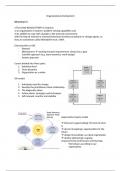
Appreciative inquiry model
Discovery (appreciating): the best of what
is
dream (imagining): opportunities for the
future
design (innovating): our ideal organization
destiny (delivering): ongoing
empowerment performance and learning.
- We behave according to our
expectations
,Major trends shaping change:
1. Globalization and environmental protection
2. Information technology
3. Managerial innovation
Environment of an organization
Open systems
- Organizations continually interact with
their environments
- Feed-back from the environment
helps the system to adapt
Model of adaptive orientation (ex. Uber)
- Combination of environmental stability
and adaptive orientation
Socio-technical system
, Changing the culture: culture is a system of shared values and beliefs that interact with an
organization’s people, structure and systems to produce behavioral norms
- ‘The way we do things around here’
- It includes:
o Artifacts: clothes, language, behaviors
o Norms and values: unwritten rules
o Deep assumptions
OD lecture 2 – understanding OD process, resistance to change and interventions
The OD process Dutch police force case
- Stages:
1. Anticipate need for change
2. Develop the practitioner-client relationship
3. The diagnostic phase
4. Action plans, strategies and techniques
5. Self-renewal, monitor, and stabilize
Issue: 2008-2011 almost no women represented at the top
Solution: introduced gender and diversity quota to raise number of women and ethnic
minorities to 25% in 2011
Interventions: which functions are eligible for diversity candidates. A temporary project
organization that actively intervenes in recruitment and selection. Crucial for the power
dynamics is the strong positioning of the
minister of internal affairs.
Outcomes: half is women at the top now, so
successful
Performance gap
Purpose of the diagnostic phase:
- To gather information to specify the exact nature of the problem requiring solution
- To identify the underlying causal forces
- And to provide a basis for selecting effective change strategies and techniques
OD Lecture 1:
• The LONG-RANGE EFFORT to improve:
1) an organization’s/system’s problem-solving capabilities and
2) its abilities to cope with changes in the external environment
with the help of external or internal behavioral-scientist consultants or change agents, as
they are sometimes called (Wendell French, 1969).
Characteristics of OD
- Planned
- Effectiveness working towards improvement, always has a goal
- Scientific approach (e.g. team dynamics, work design)
- System approach
Course divided into three parts:
1. Individual level
2. Team dynamics
3. Organization as a whole
OD model:
1. Anticipate need for change
2. Develop the practitioner-client relationship
3. The diagnostic phase
4. Action plants, strategies and techniques
5. Self-renewal, monitor and stabilize
Appreciative inquiry model
Discovery (appreciating): the best of what
is
dream (imagining): opportunities for the
future
design (innovating): our ideal organization
destiny (delivering): ongoing
empowerment performance and learning.
- We behave according to our
expectations
,Major trends shaping change:
1. Globalization and environmental protection
2. Information technology
3. Managerial innovation
Environment of an organization
Open systems
- Organizations continually interact with
their environments
- Feed-back from the environment
helps the system to adapt
Model of adaptive orientation (ex. Uber)
- Combination of environmental stability
and adaptive orientation
Socio-technical system
, Changing the culture: culture is a system of shared values and beliefs that interact with an
organization’s people, structure and systems to produce behavioral norms
- ‘The way we do things around here’
- It includes:
o Artifacts: clothes, language, behaviors
o Norms and values: unwritten rules
o Deep assumptions
OD lecture 2 – understanding OD process, resistance to change and interventions
The OD process Dutch police force case
- Stages:
1. Anticipate need for change
2. Develop the practitioner-client relationship
3. The diagnostic phase
4. Action plans, strategies and techniques
5. Self-renewal, monitor, and stabilize
Issue: 2008-2011 almost no women represented at the top
Solution: introduced gender and diversity quota to raise number of women and ethnic
minorities to 25% in 2011
Interventions: which functions are eligible for diversity candidates. A temporary project
organization that actively intervenes in recruitment and selection. Crucial for the power
dynamics is the strong positioning of the
minister of internal affairs.
Outcomes: half is women at the top now, so
successful
Performance gap
Purpose of the diagnostic phase:
- To gather information to specify the exact nature of the problem requiring solution
- To identify the underlying causal forces
- And to provide a basis for selecting effective change strategies and techniques


