

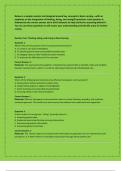
Below is a sample revision test designed around key concepts in basic nursing—with an
emphasis on the integration of thinking, doing, and caring30 questions. Each question is
followed by the correct answer and a brief rationale to help clarify the reasoning behind it.
You can use these questions to self-assess your understanding and identify areas for further
review.
Revision Test: Thinking, Doing, and Caring in Basic Nursing
Question 1:
What is the primary purpose of the nursing assessment phase?
A. To create a care plan immediately
B. To identify patient needs and establish baseline data
C. To delegate tasks to other healthcare team members
D. To evaluate the effectiveness of the care plan
Correct Answer: B
Rationale: The assessment phase gathers comprehensive patient data to identify needs and establish
baseline measurements, which is crucial for planning and delivering individualized care.
Question 2:
Which of the following best demonstrates effective therapeutic communication?
A. Giving advice without asking for patient input
B. Using medical jargon to appear knowledgeable
C. Active listening and responding empathetically
D. Focusing solely on the clinical symptoms
Correct Answer: C
Rationale: Effective therapeutic communication relies on active listening, empathy, and a patient-
centered approach. This builds trust and ensures that patients feel understood and supported.
Question 3:
In the context of nursing care, “doing” primarily refers to:
A. Analyzing patient data
B. Implementing and performing nursing interventions
C. Documenting patient information
D. Evaluating patient outcomes
Correct Answer: B
Rationale: The “doing” aspect of nursing involves the hands-on application of care interventions and
procedures. It is where theory is translated into practice through direct patient care.
, Question 4:
What is the most appropriate first step when you notice a change in a patient’s condition?
A. Immediately administer medication
B. Report the change to the supervising nurse
C. Document the change in the patient’s chart
D. Reassure the patient and wait for further instructions
Correct Answer: B
Rationale: Prompt communication with the supervising nurse or appropriate team member is critical
when a patient’s condition changes. This enables timely evaluation and intervention.
Question 5:
Which scenario best illustrates the “caring” aspect of nursing?
A. Quickly finishing a procedure to move on to the next patient
B. Spending extra time to explain the patient’s treatment plan and answer questions
C. Delegating all patient care tasks to the support staff
D. Prioritizing tasks based solely on technical complexity
Correct Answer: B
Rationale: Caring in nursing involves not only performing tasks correctly but also ensuring that patients
feel supported and understood. Taking extra time to explain procedures reinforces trust and enhances
patient satisfaction.
Question 6:
When planning a patient’s care, prioritization is essential. Which of the following tools is most often
used to determine the order of patient care needs?
A. The nursing process model
B. Maslow’s Hierarchy of Needs
C. The clinical pathway chart
D. The medication administration record
Correct Answer: B
Rationale: Maslow’s Hierarchy of Needs helps nurses determine which patient needs are most urgent
(such as physiological needs) so that care can be prioritized effectively.
Question 7:
Critical thinking in nursing involves:
A. Memorizing protocols and procedures
B. Making decisions based solely on past experiences
C. Systematically analyzing and evaluating patient information
D. Relying exclusively on technology for patient assessments
emphasis on the integration of thinking, doing, and caring30 questions. Each question is
followed by the correct answer and a brief rationale to help clarify the reasoning behind it.
You can use these questions to self-assess your understanding and identify areas for further
review.
Revision Test: Thinking, Doing, and Caring in Basic Nursing
Question 1:
What is the primary purpose of the nursing assessment phase?
A. To create a care plan immediately
B. To identify patient needs and establish baseline data
C. To delegate tasks to other healthcare team members
D. To evaluate the effectiveness of the care plan
Correct Answer: B
Rationale: The assessment phase gathers comprehensive patient data to identify needs and establish
baseline measurements, which is crucial for planning and delivering individualized care.
Question 2:
Which of the following best demonstrates effective therapeutic communication?
A. Giving advice without asking for patient input
B. Using medical jargon to appear knowledgeable
C. Active listening and responding empathetically
D. Focusing solely on the clinical symptoms
Correct Answer: C
Rationale: Effective therapeutic communication relies on active listening, empathy, and a patient-
centered approach. This builds trust and ensures that patients feel understood and supported.
Question 3:
In the context of nursing care, “doing” primarily refers to:
A. Analyzing patient data
B. Implementing and performing nursing interventions
C. Documenting patient information
D. Evaluating patient outcomes
Correct Answer: B
Rationale: The “doing” aspect of nursing involves the hands-on application of care interventions and
procedures. It is where theory is translated into practice through direct patient care.
, Question 4:
What is the most appropriate first step when you notice a change in a patient’s condition?
A. Immediately administer medication
B. Report the change to the supervising nurse
C. Document the change in the patient’s chart
D. Reassure the patient and wait for further instructions
Correct Answer: B
Rationale: Prompt communication with the supervising nurse or appropriate team member is critical
when a patient’s condition changes. This enables timely evaluation and intervention.
Question 5:
Which scenario best illustrates the “caring” aspect of nursing?
A. Quickly finishing a procedure to move on to the next patient
B. Spending extra time to explain the patient’s treatment plan and answer questions
C. Delegating all patient care tasks to the support staff
D. Prioritizing tasks based solely on technical complexity
Correct Answer: B
Rationale: Caring in nursing involves not only performing tasks correctly but also ensuring that patients
feel supported and understood. Taking extra time to explain procedures reinforces trust and enhances
patient satisfaction.
Question 6:
When planning a patient’s care, prioritization is essential. Which of the following tools is most often
used to determine the order of patient care needs?
A. The nursing process model
B. Maslow’s Hierarchy of Needs
C. The clinical pathway chart
D. The medication administration record
Correct Answer: B
Rationale: Maslow’s Hierarchy of Needs helps nurses determine which patient needs are most urgent
(such as physiological needs) so that care can be prioritized effectively.
Question 7:
Critical thinking in nursing involves:
A. Memorizing protocols and procedures
B. Making decisions based solely on past experiences
C. Systematically analyzing and evaluating patient information
D. Relying exclusively on technology for patient assessments



