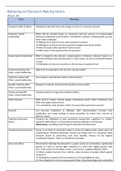
Behavioural Decision Making terms
Week 36
Term Meaning
Standard model of labour Individuals trade their time and energy in return for monetary rewards
Monetary market Effort will be exerted based on reciprocity and the amount of compensation
relationship influences individuals’ level of effort. Cost/benefit -analysis is implemented; put less
effort when underpaid.
Willingness to help increases when payment increases
Willingness to help in low-level payment is higher than social-market.
Effort increases when payment level increases
Effort lower in low-payment than no-payment
Social-market relationship Effort is shaped by the altruism, compensation is irrelevant. Altruism results in a
constant and high level of performance. In this market, no such cost-benefit analysis
is used.
Willingness to help was incentive to the increase of payment level
Communal sharing (CS) High level of cooperation and ‘we-ness’ (social-market)
Fiske’s social relationship
Authority ranking (AR) Clear superior-subordinate relation (social-market)
Fiske’s social relationship
Equality matching (EM) Between CS and AR, structured but equality (social-market)
Fiske’s social relationship
Market pricing (MP) Payments based on wage rates (money-market)
Fiske’s social relationship
Mixed markets Both social & money markets appear (monetized candy). When individuals face
both, they apply market norms.
In monetized candy situation, effort increased when payment increased
Rewards Can decrease motivation & attitudes, alter self-perception, increase over
justification and create feelings of being controlled. (& switch from intrinsic to
extrinsic value).
Cognitive dissonance Tendency for individuals to seek consistency among their cognitions (i.e. beliefs,
theory opinions). When there is a inconsistency between attitudes or behaviours
(dissonance), something must change to eliminate the dissonance
Standard economic theory Forces us to think of economics solely in terms of seeking profit, which refers to
maximising an individual advantage. Assumes no unique role of 0; consumers make
decisions based on subtracting costs from benefits. Choose for the highest
cost/benefit-analysis. Theory is violated by anomalies.
Zero-price effect Phenomenon whereby the demand for a good, service or commodity is significantly
greater at a price of exactly zero compared to a price even slightly greater than
zero. Main causes for the effect of zero: social norms, mapping difficulty, affect.
When product becomes free; intrinsic value increases & people attach special
values to it.
Participants reacted to the free product as if it had additional value
Price reduction to zero is more powerful than a five-times-larger price reduction
, with positive prices.
zero-price effect is not eliminated when transaction costs are the same
attractiveness of zero cost not eliminated to monetary transactions
When cognitive inputs are available, the benefit of zero largely dissipates.
Social norms In case of price of 0, social norms apply. (take 1 instead of more).
Mapping difficulty People have difficulty mapping the utility they expect to receive from hedonic
consumption. Always benefit from 0 price.
Affect Options with no downside (no cost) invoke more positive affective response:
consumers use affective reaction as a decision-making cue, they opt for the free
option. More applied than social norms & mapping difficulty.
System 1 (Intuition) The operations of System 1 are typically fast, automatic, effortless, associative,
implicit and often emotionally charged: they are also governed by habit and are
therefore difficult to control or modify. Generates impressions of attributes of
objects of perception and thoughts. Corrected by System 2.
System 2 (Reasoning) The operation of System 2 is slower, serial, effortful, more likely to be consciously
monitored and deliberately controlled; they are also relatively flexible and
potentially rule governed.
Accessibility The ease (effort) with which particular mental contents come to mind. The
accessibility of a thought is determined jointly by the characteristics of the cognitive
mechanisms that produce it and by the characteristics of the stimuli and events that
evoke it.
Natural assessment Attributed that are routinely and automatically registered by the perceptual system
of by System 1 without intention or effort. Such as: size, distance, loudness and
more abstract properties.
Framing effects Cognitive bias where people decide on options based on whether the options are
presented with positive or negative connotations (gains vs. losses).
Reference dependent Perception is reference dependent: focus stimuli is reflected by the concurrent
stimuli. Independent states of wealth doesn’t influence decision making
Narrow framing Tendency to see investments without considering the context of the overall
portfolio
Mental accounting Describe the process whereby people code, categorize, and evaluate economic
outcomes.
Prospect theory Describes the way people choose between probabilistic alternatives that involve
risk, where the probabilities of outcomes are known. Theory states that people
make decisions based on the potential value of losses and gains rather than the
final outcome and that people evaluate these losses and gains using some
heuristics. Contrary to the expected utility theory. Prospect theory is actual
behaviour. Focuses on the short-term
Heuristics Mental shortcuts that help solving problems and quickly judgments . An example of
heuristic-induced is bias (prefer one thing over another). Three heuristics of
judgments are: representativeness, availability and anchoring.
Bias Systematic distortion of perception, colours our judgment.
Week 36
Term Meaning
Standard model of labour Individuals trade their time and energy in return for monetary rewards
Monetary market Effort will be exerted based on reciprocity and the amount of compensation
relationship influences individuals’ level of effort. Cost/benefit -analysis is implemented; put less
effort when underpaid.
Willingness to help increases when payment increases
Willingness to help in low-level payment is higher than social-market.
Effort increases when payment level increases
Effort lower in low-payment than no-payment
Social-market relationship Effort is shaped by the altruism, compensation is irrelevant. Altruism results in a
constant and high level of performance. In this market, no such cost-benefit analysis
is used.
Willingness to help was incentive to the increase of payment level
Communal sharing (CS) High level of cooperation and ‘we-ness’ (social-market)
Fiske’s social relationship
Authority ranking (AR) Clear superior-subordinate relation (social-market)
Fiske’s social relationship
Equality matching (EM) Between CS and AR, structured but equality (social-market)
Fiske’s social relationship
Market pricing (MP) Payments based on wage rates (money-market)
Fiske’s social relationship
Mixed markets Both social & money markets appear (monetized candy). When individuals face
both, they apply market norms.
In monetized candy situation, effort increased when payment increased
Rewards Can decrease motivation & attitudes, alter self-perception, increase over
justification and create feelings of being controlled. (& switch from intrinsic to
extrinsic value).
Cognitive dissonance Tendency for individuals to seek consistency among their cognitions (i.e. beliefs,
theory opinions). When there is a inconsistency between attitudes or behaviours
(dissonance), something must change to eliminate the dissonance
Standard economic theory Forces us to think of economics solely in terms of seeking profit, which refers to
maximising an individual advantage. Assumes no unique role of 0; consumers make
decisions based on subtracting costs from benefits. Choose for the highest
cost/benefit-analysis. Theory is violated by anomalies.
Zero-price effect Phenomenon whereby the demand for a good, service or commodity is significantly
greater at a price of exactly zero compared to a price even slightly greater than
zero. Main causes for the effect of zero: social norms, mapping difficulty, affect.
When product becomes free; intrinsic value increases & people attach special
values to it.
Participants reacted to the free product as if it had additional value
Price reduction to zero is more powerful than a five-times-larger price reduction
, with positive prices.
zero-price effect is not eliminated when transaction costs are the same
attractiveness of zero cost not eliminated to monetary transactions
When cognitive inputs are available, the benefit of zero largely dissipates.
Social norms In case of price of 0, social norms apply. (take 1 instead of more).
Mapping difficulty People have difficulty mapping the utility they expect to receive from hedonic
consumption. Always benefit from 0 price.
Affect Options with no downside (no cost) invoke more positive affective response:
consumers use affective reaction as a decision-making cue, they opt for the free
option. More applied than social norms & mapping difficulty.
System 1 (Intuition) The operations of System 1 are typically fast, automatic, effortless, associative,
implicit and often emotionally charged: they are also governed by habit and are
therefore difficult to control or modify. Generates impressions of attributes of
objects of perception and thoughts. Corrected by System 2.
System 2 (Reasoning) The operation of System 2 is slower, serial, effortful, more likely to be consciously
monitored and deliberately controlled; they are also relatively flexible and
potentially rule governed.
Accessibility The ease (effort) with which particular mental contents come to mind. The
accessibility of a thought is determined jointly by the characteristics of the cognitive
mechanisms that produce it and by the characteristics of the stimuli and events that
evoke it.
Natural assessment Attributed that are routinely and automatically registered by the perceptual system
of by System 1 without intention or effort. Such as: size, distance, loudness and
more abstract properties.
Framing effects Cognitive bias where people decide on options based on whether the options are
presented with positive or negative connotations (gains vs. losses).
Reference dependent Perception is reference dependent: focus stimuli is reflected by the concurrent
stimuli. Independent states of wealth doesn’t influence decision making
Narrow framing Tendency to see investments without considering the context of the overall
portfolio
Mental accounting Describe the process whereby people code, categorize, and evaluate economic
outcomes.
Prospect theory Describes the way people choose between probabilistic alternatives that involve
risk, where the probabilities of outcomes are known. Theory states that people
make decisions based on the potential value of losses and gains rather than the
final outcome and that people evaluate these losses and gains using some
heuristics. Contrary to the expected utility theory. Prospect theory is actual
behaviour. Focuses on the short-term
Heuristics Mental shortcuts that help solving problems and quickly judgments . An example of
heuristic-induced is bias (prefer one thing over another). Three heuristics of
judgments are: representativeness, availability and anchoring.
Bias Systematic distortion of perception, colours our judgment.