
Cassian Rattray – USA Politics
Paper 3
Key terminology:
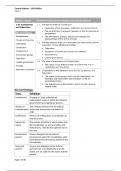
Term: Definition:
Confederacy A league or loose collection of
independent states in which the national
government lacks significant powers.
Articles of The compact between the 13 original
Confederation states that formed the new nation in
1781.
Codification Process of writing down a constitution in
one document.
Supremacy The portion of Article VI which states that
clause the constitution, as well as treaties and
federal laws, ‘shall be the supreme law of
the land’.
Enumerated Powers delegates to the federal
powers government under the Constitution, with
most being in the first three articles of the
Constitution.
Reserved Powers not delegated to the federal
powers government, or prohibited by it to the
states, are set aside for the states and the
people.
Page 1 of 80
,Cassian Rattray – USA Politics
Paper 3
Concurrent Powers possessed by both the federal and
powers state governments.
Entrenchment The application of extra, legal, safeguards
to a constitutional provision to make it
more difficult to amend or abolish.
Separation of A theory of government whereby political
powers power is distributed among the
legislature, the executive and the
judiciary, each acting both independently
and interdependently.
Checks and A system of government that gives each
balances branch the means to control the power
exercised by other branches.
Bipartisanship Close cooperation between the two major
parties to achieve desired political goals.
Divided When the presidency is controlled by one
government party, and one or both houses of Congress
are controlled by the other party.
Federalism The theory of government by which
political power is divided between the
national government and the state
governments, each having their own areas
of substantive jurisdiction.
Limited Principle that the scope of federal
government government should be limited to that
which is necessary for the common good
and of the people.
Principle A fundamental and ‘organising’ idea that
runs throughout the US constitution.
Dual Based on a clear delineation of authority
federalism and programs among the levels of
government.
Cooperative Based on a pragmatic mixing of authority
federalism and programmes among the national,
state and local governments.
Constitution A body of fundamental principles or
established precedents according to which
a state or other organisation is
acknowledged to be governed, being
ratified in the US in 1789.
1.1. Nature of the US Constitution:
Codified Constitution:
US Constitution - The basis of all government in the USA and the supreme law of the land.
Page 2 of 80
,Cassian Rattray – USA Politics
Paper 3
The US Constitution was created by a group of men known as - the “Founding Fathers”
during the War of Independence from Britain.
It was ratified in 1788 and came into force in 1789.
The US Constitution consist of - 7 articles and 27 amendments.
The first 10 amendments, ratified in 1791 are known as the Bill of Rights.
Entrenched Constitution:
As the US constitution is entrenched - it cannot be changed without a supermajority in
Congress.
With Article V entrenching the US constitution, requiring - a supermajority to change
amendments or a 3/4 majority in ratifying convention of the states.
The Bill of Rights - lists the entrenched rights, being the first 10 amendments to the
constitution.
Vagueness:
By the nature of its age, and being codified and entrenched, the US Constitution can be
vague.
Enumerated powers:
Enumerated powers - Powers that are explicitly given to each branch of government.
Article I, Section 8 of the US constitution sets out - the enumerated powers of Congress.
These include - the power to tax citizens and spend this money, and the power to issue a
currency.
Implied powers:
Implied powers - Powers allowing Congress the freedom to make necessary laws and to use
powers that the founders had not thought of.
Article I, Section 8, Clause 18 gives Congress - implied powers.
Giving Congress the power to - make all laws “necessary and proper” for its ability to rule.
The implied powers of Congress have grown since the Constitution was written allowing
them - to make laws concerning matters not mentioned in the constitution.
Nature of the Constitution - positives and negatives:
Positives of the nature of the US constitution:
Positives of the nature of the US constitution include:
The separation of powers, simplicity, entrenchment, clarity and vagueness.
The vagueness of the constitution allows - it to adopt the modern world as it can be
interpreted to mean different things.
There is a clearly outlined structure of government - with separation of powers between the
three branches of government, preventing any one person or group to have too much
power.
Page 3 of 80
, Cassian Rattray – USA Politics
Paper 3
The simplicity of a codified constitution - allows all citizens to clearly know and understand
their rights.
The entrenchment - preserves the intentions of the founding fathers and prevents populist
movements from making drastic and poorly thought through changes.
Negatives of the nature of the US constitution:
Negatives of the nature of the US constitution include:
It is difficult to amend, the extent of federal government power is unclear and it is vague.
The vagueness of the constitution leaves - a lot to interpretation, the final say on which goes
to the Supreme Court.
It is very hard to overturn a Supreme Court decision, arguably - giving the nine justices the
ultimate say over important constitutional issues.
The ‘necessary and proper’ clause in Article I of the constitution has - caused regular
conflicts between the states and the federal government.
The entrenched nature of the constitution - makes it difficult to amend.
Constitutional framework:
Articles I-III:
Articles I-III of the US constitution - clearly outline three separate branches of the cereal
government and their powers, setting up the principle of separation of powers.
Article I:
Article I - Grants all legislative powers to the Congress and outlines the election process for
each chamber and the powers allotted to them.
Members of the House or Representatives are to be elected - every two years.
Each state has a minimum of - 1 representative.
With the total number of representatives being based on - the size of the population of each
state.
Members of the Senate are - to serve six year terms.
With elections held - every two years for 1/3 of the seats.
There are two senators - per state.
Article II:
Article II - grants executive power to a President, who sits for a term of four years, alongside
their Vice-President.
Both will be elected via a system known as - the electoral college.
Article III:
Article III - grants judicial power to the Supreme Court and any smaller courts.
There is no term limit for judges.
Supreme Court justices are to be appointed by the President and approved by the Senate.
Articles IV-VII:
Articles IV-VI - set out the concept of federalism and the powers of the state.
Article VII - outline the ratification process for new states to join the union.
Page 4 of 80
Paper 3
Key terminology:
Term: Definition:
Confederacy A league or loose collection of
independent states in which the national
government lacks significant powers.
Articles of The compact between the 13 original
Confederation states that formed the new nation in
1781.
Codification Process of writing down a constitution in
one document.
Supremacy The portion of Article VI which states that
clause the constitution, as well as treaties and
federal laws, ‘shall be the supreme law of
the land’.
Enumerated Powers delegates to the federal
powers government under the Constitution, with
most being in the first three articles of the
Constitution.
Reserved Powers not delegated to the federal
powers government, or prohibited by it to the
states, are set aside for the states and the
people.
Page 1 of 80
,Cassian Rattray – USA Politics
Paper 3
Concurrent Powers possessed by both the federal and
powers state governments.
Entrenchment The application of extra, legal, safeguards
to a constitutional provision to make it
more difficult to amend or abolish.
Separation of A theory of government whereby political
powers power is distributed among the
legislature, the executive and the
judiciary, each acting both independently
and interdependently.
Checks and A system of government that gives each
balances branch the means to control the power
exercised by other branches.
Bipartisanship Close cooperation between the two major
parties to achieve desired political goals.
Divided When the presidency is controlled by one
government party, and one or both houses of Congress
are controlled by the other party.
Federalism The theory of government by which
political power is divided between the
national government and the state
governments, each having their own areas
of substantive jurisdiction.
Limited Principle that the scope of federal
government government should be limited to that
which is necessary for the common good
and of the people.
Principle A fundamental and ‘organising’ idea that
runs throughout the US constitution.
Dual Based on a clear delineation of authority
federalism and programs among the levels of
government.
Cooperative Based on a pragmatic mixing of authority
federalism and programmes among the national,
state and local governments.
Constitution A body of fundamental principles or
established precedents according to which
a state or other organisation is
acknowledged to be governed, being
ratified in the US in 1789.
1.1. Nature of the US Constitution:
Codified Constitution:
US Constitution - The basis of all government in the USA and the supreme law of the land.
Page 2 of 80
,Cassian Rattray – USA Politics
Paper 3
The US Constitution was created by a group of men known as - the “Founding Fathers”
during the War of Independence from Britain.
It was ratified in 1788 and came into force in 1789.
The US Constitution consist of - 7 articles and 27 amendments.
The first 10 amendments, ratified in 1791 are known as the Bill of Rights.
Entrenched Constitution:
As the US constitution is entrenched - it cannot be changed without a supermajority in
Congress.
With Article V entrenching the US constitution, requiring - a supermajority to change
amendments or a 3/4 majority in ratifying convention of the states.
The Bill of Rights - lists the entrenched rights, being the first 10 amendments to the
constitution.
Vagueness:
By the nature of its age, and being codified and entrenched, the US Constitution can be
vague.
Enumerated powers:
Enumerated powers - Powers that are explicitly given to each branch of government.
Article I, Section 8 of the US constitution sets out - the enumerated powers of Congress.
These include - the power to tax citizens and spend this money, and the power to issue a
currency.
Implied powers:
Implied powers - Powers allowing Congress the freedom to make necessary laws and to use
powers that the founders had not thought of.
Article I, Section 8, Clause 18 gives Congress - implied powers.
Giving Congress the power to - make all laws “necessary and proper” for its ability to rule.
The implied powers of Congress have grown since the Constitution was written allowing
them - to make laws concerning matters not mentioned in the constitution.
Nature of the Constitution - positives and negatives:
Positives of the nature of the US constitution:
Positives of the nature of the US constitution include:
The separation of powers, simplicity, entrenchment, clarity and vagueness.
The vagueness of the constitution allows - it to adopt the modern world as it can be
interpreted to mean different things.
There is a clearly outlined structure of government - with separation of powers between the
three branches of government, preventing any one person or group to have too much
power.
Page 3 of 80
, Cassian Rattray – USA Politics
Paper 3
The simplicity of a codified constitution - allows all citizens to clearly know and understand
their rights.
The entrenchment - preserves the intentions of the founding fathers and prevents populist
movements from making drastic and poorly thought through changes.
Negatives of the nature of the US constitution:
Negatives of the nature of the US constitution include:
It is difficult to amend, the extent of federal government power is unclear and it is vague.
The vagueness of the constitution leaves - a lot to interpretation, the final say on which goes
to the Supreme Court.
It is very hard to overturn a Supreme Court decision, arguably - giving the nine justices the
ultimate say over important constitutional issues.
The ‘necessary and proper’ clause in Article I of the constitution has - caused regular
conflicts between the states and the federal government.
The entrenched nature of the constitution - makes it difficult to amend.
Constitutional framework:
Articles I-III:
Articles I-III of the US constitution - clearly outline three separate branches of the cereal
government and their powers, setting up the principle of separation of powers.
Article I:
Article I - Grants all legislative powers to the Congress and outlines the election process for
each chamber and the powers allotted to them.
Members of the House or Representatives are to be elected - every two years.
Each state has a minimum of - 1 representative.
With the total number of representatives being based on - the size of the population of each
state.
Members of the Senate are - to serve six year terms.
With elections held - every two years for 1/3 of the seats.
There are two senators - per state.
Article II:
Article II - grants executive power to a President, who sits for a term of four years, alongside
their Vice-President.
Both will be elected via a system known as - the electoral college.
Article III:
Article III - grants judicial power to the Supreme Court and any smaller courts.
There is no term limit for judges.
Supreme Court justices are to be appointed by the President and approved by the Senate.
Articles IV-VII:
Articles IV-VI - set out the concept of federalism and the powers of the state.
Article VII - outline the ratification process for new states to join the union.
Page 4 of 80


