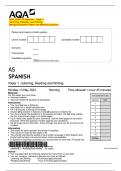
AQA_2024: A-level Religious Studies - Paper 2E
Study of Religion and Dialogues: Judaism.
(Merged Question Paper and Marking Scheme)
A-level
RELIGIOUS STUDIES
Paper 2E Study of Religion and Dialogues: Judaism
Monday 17 June 2024 Afternoon Time allowed: 3 hours
Materials
For this paper you must have:
an AQA 16-page answer book.
Instructions
Use black ink or black ball-point pen.
Write the information required on the front of your answer book. The Paper Reference is 7062/2E.
Answer:
– both two-part questions from Section A, and
– one question from Section B, and
– one question from Section C.
Do all rough work in your answer book. Cross through any work you do not want to be marked.
Information
The marks for questions are shown in brackets.
The maximum mark for this paper is 100.
In each two-part question in Section A, the first part tests your knowledge and understanding,
while the second part tests your skills of reasoning and evaluation.
The one-part questions in Sections B and C test your knowledge and understanding and your
skills of reasoning and evaluation.
You will be marked on your ability to:
– use good English
– organise information clearly
– use specialist vocabulary where appropriate.
,For A-level Religious Studies Paper 2E on Judaism, focus on the following key areas:
1. Key Beliefs in Judaism:
Monotheism: Belief in one, indivisible God (Yahweh), who is the creator, sustainer, and ruler of the
universe.
The Covenant: The special relationship between God and the Jewish people, established through
figures like Abraham and Moses. The covenant is marked by God's promises to protect and bless
the Jewish people if they remain faithful to Him.
The Messiah: The belief in a future Jewish Messiah, a leader who will bring peace, rebuild the
Temple in Jerusalem, and restore Jewish sovereignty.
2. The Hebrew Scriptures (Tanakh):
The Torah: The first five books of the Bible (Genesis, Exodus, Leviticus, Numbers, and
Deuteronomy), which are the most sacred texts, containing laws, commandments, and the
teachings of Moses.
The Nevi'im (Prophets): Books that record the history of the Jewish people and the messages of
the prophets who called the people to repentance and faithfulness.
3. The 613 Mitzvot (Commandments):
Halakhah: Jewish law, which includes 613 commandments (mitzvot) derived from the Torah. These
cover aspects of daily life such as ethics, food laws (kashrut), and ritual observance.
Kosher Laws: Food laws that govern what is permissible to eat (e.g., prohibitions on pork and
mixing meat with dairy).
Sabbath (Shabbat): The weekly day of rest from Friday evening to Saturday evening,
commemorating God’s creation and resting on the seventh day. Observances include prayer,
lighting candles, and refraining from work.
4. Jewish Rituals and Worship:
Synagogue Worship: The synagogue is the central place of Jewish communal prayer and study.
The services are led by a rabbi, with prayer led in Hebrew.
Shabbat Observance: Celebrations of the Sabbath, including lighting candles, reciting prayers
(Kiddush), and sharing a festive meal.
Circumcision (Brit Milah): A ritual performed on male Jewish infants on the eighth day of life,
signifying the covenant between God and the Jewish people.
5. Jewish Holidays and Festivals:
Rosh Hashanah: The Jewish New Year, a time for reflection and repentance, marking the
beginning of the High Holy Days.
Yom Kippur: The Day of Atonement, the holiest day in Judaism, spent in fasting, prayer, and
repentance for sins.
Passover (Pesach): Celebrates the Exodus from Egypt, with rituals such as the Seder meal and
eating unleavened bread (matzah).
IB/M/Jun24/G4005/E3 7062/2E
, 2
Section A: Study of Judaism
Answer both questions in this section.
Each question has two parts.
Question 1
0 1 . 1 Examine Jewish understandings of life after death.
[10 marks]
and
0 1 . 2 ‘Gender based language about God is not useful.’
Evaluate this view.
[15 marks]
Question 2
0 2 . 1 Examine how ghettoism influences Jewish identity today.
[10 marks]
and
0 2 . 2 ‘There is little agreement about the ordination of women as rabbis.’
Evaluate this view.
[15 marks]
IB/M/Jun24/7062/2E
Study of Religion and Dialogues: Judaism.
(Merged Question Paper and Marking Scheme)
A-level
RELIGIOUS STUDIES
Paper 2E Study of Religion and Dialogues: Judaism
Monday 17 June 2024 Afternoon Time allowed: 3 hours
Materials
For this paper you must have:
an AQA 16-page answer book.
Instructions
Use black ink or black ball-point pen.
Write the information required on the front of your answer book. The Paper Reference is 7062/2E.
Answer:
– both two-part questions from Section A, and
– one question from Section B, and
– one question from Section C.
Do all rough work in your answer book. Cross through any work you do not want to be marked.
Information
The marks for questions are shown in brackets.
The maximum mark for this paper is 100.
In each two-part question in Section A, the first part tests your knowledge and understanding,
while the second part tests your skills of reasoning and evaluation.
The one-part questions in Sections B and C test your knowledge and understanding and your
skills of reasoning and evaluation.
You will be marked on your ability to:
– use good English
– organise information clearly
– use specialist vocabulary where appropriate.
,For A-level Religious Studies Paper 2E on Judaism, focus on the following key areas:
1. Key Beliefs in Judaism:
Monotheism: Belief in one, indivisible God (Yahweh), who is the creator, sustainer, and ruler of the
universe.
The Covenant: The special relationship between God and the Jewish people, established through
figures like Abraham and Moses. The covenant is marked by God's promises to protect and bless
the Jewish people if they remain faithful to Him.
The Messiah: The belief in a future Jewish Messiah, a leader who will bring peace, rebuild the
Temple in Jerusalem, and restore Jewish sovereignty.
2. The Hebrew Scriptures (Tanakh):
The Torah: The first five books of the Bible (Genesis, Exodus, Leviticus, Numbers, and
Deuteronomy), which are the most sacred texts, containing laws, commandments, and the
teachings of Moses.
The Nevi'im (Prophets): Books that record the history of the Jewish people and the messages of
the prophets who called the people to repentance and faithfulness.
3. The 613 Mitzvot (Commandments):
Halakhah: Jewish law, which includes 613 commandments (mitzvot) derived from the Torah. These
cover aspects of daily life such as ethics, food laws (kashrut), and ritual observance.
Kosher Laws: Food laws that govern what is permissible to eat (e.g., prohibitions on pork and
mixing meat with dairy).
Sabbath (Shabbat): The weekly day of rest from Friday evening to Saturday evening,
commemorating God’s creation and resting on the seventh day. Observances include prayer,
lighting candles, and refraining from work.
4. Jewish Rituals and Worship:
Synagogue Worship: The synagogue is the central place of Jewish communal prayer and study.
The services are led by a rabbi, with prayer led in Hebrew.
Shabbat Observance: Celebrations of the Sabbath, including lighting candles, reciting prayers
(Kiddush), and sharing a festive meal.
Circumcision (Brit Milah): A ritual performed on male Jewish infants on the eighth day of life,
signifying the covenant between God and the Jewish people.
5. Jewish Holidays and Festivals:
Rosh Hashanah: The Jewish New Year, a time for reflection and repentance, marking the
beginning of the High Holy Days.
Yom Kippur: The Day of Atonement, the holiest day in Judaism, spent in fasting, prayer, and
repentance for sins.
Passover (Pesach): Celebrates the Exodus from Egypt, with rituals such as the Seder meal and
eating unleavened bread (matzah).
IB/M/Jun24/G4005/E3 7062/2E
, 2
Section A: Study of Judaism
Answer both questions in this section.
Each question has two parts.
Question 1
0 1 . 1 Examine Jewish understandings of life after death.
[10 marks]
and
0 1 . 2 ‘Gender based language about God is not useful.’
Evaluate this view.
[15 marks]
Question 2
0 2 . 1 Examine how ghettoism influences Jewish identity today.
[10 marks]
and
0 2 . 2 ‘There is little agreement about the ordination of women as rabbis.’
Evaluate this view.
[15 marks]
IB/M/Jun24/7062/2E