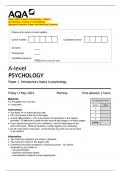
AQA_2024: A-level Religious Studies - Paper 2D
Study of Religion and Dialogues: Islam
(Merged Question Paper and Marking Scheme)
A-level
RELIGIOUS STUDIES
Paper 2D Study of Religion and Dialogues: Islam
Monday 17 June 2024 Afternoon Time allowed: 3 hours
Materials
For this paper you must have:
an AQA 16-page answer book.
Instructions
Use black ink or black ball-point pen.
Write the information required on the front of your answer book. The Paper Reference is
7062/2D.
Answer:
– both two-part questions from Section A, and
– one question from Section B, and
– one question from Section C.
Do all rough work in your answer book. Cross through any work you do not want to be marked.
Information
The marks for questions are shown in brackets.
The maximum mark for this paper is 100.
In each two-part question in Section A, the first part tests your knowledge and understanding,
while the second part tests your skills of reasoning and evaluation.
The one-part questions in Sections B and C test your knowledge and understanding and your
skills of reasoning and evaluation.
You will be marked on your ability to:
– use good English
– organise information clearly
– use specialist vocabulary where appropriate.
,For A-level Religious Studies Paper 2D on Islam, focus on the following key areas:
1. Core Beliefs in Islam:
Tawhid: The belief in the absolute oneness of God (Allah), emphasizing that God is unique and
indivisible.
Angels: Belief in angels as messengers of God, with key angels like Jibril (Gabriel) and Mikail
(Michael).
Prophethood (Nubuwwah): The belief in a series of prophets sent by God, including Adam,
Ibrahim (Abraham), Musa (Moses), Isa (Jesus), and the final prophet, Muhammad.
Revelation: The Qur’an as the final, complete revelation from God, and the Hadiths as sayings and
actions of the Prophet Muhammad.
Akhirah: Belief in life after death, including the concepts of Jannah (paradise) and Jahannam (hell),
where individuals are rewarded or punished based on their actions.
Day of Judgement: The belief in the Day of Judgement when all humans will be resurrected and
judged by God for their deeds.
2. The Five Pillars of Islam:
Shahada: The declaration of faith, stating that "There is no god but Allah, and Muhammad is his
messenger."
Salat: The performance of ritual prayers five times a day, which include physical postures of
worship, facing Mecca.
Zakat: The giving of alms (charity), usually 2.5% of one’s savings annually, to support the poor and
needy.
Sawm: Fasting during the month of Ramadan, refraining from food, drink, and other physical needs
from dawn to sunset.
Hajj: The pilgrimage to Mecca, which Muslims are required to undertake at least once in their
lifetime, if physically and financially able.
3. The Qur'an and Hadith:
Qur'an: The sacred text of Islam, considered the direct word of God revealed to Muhammad over 23
years. It is composed of surahs (chapters) and ayahs (verses).
Hadith: Collections of sayings, actions, and approvals of the Prophet Muhammad, which provide
guidance on how to live according to Islam.
4. Islamic Law (Shari’ah):
Sources of Shari’ah: The Qur’an and Hadith are the primary sources of Islamic law. Ijma
(consensus of scholars) and Qiyas (analogical reasoning) are also used.
The Role of Shari’ah: Shari’ah covers all aspects of a Muslim's life, including worship, personal
conduct, and ethical decisions. It also includes principles for social justice and community life.
Differences in Interpretation: Sunni and Shia interpretations of Shari'ah differ, particularly
regarding leadership and legal schools (e.g., Hanafi, Shafi'i, Maliki, Hanbali).
5. Key Figures in Islam:
Prophet Muhammad: The final prophet in Islam, believed to be the “Seal of the Prophets.” Study
his life, mission, and the role of the Sunnah in Islamic practice.
Imams: In Shia Islam, Imams are considered divinely appointed leaders, with a spiritual authority
greater than that of regular scholars.
Caliphs: The leaders of the Muslim community after Muhammad’s death. The Sunni-Shia split
centers on the dispute over rightful leadership.
IB/M/Jun24/G4005/E2 7062/2D
, 2
Section A: Study of Islam
Answer both questions in this section.
Each question has two parts.
Question 1
0 1 . 1 Examine Muslim understandings of Akhirah (afterlife).
[10 marks]
and
0 1 . 2 ‘The Sufi concept of God is confusing.’
Evaluate this claim.
[15 marks]
Question 2
0 2 . 1 Examine how Muslim liberationist approaches influence society today.
[10 marks]
and
0 2 . 2 ‘There is little agreement in Islam about the role and status of women.’
Evaluate this claim.
[15 marks]
IB/M/Jun24/7062/2D
Study of Religion and Dialogues: Islam
(Merged Question Paper and Marking Scheme)
A-level
RELIGIOUS STUDIES
Paper 2D Study of Religion and Dialogues: Islam
Monday 17 June 2024 Afternoon Time allowed: 3 hours
Materials
For this paper you must have:
an AQA 16-page answer book.
Instructions
Use black ink or black ball-point pen.
Write the information required on the front of your answer book. The Paper Reference is
7062/2D.
Answer:
– both two-part questions from Section A, and
– one question from Section B, and
– one question from Section C.
Do all rough work in your answer book. Cross through any work you do not want to be marked.
Information
The marks for questions are shown in brackets.
The maximum mark for this paper is 100.
In each two-part question in Section A, the first part tests your knowledge and understanding,
while the second part tests your skills of reasoning and evaluation.
The one-part questions in Sections B and C test your knowledge and understanding and your
skills of reasoning and evaluation.
You will be marked on your ability to:
– use good English
– organise information clearly
– use specialist vocabulary where appropriate.
,For A-level Religious Studies Paper 2D on Islam, focus on the following key areas:
1. Core Beliefs in Islam:
Tawhid: The belief in the absolute oneness of God (Allah), emphasizing that God is unique and
indivisible.
Angels: Belief in angels as messengers of God, with key angels like Jibril (Gabriel) and Mikail
(Michael).
Prophethood (Nubuwwah): The belief in a series of prophets sent by God, including Adam,
Ibrahim (Abraham), Musa (Moses), Isa (Jesus), and the final prophet, Muhammad.
Revelation: The Qur’an as the final, complete revelation from God, and the Hadiths as sayings and
actions of the Prophet Muhammad.
Akhirah: Belief in life after death, including the concepts of Jannah (paradise) and Jahannam (hell),
where individuals are rewarded or punished based on their actions.
Day of Judgement: The belief in the Day of Judgement when all humans will be resurrected and
judged by God for their deeds.
2. The Five Pillars of Islam:
Shahada: The declaration of faith, stating that "There is no god but Allah, and Muhammad is his
messenger."
Salat: The performance of ritual prayers five times a day, which include physical postures of
worship, facing Mecca.
Zakat: The giving of alms (charity), usually 2.5% of one’s savings annually, to support the poor and
needy.
Sawm: Fasting during the month of Ramadan, refraining from food, drink, and other physical needs
from dawn to sunset.
Hajj: The pilgrimage to Mecca, which Muslims are required to undertake at least once in their
lifetime, if physically and financially able.
3. The Qur'an and Hadith:
Qur'an: The sacred text of Islam, considered the direct word of God revealed to Muhammad over 23
years. It is composed of surahs (chapters) and ayahs (verses).
Hadith: Collections of sayings, actions, and approvals of the Prophet Muhammad, which provide
guidance on how to live according to Islam.
4. Islamic Law (Shari’ah):
Sources of Shari’ah: The Qur’an and Hadith are the primary sources of Islamic law. Ijma
(consensus of scholars) and Qiyas (analogical reasoning) are also used.
The Role of Shari’ah: Shari’ah covers all aspects of a Muslim's life, including worship, personal
conduct, and ethical decisions. It also includes principles for social justice and community life.
Differences in Interpretation: Sunni and Shia interpretations of Shari'ah differ, particularly
regarding leadership and legal schools (e.g., Hanafi, Shafi'i, Maliki, Hanbali).
5. Key Figures in Islam:
Prophet Muhammad: The final prophet in Islam, believed to be the “Seal of the Prophets.” Study
his life, mission, and the role of the Sunnah in Islamic practice.
Imams: In Shia Islam, Imams are considered divinely appointed leaders, with a spiritual authority
greater than that of regular scholars.
Caliphs: The leaders of the Muslim community after Muhammad’s death. The Sunni-Shia split
centers on the dispute over rightful leadership.
IB/M/Jun24/G4005/E2 7062/2D
, 2
Section A: Study of Islam
Answer both questions in this section.
Each question has two parts.
Question 1
0 1 . 1 Examine Muslim understandings of Akhirah (afterlife).
[10 marks]
and
0 1 . 2 ‘The Sufi concept of God is confusing.’
Evaluate this claim.
[15 marks]
Question 2
0 2 . 1 Examine how Muslim liberationist approaches influence society today.
[10 marks]
and
0 2 . 2 ‘There is little agreement in Islam about the role and status of women.’
Evaluate this claim.
[15 marks]
IB/M/Jun24/7062/2D