AQA_2024: A-level Psychology - Paper 1
Introductory Topics in Psychology.
(Merged Question Paper and Marking Scheme)
Please write clearly in block capitals.
Centre number Candidate number
Surname
Forename(s)
Candidate signat ure
I declare this is my own work.
A-level
PSYCHOLOGY
Paper 1 Introductory topics in psychology
Friday 17 May 2024 Morning Time allowed: 2 hours
Materials
For Examiner’s Use
For this paper you may use:
a calculator. Section Mark
A
Instructions
Use black ink or black ball-point pen. B
Fill in the boxes at the top of this page. C
Answer all questions. You must answer the questions in the spaces D
provided. Do not write outside the box around each page or on blank pages.
If you need extra space for your answer(s), use the lined pages at the TOTAL
end of this book. Write the question number against your answer(s).
Do all rough work in this book. Cross through any work you do not want
to be marked.
Information
The marks for questions are shown in brackets.
The maximum mark for this paper is 96.
Questions should be answered in continuous prose. You will be
assessed on your ability to:
– use good English
– organise information clearly
– use specialist vocabulary where appropriate.
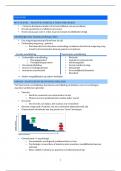
,For A-level Psychology Paper 1 on Introductory Topics in Psychology, focus on these key areas:
1. Social Influence:
o Conformity: Study Asch’s research on conformity, and types of conformity (compliance,
identification, internalization).
o Obedience: Review Milgram’s study and factors affecting obedience (authority, proximity).
o Group Behaviour: Understand Zimbardo’s Stanford Prison Experiment, social roles, the
bystander effect, and factors influencing helping behaviour.
2. Memory:
o Models of Memory: Focus on the multi-store model (Atkinson & Shiffrin) and the working
memory model (Baddeley & Hitch).
o Types of Memory: Study encoding, storage, and retrieval processes, along with research on the
capacity and duration of different memory stores.
o Eyewitness Testimony: Understand factors affecting memory accuracy (e.g., leading questions,
stress).
o Forgetting: Review interference theory and retrieval failure as explanations for forgetting.
3. Attachment:
o Stages of Attachment: Study Bowlby’s theory and Ainsworth’s Strange Situation, focusing on
attachment types (secure, insecure-avoidant, and insecure-resistant).
o Cultural Variations: Review studies like Van Ijzendoorn & Kroonenberg on cross-cultural
attachment differences.
o Bowlby’s Maternal Deprivation Hypothesis: Understand the impact of early attachment on
emotional and intellectual development.
4. Approaches in Psychology:
o Behaviourism: Study classical conditioning (Pavlov) and operant conditioning (Skinner).
o Cognitive: Review the information-processing model and memory research.
o Biological: Understand the role of genetics and brain structures in behaviour.
o Psychodynamic: Study Freud’s theory of the unconscious and defence mechanisms.
o Humanistic: Focus on Maslow’s hierarchy of needs and Rogers’ self-actualization.
5. Research Methods:
o Types of Research: Understand experiments, case studies, observational studies, and surveys.
o Sampling: Study methods like random and stratified sampling.
o Data Analysis: Focus on measures of central tendency (mean, median, mode) and standard
deviation.
o Ethics: Be familiar with ethical guidelines like informed consent and confidentiality.
IB/G/Jun24/G4004/E11 7182/1
, 2
Do not write
outside the
Section A box
Social influence
Answer all questions in this section.
0 1 Outline one ethical issue that has arisen in social influence research. Refer to one or
more social influence studies in your answer.
[4 marks]
Extra space
IB/G/Jun24/7182/1
, 3
Do not write
outside the
0 2 Charlie has just started at a new school. He has become friendly with a group of boys in box
his year group. Charlie thinks they are ‘cool’.
One day, one of the more popular boys in the group suggests they all wear their school
jumpers inside-out for a week, ‘just to see what will happen’. Charlie worries about this all
night but still goes to school the following day wearing his jumper inside-out.
Use your knowledge of conformity to explain Charlie’s behaviour.
[6 marks]
Extra space
Turn over ►
IB/G/Jun24/7182/1
Introductory Topics in Psychology.
(Merged Question Paper and Marking Scheme)
Please write clearly in block capitals.
Centre number Candidate number
Surname
Forename(s)
Candidate signat ure
I declare this is my own work.
A-level
PSYCHOLOGY
Paper 1 Introductory topics in psychology
Friday 17 May 2024 Morning Time allowed: 2 hours
Materials
For Examiner’s Use
For this paper you may use:
a calculator. Section Mark
A
Instructions
Use black ink or black ball-point pen. B
Fill in the boxes at the top of this page. C
Answer all questions. You must answer the questions in the spaces D
provided. Do not write outside the box around each page or on blank pages.
If you need extra space for your answer(s), use the lined pages at the TOTAL
end of this book. Write the question number against your answer(s).
Do all rough work in this book. Cross through any work you do not want
to be marked.
Information
The marks for questions are shown in brackets.
The maximum mark for this paper is 96.
Questions should be answered in continuous prose. You will be
assessed on your ability to:
– use good English
– organise information clearly
– use specialist vocabulary where appropriate.
,For A-level Psychology Paper 1 on Introductory Topics in Psychology, focus on these key areas:
1. Social Influence:
o Conformity: Study Asch’s research on conformity, and types of conformity (compliance,
identification, internalization).
o Obedience: Review Milgram’s study and factors affecting obedience (authority, proximity).
o Group Behaviour: Understand Zimbardo’s Stanford Prison Experiment, social roles, the
bystander effect, and factors influencing helping behaviour.
2. Memory:
o Models of Memory: Focus on the multi-store model (Atkinson & Shiffrin) and the working
memory model (Baddeley & Hitch).
o Types of Memory: Study encoding, storage, and retrieval processes, along with research on the
capacity and duration of different memory stores.
o Eyewitness Testimony: Understand factors affecting memory accuracy (e.g., leading questions,
stress).
o Forgetting: Review interference theory and retrieval failure as explanations for forgetting.
3. Attachment:
o Stages of Attachment: Study Bowlby’s theory and Ainsworth’s Strange Situation, focusing on
attachment types (secure, insecure-avoidant, and insecure-resistant).
o Cultural Variations: Review studies like Van Ijzendoorn & Kroonenberg on cross-cultural
attachment differences.
o Bowlby’s Maternal Deprivation Hypothesis: Understand the impact of early attachment on
emotional and intellectual development.
4. Approaches in Psychology:
o Behaviourism: Study classical conditioning (Pavlov) and operant conditioning (Skinner).
o Cognitive: Review the information-processing model and memory research.
o Biological: Understand the role of genetics and brain structures in behaviour.
o Psychodynamic: Study Freud’s theory of the unconscious and defence mechanisms.
o Humanistic: Focus on Maslow’s hierarchy of needs and Rogers’ self-actualization.
5. Research Methods:
o Types of Research: Understand experiments, case studies, observational studies, and surveys.
o Sampling: Study methods like random and stratified sampling.
o Data Analysis: Focus on measures of central tendency (mean, median, mode) and standard
deviation.
o Ethics: Be familiar with ethical guidelines like informed consent and confidentiality.
IB/G/Jun24/G4004/E11 7182/1
, 2
Do not write
outside the
Section A box
Social influence
Answer all questions in this section.
0 1 Outline one ethical issue that has arisen in social influence research. Refer to one or
more social influence studies in your answer.
[4 marks]
Extra space
IB/G/Jun24/7182/1
, 3
Do not write
outside the
0 2 Charlie has just started at a new school. He has become friendly with a group of boys in box
his year group. Charlie thinks they are ‘cool’.
One day, one of the more popular boys in the group suggests they all wear their school
jumpers inside-out for a week, ‘just to see what will happen’. Charlie worries about this all
night but still goes to school the following day wearing his jumper inside-out.
Use your knowledge of conformity to explain Charlie’s behaviour.
[6 marks]
Extra space
Turn over ►
IB/G/Jun24/7182/1