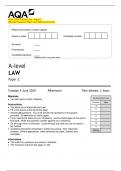
AQA_2024: A-level Further Mathematics - Paper 1
(Merged Question Paper and Marking Scheme)
Please write clearly in block capitals.
Centre number Candidate number
Surname
Forename(s)
Candidate signature
I declare this is my own work.
A-level
FURTHER MATHEMATICS
Paper 1
Wednesday 22 May 2024 Afternoon Time allowed: 2 hours
Materials For Examiner’s Use
You must have the AQA Formulae and statistical tables booklet for Question Mark
A‑ level Mathematics and A‑ level Further Mathematics.
You should have a graphical or scientific calculator that meets the
1
requirements of the specification. 2
3
Instructions 4
Use black ink or black ball‑ point pen. Pencil should only be used for drawing.
Fill in the boxes at the top of this page.
5
Answer all questions. 6
You must answer each question in the space provided for that question. 7
If you require extra space for your answer(s), use the lined pages at the end
8
of this book. Write the question number against your answer(s).
Do not write outside the box around each page or on blank pages. 9
Show all necessary working; otherwise marks for method may be lost. 10
Do all rough work in this book. Cross through any work that you do not want
11
to be marked.
12
Information 13
The marks for questions are shown in brackets. 14
The maximum mark for this paper is 100.
15
Advice 16
Unless stated otherwise, you may quote formulae, without proof, 17
from the booklet. 18
You do not necessarily need to use all the space provided.
TOTAL
,For A-Level Further Mathematics - Paper 1, focus on the following key areas:
1. Algebra:
Polynomials: Factorization, division, and roots of polynomials. Understand the remainder theorem
and factor theorem.
Equations: Solving higher-order polynomials (quadratic, cubic, quartic), and solving simultaneous
equations.
Binomial Expansion: Expand binomial expressions using binomial theorem for both positive and
negative integers.
Complex Numbers: Perform arithmetic operations on complex numbers, convert to polar form, and
apply in solving equations and geometry.
2. Calculus:
Differentiation: Differentiate functions using product rule, quotient rule, and chain rule. Apply
differentiation to find tangents, rates of change, and solve problems involving maxima and minima.
Integration: Integrate standard functions and use substitution and integration by parts for more
complex integrals. Understand definite and indefinite integrals.
Applications of Calculus: Solve real-world problems involving motion, area under curves, and related
rates.
3. Vectors:
Vector Algebra: Operations on vectors, including addition, scalar multiplication, and understanding
unit vectors.
Dot Product: Use the dot product to calculate the angle between vectors and apply in problems
involving geometry.
Cross Product: Understand and apply the cross product in 3D space to find perpendicular vectors
and areas of parallelograms.
4. Matrices:
Matrix Operations: Addition, subtraction, and multiplication of matrices. Understanding inverses and
determinants.
Solving Linear Equations: Use matrices to solve systems of linear equations, including applications
of Gaussian elimination and Cramer's rule.
Eigenvalues and Eigenvectors: Know how to find eigenvalues and eigenvectors and their
applications in solving linear systems and diagonalization.
5. Differential Equations:
First-order Differential Equations: Solve basic first-order linear and separable differential equations,
using methods like separation of variables.
Higher-order Differential Equations: Understand second-order linear differential equations and their
applications, including homogeneous and non-homogeneous cases.
6. Sequences and Series:
Arithmetic and Geometric Sequences: Recognize and work with arithmetic and geometric
sequences, find nth terms, and sums of terms.
Convergence and Divergence: Work with series, including convergence of infinite series, and
applying tests like the ratio test and root test.
G/LM/Jun24/G4006/V8 7367/1
, 2
Do not write
outside the
box
Answer all questions in the spaces provided.
1 The roots of the equation 20x3 – 16x2 – 4x + 7 = 0 are α, β and γ
Find the value of αβ + βγ + γα
Circle your answer.
[1 mark]
–4 –
1 1 4
5 5 5 5
iπ
2 The complex number z = e3
Which one of the following is a real number?
Circle your answer.
[1 mark]
z4 z5 z6 z7
G/Jun24/7367/1
, 3
Do not write
outside the
box
3 The function f is defined by
f (x) = x2 (x ℝ)
Find the mean value of f (x) between x = 0 and x = 2
Circle your answer.
[1 mark]
2 4 8 16
3 3 3 3
4 Which one of the following statements is correct?
Tick () one box.
[1 mark]
lim(x2 ln x) = 0
x 0
lim(x2 ln x) = 1
x 0
lim(x2 ln x) = 2
x 0
lim(x2 ln x) is not defined.
x 0
Turn over for the next question
Turn over U
G/Jun24/7367/1
(Merged Question Paper and Marking Scheme)
Please write clearly in block capitals.
Centre number Candidate number
Surname
Forename(s)
Candidate signature
I declare this is my own work.
A-level
FURTHER MATHEMATICS
Paper 1
Wednesday 22 May 2024 Afternoon Time allowed: 2 hours
Materials For Examiner’s Use
You must have the AQA Formulae and statistical tables booklet for Question Mark
A‑ level Mathematics and A‑ level Further Mathematics.
You should have a graphical or scientific calculator that meets the
1
requirements of the specification. 2
3
Instructions 4
Use black ink or black ball‑ point pen. Pencil should only be used for drawing.
Fill in the boxes at the top of this page.
5
Answer all questions. 6
You must answer each question in the space provided for that question. 7
If you require extra space for your answer(s), use the lined pages at the end
8
of this book. Write the question number against your answer(s).
Do not write outside the box around each page or on blank pages. 9
Show all necessary working; otherwise marks for method may be lost. 10
Do all rough work in this book. Cross through any work that you do not want
11
to be marked.
12
Information 13
The marks for questions are shown in brackets. 14
The maximum mark for this paper is 100.
15
Advice 16
Unless stated otherwise, you may quote formulae, without proof, 17
from the booklet. 18
You do not necessarily need to use all the space provided.
TOTAL
,For A-Level Further Mathematics - Paper 1, focus on the following key areas:
1. Algebra:
Polynomials: Factorization, division, and roots of polynomials. Understand the remainder theorem
and factor theorem.
Equations: Solving higher-order polynomials (quadratic, cubic, quartic), and solving simultaneous
equations.
Binomial Expansion: Expand binomial expressions using binomial theorem for both positive and
negative integers.
Complex Numbers: Perform arithmetic operations on complex numbers, convert to polar form, and
apply in solving equations and geometry.
2. Calculus:
Differentiation: Differentiate functions using product rule, quotient rule, and chain rule. Apply
differentiation to find tangents, rates of change, and solve problems involving maxima and minima.
Integration: Integrate standard functions and use substitution and integration by parts for more
complex integrals. Understand definite and indefinite integrals.
Applications of Calculus: Solve real-world problems involving motion, area under curves, and related
rates.
3. Vectors:
Vector Algebra: Operations on vectors, including addition, scalar multiplication, and understanding
unit vectors.
Dot Product: Use the dot product to calculate the angle between vectors and apply in problems
involving geometry.
Cross Product: Understand and apply the cross product in 3D space to find perpendicular vectors
and areas of parallelograms.
4. Matrices:
Matrix Operations: Addition, subtraction, and multiplication of matrices. Understanding inverses and
determinants.
Solving Linear Equations: Use matrices to solve systems of linear equations, including applications
of Gaussian elimination and Cramer's rule.
Eigenvalues and Eigenvectors: Know how to find eigenvalues and eigenvectors and their
applications in solving linear systems and diagonalization.
5. Differential Equations:
First-order Differential Equations: Solve basic first-order linear and separable differential equations,
using methods like separation of variables.
Higher-order Differential Equations: Understand second-order linear differential equations and their
applications, including homogeneous and non-homogeneous cases.
6. Sequences and Series:
Arithmetic and Geometric Sequences: Recognize and work with arithmetic and geometric
sequences, find nth terms, and sums of terms.
Convergence and Divergence: Work with series, including convergence of infinite series, and
applying tests like the ratio test and root test.
G/LM/Jun24/G4006/V8 7367/1
, 2
Do not write
outside the
box
Answer all questions in the spaces provided.
1 The roots of the equation 20x3 – 16x2 – 4x + 7 = 0 are α, β and γ
Find the value of αβ + βγ + γα
Circle your answer.
[1 mark]
–4 –
1 1 4
5 5 5 5
iπ
2 The complex number z = e3
Which one of the following is a real number?
Circle your answer.
[1 mark]
z4 z5 z6 z7
G/Jun24/7367/1
, 3
Do not write
outside the
box
3 The function f is defined by
f (x) = x2 (x ℝ)
Find the mean value of f (x) between x = 0 and x = 2
Circle your answer.
[1 mark]
2 4 8 16
3 3 3 3
4 Which one of the following statements is correct?
Tick () one box.
[1 mark]
lim(x2 ln x) = 0
x 0
lim(x2 ln x) = 1
x 0
lim(x2 ln x) = 2
x 0
lim(x2 ln x) is not defined.
x 0
Turn over for the next question
Turn over U
G/Jun24/7367/1