2
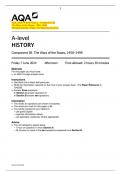
AQA_2024: A-level History - Component 2A
Royal Authority and the Angevin Kings, 1154–1216
(Merged Question Paper and Marking Scheme)
A-level
HISTORY
Component 2A Royal Authority and the Angevin Kings, 1154–1216
Friday 7 June 2024 Afternoon Time allowed: 2 hours 30 minutes
Materials
For this paper you must have:
an AQA 16-page answer book.
Instructions
Use black ink or black ball-point pen.
Write the information required on the front of your answer book. The Paper Reference is
7042/2A.
Answer three questions.
In Section A answer Question 01.
In Section B answer two questions.
Information
The marks for questions are shown in brackets.
The maximum mark for this paper is 80.
You will be marked on your ability to:
– use good English
– organise information clearly
– use specialist vocabulary where appropriate.
Advice
You are advised to spend about:
– 1 hour on Question 01 from Section A
– 45 minutes on each of the two questions answered from Section B.
IB/M/Jun24/7042/2A
, 3
Key areas:
1. Henry II’s Early Reign (1154–1171):
Accession to the Throne: Henry II inherited a vast empire, including England, Normandy, and
parts of France, and aimed to consolidate royal authority after the chaos of Stephen’s reign.
Reforms of the Legal System: Henry strengthened royal control through reforms like the
establishment of common law and itinerant justices, creating a more unified legal system across
his domains.
Conflict with Thomas Becket: The ongoing struggle between Henry II and Thomas Becket,
Archbishop of Canterbury, over the rights of the Church and royal authority escalated with Becket’s
murder in 1170. The incident damaged Henry's reputation but also reinforced royal power over the
Church.
2. The Angevin Empire (1174–1189):
Expansion and Control: Henry II sought to expand and manage his vast territories, focusing on
maintaining control over England, Normandy, and his other French holdings.
Challenges of Empire: Henry’s authority was challenged by his sons, particularly in the Revolt of
1173–1174, where his sons (supported by France and Scotland) rebelled, but Henry ultimately
quashed the rebellion and reaffirmed his power.
3. Richard I’s Reign (1189–1199):
Richard the Lionheart: Richard I spent most of his reign abroad on Crusade and in war with
France. His absence from England led to a decline in royal authority domestically.
Taxation and Resources: To fund his Crusade, Richard levied heavy taxes on England, which
caused resentment but was necessary for financing military campaigns.
French Conflict: Richard’s reign saw prolonged warfare with France, especially with King Philip II,
as Richard sought to defend and expand his territories.
4. John’s Reign (1199–1216):
Loss of French Territories: King John’s reign saw the loss of key territories in France, including
Normandy, which significantly weakened his authority and angered his barons.
Conflict with the Nobility: John’s increasing demands for money and control over the barons led to
widespread discontent and rebellion. His inability to effectively manage England’s finances or
military resources further undermined his authority.
Magna Carta (1215): The culmination of John’s misrule was the signing of the Magna Carta in
1215, a document that limited the king’s power and established important principles of law and
governance.
5. Royal Authority and Legacy:
Centralization of Power: Despite challenges, the Angevin kings strengthened the power of the
monarchy, particularly through legal reforms, though the long-term legacy was one of tension
between the crown and the barons.
Financial and Military Struggles: The financial burden of maintaining the empire and the military
challenges faced by the Angevin kings highlighted the limits of royal authority, particularly in the face
of noble opposition.
IB/M/Jun24/G4006/E4 7042/2A
IB/M/Jun24/7042/2A Turn over ►
, 4
Section A
Answer Question 01.
Source A
From the ‘History of the Dukes of Normandy and the Kings of England’ by the unknown
Flemish Chronicler, ‘Anonymous of Béthune’, early 13th century.
There was a very nasty streak in King John’s character. He was the most cruel of men.
He often humiliated the most important men in the land because he was attracted to
beautiful women, and this caused a great deal of hatred. He would never willingly tell the
truth. He did his utmost to create friction between his barons, taking great delight in
seeing this turn into hatred. In 1210 John attacked a magnate with whom he had 5
quarrelled, William de Briouse. John imprisoned William’s wife, Maud de Briouse, and
their son in Corfe castle, placing in their cell a sheaf of oats and some uncooked bacon.
He allowed them no more food than this. Ten days after, the mother was found dead,
sitting between the legs of her son. As for the son, he was also dead. The mother in her
anguish had eaten both of her son’s cheeks. William de Briouse, who was in Paris at the 10
time, died of grief shortly after he heard the news.
Source B
From a letter to Archbishop Stephen Langton from Pope Innocent III, March 1213. John
had recently offered peace terms to the Pope regarding his excommunication.
Sometimes the perversity of the wicked passes down by succession of blood from father
to son. This is clearly apparent from the fact that Henry, King of the English, for a long
time persecuted the blessed Thomas, Archbishop of Canterbury, who defended justice
and ecclesiastical liberty and was later killed by the swords of the impious King’s men.
For a long time now his son John, King of England, for the same reason has been 5
unjustly persecuting you and our beloved sons the monks of Canterbury and many
others, driving you to live pitiably in exile deprived of your entire property. We, therefore,
kindled with a zeal for ecclesiastical liberty, charge and strictly command you that, if the
King should violate the peace which has been restored between him and the English
Church by apostolic provision, neither you nor any others should anoint or crown any of 10
his heirs. This action preserves the orders of the Apostolic See.
IB/M/Jun24/7042/2A
AQA_2024: A-level History - Component 2A
Royal Authority and the Angevin Kings, 1154–1216
(Merged Question Paper and Marking Scheme)
A-level
HISTORY
Component 2A Royal Authority and the Angevin Kings, 1154–1216
Friday 7 June 2024 Afternoon Time allowed: 2 hours 30 minutes
Materials
For this paper you must have:
an AQA 16-page answer book.
Instructions
Use black ink or black ball-point pen.
Write the information required on the front of your answer book. The Paper Reference is
7042/2A.
Answer three questions.
In Section A answer Question 01.
In Section B answer two questions.
Information
The marks for questions are shown in brackets.
The maximum mark for this paper is 80.
You will be marked on your ability to:
– use good English
– organise information clearly
– use specialist vocabulary where appropriate.
Advice
You are advised to spend about:
– 1 hour on Question 01 from Section A
– 45 minutes on each of the two questions answered from Section B.
IB/M/Jun24/7042/2A
, 3
Key areas:
1. Henry II’s Early Reign (1154–1171):
Accession to the Throne: Henry II inherited a vast empire, including England, Normandy, and
parts of France, and aimed to consolidate royal authority after the chaos of Stephen’s reign.
Reforms of the Legal System: Henry strengthened royal control through reforms like the
establishment of common law and itinerant justices, creating a more unified legal system across
his domains.
Conflict with Thomas Becket: The ongoing struggle between Henry II and Thomas Becket,
Archbishop of Canterbury, over the rights of the Church and royal authority escalated with Becket’s
murder in 1170. The incident damaged Henry's reputation but also reinforced royal power over the
Church.
2. The Angevin Empire (1174–1189):
Expansion and Control: Henry II sought to expand and manage his vast territories, focusing on
maintaining control over England, Normandy, and his other French holdings.
Challenges of Empire: Henry’s authority was challenged by his sons, particularly in the Revolt of
1173–1174, where his sons (supported by France and Scotland) rebelled, but Henry ultimately
quashed the rebellion and reaffirmed his power.
3. Richard I’s Reign (1189–1199):
Richard the Lionheart: Richard I spent most of his reign abroad on Crusade and in war with
France. His absence from England led to a decline in royal authority domestically.
Taxation and Resources: To fund his Crusade, Richard levied heavy taxes on England, which
caused resentment but was necessary for financing military campaigns.
French Conflict: Richard’s reign saw prolonged warfare with France, especially with King Philip II,
as Richard sought to defend and expand his territories.
4. John’s Reign (1199–1216):
Loss of French Territories: King John’s reign saw the loss of key territories in France, including
Normandy, which significantly weakened his authority and angered his barons.
Conflict with the Nobility: John’s increasing demands for money and control over the barons led to
widespread discontent and rebellion. His inability to effectively manage England’s finances or
military resources further undermined his authority.
Magna Carta (1215): The culmination of John’s misrule was the signing of the Magna Carta in
1215, a document that limited the king’s power and established important principles of law and
governance.
5. Royal Authority and Legacy:
Centralization of Power: Despite challenges, the Angevin kings strengthened the power of the
monarchy, particularly through legal reforms, though the long-term legacy was one of tension
between the crown and the barons.
Financial and Military Struggles: The financial burden of maintaining the empire and the military
challenges faced by the Angevin kings highlighted the limits of royal authority, particularly in the face
of noble opposition.
IB/M/Jun24/G4006/E4 7042/2A
IB/M/Jun24/7042/2A Turn over ►
, 4
Section A
Answer Question 01.
Source A
From the ‘History of the Dukes of Normandy and the Kings of England’ by the unknown
Flemish Chronicler, ‘Anonymous of Béthune’, early 13th century.
There was a very nasty streak in King John’s character. He was the most cruel of men.
He often humiliated the most important men in the land because he was attracted to
beautiful women, and this caused a great deal of hatred. He would never willingly tell the
truth. He did his utmost to create friction between his barons, taking great delight in
seeing this turn into hatred. In 1210 John attacked a magnate with whom he had 5
quarrelled, William de Briouse. John imprisoned William’s wife, Maud de Briouse, and
their son in Corfe castle, placing in their cell a sheaf of oats and some uncooked bacon.
He allowed them no more food than this. Ten days after, the mother was found dead,
sitting between the legs of her son. As for the son, he was also dead. The mother in her
anguish had eaten both of her son’s cheeks. William de Briouse, who was in Paris at the 10
time, died of grief shortly after he heard the news.
Source B
From a letter to Archbishop Stephen Langton from Pope Innocent III, March 1213. John
had recently offered peace terms to the Pope regarding his excommunication.
Sometimes the perversity of the wicked passes down by succession of blood from father
to son. This is clearly apparent from the fact that Henry, King of the English, for a long
time persecuted the blessed Thomas, Archbishop of Canterbury, who defended justice
and ecclesiastical liberty and was later killed by the swords of the impious King’s men.
For a long time now his son John, King of England, for the same reason has been 5
unjustly persecuting you and our beloved sons the monks of Canterbury and many
others, driving you to live pitiably in exile deprived of your entire property. We, therefore,
kindled with a zeal for ecclesiastical liberty, charge and strictly command you that, if the
King should violate the peace which has been restored between him and the English
Church by apostolic provision, neither you nor any others should anoint or crown any of 10
his heirs. This action preserves the orders of the Apostolic See.
IB/M/Jun24/7042/2A