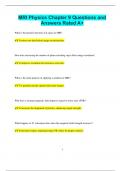
MRI Physics Chapter 9 Questions and
Answers Rated A+
What is the primary function of k-space in MRI?
✔✔ It stores raw data before image reconstruction.
How does increasing the number of phase-encoding steps affect image resolution?
✔✔ It improves resolution but increases scan time.
What is the main purpose of applying a gradient in MRI?
✔✔ To spatially encode signals and create images.
Why does a stronger magnetic field improve signal-to-noise ratio (SNR)?
✔✔ It increases the alignment of protons, enhancing signal strength.
What happens to T1 relaxation time when the magnetic field strength increases?
✔✔ It becomes longer, requiring longer TR values for proper contrast.
1
, Why is T2-weighted imaging useful for detecting pathology?
✔✔ It highlights fluid and edema, making abnormalities more visible.
What is the purpose of the Fourier transform in MRI?
✔✔ It converts raw data from k-space into an image.
How does decreasing slice thickness affect spatial resolution?
✔✔ It improves resolution but may reduce signal strength.
What is the relationship between voxel size and image detail?
✔✔ Smaller voxels improve detail but require longer scan times.
Why is gradient echo imaging more sensitive to magnetic field inhomogeneities?
✔✔ It does not use a 180-degree refocusing pulse, making it more susceptible to artifacts.
How does increasing the echo time (TE) affect T2-weighted images?
✔✔ It enhances contrast between tissues with different T2 relaxation times.
2
Answers Rated A+
What is the primary function of k-space in MRI?
✔✔ It stores raw data before image reconstruction.
How does increasing the number of phase-encoding steps affect image resolution?
✔✔ It improves resolution but increases scan time.
What is the main purpose of applying a gradient in MRI?
✔✔ To spatially encode signals and create images.
Why does a stronger magnetic field improve signal-to-noise ratio (SNR)?
✔✔ It increases the alignment of protons, enhancing signal strength.
What happens to T1 relaxation time when the magnetic field strength increases?
✔✔ It becomes longer, requiring longer TR values for proper contrast.
1
, Why is T2-weighted imaging useful for detecting pathology?
✔✔ It highlights fluid and edema, making abnormalities more visible.
What is the purpose of the Fourier transform in MRI?
✔✔ It converts raw data from k-space into an image.
How does decreasing slice thickness affect spatial resolution?
✔✔ It improves resolution but may reduce signal strength.
What is the relationship between voxel size and image detail?
✔✔ Smaller voxels improve detail but require longer scan times.
Why is gradient echo imaging more sensitive to magnetic field inhomogeneities?
✔✔ It does not use a 180-degree refocusing pulse, making it more susceptible to artifacts.
How does increasing the echo time (TE) affect T2-weighted images?
✔✔ It enhances contrast between tissues with different T2 relaxation times.
2