RM4 LECTURE 1: ANOVA and ANCOVA
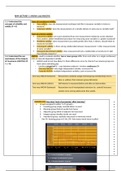
1.1: Understand the Types of translational validity:
concepts of reliability and Face validity= does the measurement technique look like it measures variable it claims to
validity (P + R) measure?
Construct validity= does the measurement of a variable behave in same way as variable itself?
Types of criterion validity:
Concurrent validity= are scores obtained from new measurement related to scores obtained
from another, better-established procedure for measuring same variable (i.e. golden standard)?
Predictive validity= does measurement accurately predict bhvr that, in theory, should relate to
measured variable?
Convergent validity= is there strong relationship between measurement + other measurements
of same variable?
Divergent/discriminant validity= does measurement lack a relationship w/constructs it’s not
theoretically related to?
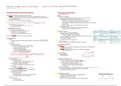
1.4: Understand the use ANOVA= used to evaluate whether two or more groups differ from each other on a single continuous)
(and abuse) of the Analysis ratio or interval) dependent variable
of Covariance (ANCOVA) (P ANOVA used to test how likely it is these differences occur by chance if we assume groups are
+ L + R) from same underlying pop
- Involves categorical IV – uses between-subjects + involves continuous DV
- One-way ANOVA= only single independent variable, w/several lvls
- Factorial ANOVA= multiple independent variables, each w/several lvls
One-way ANOVA (between) Researchers randomly assign minimal group membership (red vs.
blue vs. yellow), then measure group behaviour.
One-way ANOVA (within) Self-esteem is measured before and after an intervention.
Two-way ANOVA (between) Researchers test if manipulated ostracism (vs. control) increases
anxiety more among adolescents than adults.
EXAMPLE RQ: How does ‘level of processing’ affect learning?
50 ppts assigned to either 1 of 5 groups—
1. Counting group simply counted letters in word simply counted letters in word
2. Rhyming group simply counted letters in word think of words that rhyme
3. Adjective group simply counted letters in word think of adjective for that word
4. Imagery group simply counted letters in word visualize words you read
5. Intentional group simply counted letters in word explicitly instructed to memorize words
- One IV= learning group w/5 lvls, DV= how many words were recalled
, The greater the between groups differences the less likely it is that this difference is caused
by chance
The greater the within group differences the more likely it is that any between group
differences are caused by chance
Hence, we need to make a distinction between differences within and between each of the
groups:
- MSerror—i.e. MSwithin
- MSgroup—i.e. MSbetween
How to calculate ‘MS’ (mean square) for one-way ANOVA:
1. Compute total sum of squares (SS)
SStotal= ∑ (Xij- X..) 2
- SS total= (all differences between groups + individual’s deviations from average – all
differences) 2
- Compute difference between ppts individual score + overall group average
2. Determine sum of squares that can be attributed to individuals
SSERROR= SSTOTAL – SSGROUP
- Compute for each group the difference w/overall mean + take square of that value
- After doing this for all groups add all squared values together X amount of ppts in each
group
3. Transform ‘sum of squares’ into ‘mean square’ (MS) divide SS values by df associated
w/them—done in order to correct for when SS become larger when sample sizes + amount of
groups increases
- For SSgroup df= total no of groups (k)-1
- For SSerror df= total ppts-1 i.e. k(n-1)
- Then calculate MSERROR and MSGROUP
- MSERROR= SSERROR ÷ df error
- MSGROUP= SSGROUP ÷ df group
4. Make comparison between MS error and MS group to see how large the differences are
relative to each other
Larger the F value, the smaller the P value
5. Look up the p-value linked w/ratio by inspecting F-distribution table to check if groups differ
significantly
Assumptions of ANOVA:
Homogeneity of variance= i.e. homoscedasticity implies pop variances underlying groups
should be same distributions between groups are roughly same (SD are same + width of
distribution)
- Levene’s Test reveals if there are significant differences between variances of each condition
Normality= i.e. scores are normally distributed
Independence of error terms= i.e. ppts scores are not influenced/independent from each
other if scores are not independent from each other (e.g. having similar attitudes to each
other)—have to conduct BS design
1.5: Be able to perform an ANCOVA=
ANCOVA in SPSS (P + L + R) - Statistical control can be used when comparing groups (co-variance i.e. sm that relates to
DV that is difficult to experimentally manipulate)
- When conducting experiments, researcher can account for factors by:
- Manipulating them (e.g. comparing treatment vs. placebo)
- Experimentally controlling them (e.g. random assignment)
- However, sometimes this does not work; often for quasi-experimental + correlational designs
- Covariate= continuous variable we want to control for e.g. age, SES, IQ, clinical history
- By controlling for such variables, we can examine whether differences between groups
emerge after controlling for these variables
1.1: Understand the Types of translational validity:
concepts of reliability and Face validity= does the measurement technique look like it measures variable it claims to
validity (P + R) measure?
Construct validity= does the measurement of a variable behave in same way as variable itself?
Types of criterion validity:
Concurrent validity= are scores obtained from new measurement related to scores obtained
from another, better-established procedure for measuring same variable (i.e. golden standard)?
Predictive validity= does measurement accurately predict bhvr that, in theory, should relate to
measured variable?
Convergent validity= is there strong relationship between measurement + other measurements
of same variable?
Divergent/discriminant validity= does measurement lack a relationship w/constructs it’s not
theoretically related to?
1.4: Understand the use ANOVA= used to evaluate whether two or more groups differ from each other on a single continuous)
(and abuse) of the Analysis ratio or interval) dependent variable
of Covariance (ANCOVA) (P ANOVA used to test how likely it is these differences occur by chance if we assume groups are
+ L + R) from same underlying pop
- Involves categorical IV – uses between-subjects + involves continuous DV
- One-way ANOVA= only single independent variable, w/several lvls
- Factorial ANOVA= multiple independent variables, each w/several lvls
One-way ANOVA (between) Researchers randomly assign minimal group membership (red vs.
blue vs. yellow), then measure group behaviour.
One-way ANOVA (within) Self-esteem is measured before and after an intervention.
Two-way ANOVA (between) Researchers test if manipulated ostracism (vs. control) increases
anxiety more among adolescents than adults.
EXAMPLE RQ: How does ‘level of processing’ affect learning?
50 ppts assigned to either 1 of 5 groups—
1. Counting group simply counted letters in word simply counted letters in word
2. Rhyming group simply counted letters in word think of words that rhyme
3. Adjective group simply counted letters in word think of adjective for that word
4. Imagery group simply counted letters in word visualize words you read
5. Intentional group simply counted letters in word explicitly instructed to memorize words
- One IV= learning group w/5 lvls, DV= how many words were recalled
, The greater the between groups differences the less likely it is that this difference is caused
by chance
The greater the within group differences the more likely it is that any between group
differences are caused by chance
Hence, we need to make a distinction between differences within and between each of the
groups:
- MSerror—i.e. MSwithin
- MSgroup—i.e. MSbetween
How to calculate ‘MS’ (mean square) for one-way ANOVA:
1. Compute total sum of squares (SS)
SStotal= ∑ (Xij- X..) 2
- SS total= (all differences between groups + individual’s deviations from average – all
differences) 2
- Compute difference between ppts individual score + overall group average
2. Determine sum of squares that can be attributed to individuals
SSERROR= SSTOTAL – SSGROUP
- Compute for each group the difference w/overall mean + take square of that value
- After doing this for all groups add all squared values together X amount of ppts in each
group
3. Transform ‘sum of squares’ into ‘mean square’ (MS) divide SS values by df associated
w/them—done in order to correct for when SS become larger when sample sizes + amount of
groups increases
- For SSgroup df= total no of groups (k)-1
- For SSerror df= total ppts-1 i.e. k(n-1)
- Then calculate MSERROR and MSGROUP
- MSERROR= SSERROR ÷ df error
- MSGROUP= SSGROUP ÷ df group
4. Make comparison between MS error and MS group to see how large the differences are
relative to each other
Larger the F value, the smaller the P value
5. Look up the p-value linked w/ratio by inspecting F-distribution table to check if groups differ
significantly
Assumptions of ANOVA:
Homogeneity of variance= i.e. homoscedasticity implies pop variances underlying groups
should be same distributions between groups are roughly same (SD are same + width of
distribution)
- Levene’s Test reveals if there are significant differences between variances of each condition
Normality= i.e. scores are normally distributed
Independence of error terms= i.e. ppts scores are not influenced/independent from each
other if scores are not independent from each other (e.g. having similar attitudes to each
other)—have to conduct BS design
1.5: Be able to perform an ANCOVA=
ANCOVA in SPSS (P + L + R) - Statistical control can be used when comparing groups (co-variance i.e. sm that relates to
DV that is difficult to experimentally manipulate)
- When conducting experiments, researcher can account for factors by:
- Manipulating them (e.g. comparing treatment vs. placebo)
- Experimentally controlling them (e.g. random assignment)
- However, sometimes this does not work; often for quasi-experimental + correlational designs
- Covariate= continuous variable we want to control for e.g. age, SES, IQ, clinical history
- By controlling for such variables, we can examine whether differences between groups
emerge after controlling for these variables