
Nucleotides and Nucleic Acids
a) Structure of a nucleotide (monomer from which nucleic acids are made)
Nucleic acids – polymers that are made up of many repeating units called nucleotides. Provide the
information to build an organism
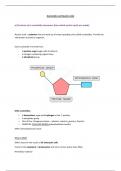
Each nucleotide is formed from:
- A pentose sugar (sugar with 5 carbons)
- A nitrogen-containing organic base
- A phosphate group
DNA nucleotides:
o A deoxyribose sugar with hydrogen at the 2’ position
o A phosphate group
o One of four nitrogenous bases – adenine, cytosine, guanine, thymine
o JOINED BY COVALENT BONDS (phosphodiester bonds)
DNA is Deoxyribonucleic Acid
What is DNA?
DNA is found in the nuclei of all eukaryotic cells
Found in the cytoplasm of prokaryotes and some viruses (some have RNA)
Hereditary material
,Carries coded instructions used in the development and functioning of all known living organisms
DNA is a polymer – made up of many repeating nucleotide units
A molecule of DNA consists of two polynucleotide strands
Phosphate group has a negative charge → therefore DNA has an overall negative charge
RNA nucleotides:
o A ribose sugar with a hydroxyl (OH) group at the 2’ position
o A phosphate group
o One of four nitrogenous bases – adenine, cytosine, guanine, uracil
RNA is Ribonucleic Acid
The presence of the 2’ hydroxyl group makes RNA more susceptible to hydrolysis
▪ This is why DNA is the storage molecule and RNA is the transport molecule with a shorter
molecular lifespan
RNA is a very unstable molecule as it has exposed bases
, Purines and pyrimidines:
Role of nucleotides:
Form the monomers of nucleic acids – RNA and DNA
a) Structure of a nucleotide (monomer from which nucleic acids are made)
Nucleic acids – polymers that are made up of many repeating units called nucleotides. Provide the
information to build an organism
Each nucleotide is formed from:
- A pentose sugar (sugar with 5 carbons)
- A nitrogen-containing organic base
- A phosphate group
DNA nucleotides:
o A deoxyribose sugar with hydrogen at the 2’ position
o A phosphate group
o One of four nitrogenous bases – adenine, cytosine, guanine, thymine
o JOINED BY COVALENT BONDS (phosphodiester bonds)
DNA is Deoxyribonucleic Acid
What is DNA?
DNA is found in the nuclei of all eukaryotic cells
Found in the cytoplasm of prokaryotes and some viruses (some have RNA)
Hereditary material
,Carries coded instructions used in the development and functioning of all known living organisms
DNA is a polymer – made up of many repeating nucleotide units
A molecule of DNA consists of two polynucleotide strands
Phosphate group has a negative charge → therefore DNA has an overall negative charge
RNA nucleotides:
o A ribose sugar with a hydroxyl (OH) group at the 2’ position
o A phosphate group
o One of four nitrogenous bases – adenine, cytosine, guanine, uracil
RNA is Ribonucleic Acid
The presence of the 2’ hydroxyl group makes RNA more susceptible to hydrolysis
▪ This is why DNA is the storage molecule and RNA is the transport molecule with a shorter
molecular lifespan
RNA is a very unstable molecule as it has exposed bases
, Purines and pyrimidines:
Role of nucleotides:
Form the monomers of nucleic acids – RNA and DNA


