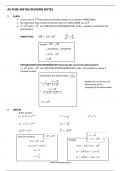
AS PURE MATHS REVISION NOTES
1 SURDS
• A root such as √3 that cannot be written exactly as a fraction is IRRATIONAL
• An expression that involves irrational roots is in SURD FORM e.g. 2√3
• 3 + √2 and 3 - √2 are CONJUGATE/COMPLEMENTARY surds – needed to rationalise the
denominator
𝑎𝑎 √𝑎𝑎
SIMPLIFYING √𝑎𝑎𝑎𝑎 = √𝑎𝑎 × √𝑏𝑏 �𝑏𝑏 = √𝑏𝑏
Simplify √75 − √12
= √5 × 5 × 3 − √2 × 2 × 3
= 5√3 − 2√3
= 3√3
RATIONALISING THE DENOMINATOR (removing the surd in the denominator)
a + √𝑏𝑏 and a - √𝑏𝑏 are CONJUGATE/COMPLEMENTARY surds – the product is always a
rational number
2
Rationalise the denominator 2 −√3
2 2 + √3 Multiply the numerator and
= ×
2 − √3 2 + √3 denominator by the
conjugate of the denominator
4 + 2√3
=
4 + 2√3 − 2√3 − 3
= 4 + 2√3
2 INDICES
Rules to learn
1
𝑥𝑥 𝑎𝑎 × 𝑥𝑥 𝑏𝑏 = 𝑥𝑥 𝑎𝑎+𝑏𝑏 𝑥𝑥 −𝑎𝑎 = 𝑥𝑥 𝑎𝑎 𝑥𝑥 0 = 1
1
𝑛𝑛
𝑥𝑥 𝑎𝑎 ÷ 𝑥𝑥 𝑏𝑏 = 𝑥𝑥 𝑎𝑎−𝑏𝑏 𝑥𝑥 𝑛𝑛 = √𝑥𝑥
𝑚𝑚
𝑛𝑛
(𝑥𝑥 𝑎𝑎 )𝑏𝑏 = 𝑥𝑥 𝑎𝑎𝑎𝑎 𝑥𝑥 𝑛𝑛 = √𝑥𝑥 𝑚𝑚
3
25x = (52)x (𝑥𝑥 − 𝑦𝑦)2
Solve the equation 1
= (𝑥𝑥 − 𝑦𝑦)2 (𝑥𝑥 − 𝑦𝑦)
Simplify
32𝑥𝑥 × 25𝑥𝑥 = 15
3 1
(3 × 5)2𝑥𝑥 = (15)1 2𝑥𝑥(𝑥𝑥 − 𝑦𝑦)2 + 3(𝑥𝑥 − 𝑦𝑦)2
2𝑥𝑥 = 1 1
(𝑥𝑥 − 𝑦𝑦)2 (2𝑥𝑥(𝑥𝑥 − 𝑦𝑦) + 3)
1 1
𝑥𝑥 =
2 (𝑥𝑥 − 𝑦𝑦)2 (2𝑥𝑥 2 − 2𝑥𝑥𝑥𝑥 + 3)
www.mathsbox.org.uk
, 3 QUADRATIC EQUATIONS AND GRAPHS
Factorising identifying the roots of the equation ax2 + bc + c = 0
• Look out for the difference of 2 squares x2 – a2= (x - a)(x + a)
• Look out for the perfect square x2 + 2ax + a2 = (x + a)2 or x2 – 2ax + a2 = (x -a)2
• Look out for equations which can be transformed into quadratic equations
Solve 𝑥𝑥 + 1 −
12
=0 Solve 6𝑥𝑥 4 − 7𝑥𝑥 2 + 2 = 0
𝑥𝑥
Let z = x2
𝑥𝑥 2 + 𝑥𝑥 − 12 = 0
(𝑥𝑥 + 4)(𝑥𝑥 − 3) = 0 6𝑧𝑧 2 − 7𝑧𝑧 + 2 = 0
(2𝑧𝑧 − 1)(3𝑧𝑧 − 2) = 0
x = 3, x = -4
1 2
𝑧𝑧 = 𝑧𝑧 =
2 3
1 2
𝑥𝑥 = ±� 𝑥𝑥 = ±�
2 3
Completing the square - Identifying the vertex and line of symmetry
In completed square form
y = (x + a)2 + b the vertex is (-a, b)
the equation of the line of symmetry is x = -a
y = (x - 3)2 - 4
Line of symmetry Sketch the graph of
x=3 y = 4x – x2 – 1 Line of Symmetry
y = - (x2 - 4x) – 1 x = -a
y = - ((x – 2)2 – 4) – 1
Vertex (2,3)
y = - (x-2)2 + 3
Vertex (3,-4)
Quadratic formula
−𝑏𝑏±√𝑏𝑏2 −4𝑎𝑎𝑎𝑎
𝑥𝑥 = for solving ax2 + bx + c = 0
2𝑎𝑎
The DISCRIMINANT b2 – 4ac can be used to identify the number of solutions
b2 – 4ac > 0 there are 2 real and distinct roots (the graphs crosses the x- axis in 2 places)
b2 – 4ac = 0 the is a single repeated root (the x-axis is a tangent to the graph)
b2 – 4ac < 0 there are no 2 real roots (the graph does not touch or cross the x-axis)
www.mathsbox.org.uk
1 SURDS
• A root such as √3 that cannot be written exactly as a fraction is IRRATIONAL
• An expression that involves irrational roots is in SURD FORM e.g. 2√3
• 3 + √2 and 3 - √2 are CONJUGATE/COMPLEMENTARY surds – needed to rationalise the
denominator
𝑎𝑎 √𝑎𝑎
SIMPLIFYING √𝑎𝑎𝑎𝑎 = √𝑎𝑎 × √𝑏𝑏 �𝑏𝑏 = √𝑏𝑏
Simplify √75 − √12
= √5 × 5 × 3 − √2 × 2 × 3
= 5√3 − 2√3
= 3√3
RATIONALISING THE DENOMINATOR (removing the surd in the denominator)
a + √𝑏𝑏 and a - √𝑏𝑏 are CONJUGATE/COMPLEMENTARY surds – the product is always a
rational number
2
Rationalise the denominator 2 −√3
2 2 + √3 Multiply the numerator and
= ×
2 − √3 2 + √3 denominator by the
conjugate of the denominator
4 + 2√3
=
4 + 2√3 − 2√3 − 3
= 4 + 2√3
2 INDICES
Rules to learn
1
𝑥𝑥 𝑎𝑎 × 𝑥𝑥 𝑏𝑏 = 𝑥𝑥 𝑎𝑎+𝑏𝑏 𝑥𝑥 −𝑎𝑎 = 𝑥𝑥 𝑎𝑎 𝑥𝑥 0 = 1
1
𝑛𝑛
𝑥𝑥 𝑎𝑎 ÷ 𝑥𝑥 𝑏𝑏 = 𝑥𝑥 𝑎𝑎−𝑏𝑏 𝑥𝑥 𝑛𝑛 = √𝑥𝑥
𝑚𝑚
𝑛𝑛
(𝑥𝑥 𝑎𝑎 )𝑏𝑏 = 𝑥𝑥 𝑎𝑎𝑎𝑎 𝑥𝑥 𝑛𝑛 = √𝑥𝑥 𝑚𝑚
3
25x = (52)x (𝑥𝑥 − 𝑦𝑦)2
Solve the equation 1
= (𝑥𝑥 − 𝑦𝑦)2 (𝑥𝑥 − 𝑦𝑦)
Simplify
32𝑥𝑥 × 25𝑥𝑥 = 15
3 1
(3 × 5)2𝑥𝑥 = (15)1 2𝑥𝑥(𝑥𝑥 − 𝑦𝑦)2 + 3(𝑥𝑥 − 𝑦𝑦)2
2𝑥𝑥 = 1 1
(𝑥𝑥 − 𝑦𝑦)2 (2𝑥𝑥(𝑥𝑥 − 𝑦𝑦) + 3)
1 1
𝑥𝑥 =
2 (𝑥𝑥 − 𝑦𝑦)2 (2𝑥𝑥 2 − 2𝑥𝑥𝑥𝑥 + 3)
www.mathsbox.org.uk
, 3 QUADRATIC EQUATIONS AND GRAPHS
Factorising identifying the roots of the equation ax2 + bc + c = 0
• Look out for the difference of 2 squares x2 – a2= (x - a)(x + a)
• Look out for the perfect square x2 + 2ax + a2 = (x + a)2 or x2 – 2ax + a2 = (x -a)2
• Look out for equations which can be transformed into quadratic equations
Solve 𝑥𝑥 + 1 −
12
=0 Solve 6𝑥𝑥 4 − 7𝑥𝑥 2 + 2 = 0
𝑥𝑥
Let z = x2
𝑥𝑥 2 + 𝑥𝑥 − 12 = 0
(𝑥𝑥 + 4)(𝑥𝑥 − 3) = 0 6𝑧𝑧 2 − 7𝑧𝑧 + 2 = 0
(2𝑧𝑧 − 1)(3𝑧𝑧 − 2) = 0
x = 3, x = -4
1 2
𝑧𝑧 = 𝑧𝑧 =
2 3
1 2
𝑥𝑥 = ±� 𝑥𝑥 = ±�
2 3
Completing the square - Identifying the vertex and line of symmetry
In completed square form
y = (x + a)2 + b the vertex is (-a, b)
the equation of the line of symmetry is x = -a
y = (x - 3)2 - 4
Line of symmetry Sketch the graph of
x=3 y = 4x – x2 – 1 Line of Symmetry
y = - (x2 - 4x) – 1 x = -a
y = - ((x – 2)2 – 4) – 1
Vertex (2,3)
y = - (x-2)2 + 3
Vertex (3,-4)
Quadratic formula
−𝑏𝑏±√𝑏𝑏2 −4𝑎𝑎𝑎𝑎
𝑥𝑥 = for solving ax2 + bx + c = 0
2𝑎𝑎
The DISCRIMINANT b2 – 4ac can be used to identify the number of solutions
b2 – 4ac > 0 there are 2 real and distinct roots (the graphs crosses the x- axis in 2 places)
b2 – 4ac = 0 the is a single repeated root (the x-axis is a tangent to the graph)
b2 – 4ac < 0 there are no 2 real roots (the graph does not touch or cross the x-axis)
www.mathsbox.org.uk