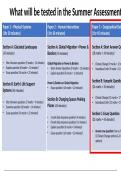
What will be tested in the Summer Assessment
Paper 1 – Physical Systems Paper 2 – Human Interactions Paper 3 – Geographical Deb
(1hr 30 minutes) (1hr 30 minutes) (1hr 45 minutes)
Section A: Glaciated Landscapes Section A: Global Migration + Power & Section A: Short Answer Qu
(45 minutes) Borders(45 minutes) (18 marks = 24 minutes)
• Short Answer questions (9 marks = 12 minutes) Global Migration or Power & Borders • Climate Change (9 marks = 12 m
• Explain question (8 marks = 11 minutes) • Short Answer Questions (9 marks = 12 minutes) • Hazardous Earth (9 marks = 12 m
• Essay question (16 marks = 22 minutes) • Explain question (8 marks = 11 minutes)
Power & Borders or Global Migration Section B: Synoptic Questio
Section B: Earth’s Life Support (24 marks = 34 minutes)
• Essay question (16 marks = 22 minutes)
Systems (45 minutes)
Section B: Changing Spaces Making • Climate Change (12 marks = 17 m
• Short Answer questions (7 marks = 9 minutes) • Hazardous Earth (12 marks = 17
• Examine question (10 marks = 14 minutes) Places (45 minutes)
• Essay question (16 marks = 22 minutes) Section C: Essay Question
• 3 mark data response question (4 minutes)
(33 marks = 45 minutes)
• 8 mark data response question (11 minutes)
• Explain question (6 marks = 8 minutes)
• Essay question (16 marks = 22 minutes) • Answer one question from a ch
(2 Climate Change options & 2 H
options)
, What will be tested on Climate Change?
Paper 3 – Geographical Debates (2hrs 30 Climate Change
minutes) • How and why has climate changed in the geological past?
• Climate Proxies (ice cores, tree rings, fossils, marine + lake sediments)
• Past climate (100mya, 35mya, Quaternary, Holocene)
• Climate Change • Natural Forcing (Milankovitch cycles, plate tectonics, solar output, GHGs)
(54 marks = 1hr 15 minutes) • How and why has the era of industrialisation affected global climate?
• Evidence of warming (temperatures, melting ice, rising sea level, water vapour
• The enhanced greenhouse effect
• Short Answer questions (9 marks = 12 minutes)
• Case Studies: UK (AC) & China (EDC): GHG contributions over time
• Synoptic question (12 marks = 17 minutes)
• Essay question (33 marks = 22 minutes) • Why is there a debate over climate change?
• Historical background to debate and how it has evolved over time
• Role and possible bias of media and different interest groups
• In what ways can humans respond to climate change?
• IPCC emissions scenarios; importance of positive + negative feedback
• Vulnerability of people + environment to climate change
• Impacts of climate change (ecosystem change, extreme weather, disease)
• Mitigation strategies (energy efficiency + conservation, low carbon energy, car
and storage, afforestation, geoengineering)
• Adaptation strategies (retreat, accommodate, protect)
• Case Studies: Bangladesh (LIDC) & Australia (AC): mitigation + adaptation
• Can an international response to climate change ever work?
• Role of IPCC
• International directives: Kyoto Protocol (1997), Paris Agreement (2015)
• Carbon trading and Carbon Credits (EU Emissions Trading Scheme)
• Case Studies: National (Denmark) & Sub-national (California) policies
Paper 1 – Physical Systems Paper 2 – Human Interactions Paper 3 – Geographical Deb
(1hr 30 minutes) (1hr 30 minutes) (1hr 45 minutes)
Section A: Glaciated Landscapes Section A: Global Migration + Power & Section A: Short Answer Qu
(45 minutes) Borders(45 minutes) (18 marks = 24 minutes)
• Short Answer questions (9 marks = 12 minutes) Global Migration or Power & Borders • Climate Change (9 marks = 12 m
• Explain question (8 marks = 11 minutes) • Short Answer Questions (9 marks = 12 minutes) • Hazardous Earth (9 marks = 12 m
• Essay question (16 marks = 22 minutes) • Explain question (8 marks = 11 minutes)
Power & Borders or Global Migration Section B: Synoptic Questio
Section B: Earth’s Life Support (24 marks = 34 minutes)
• Essay question (16 marks = 22 minutes)
Systems (45 minutes)
Section B: Changing Spaces Making • Climate Change (12 marks = 17 m
• Short Answer questions (7 marks = 9 minutes) • Hazardous Earth (12 marks = 17
• Examine question (10 marks = 14 minutes) Places (45 minutes)
• Essay question (16 marks = 22 minutes) Section C: Essay Question
• 3 mark data response question (4 minutes)
(33 marks = 45 minutes)
• 8 mark data response question (11 minutes)
• Explain question (6 marks = 8 minutes)
• Essay question (16 marks = 22 minutes) • Answer one question from a ch
(2 Climate Change options & 2 H
options)
, What will be tested on Climate Change?
Paper 3 – Geographical Debates (2hrs 30 Climate Change
minutes) • How and why has climate changed in the geological past?
• Climate Proxies (ice cores, tree rings, fossils, marine + lake sediments)
• Past climate (100mya, 35mya, Quaternary, Holocene)
• Climate Change • Natural Forcing (Milankovitch cycles, plate tectonics, solar output, GHGs)
(54 marks = 1hr 15 minutes) • How and why has the era of industrialisation affected global climate?
• Evidence of warming (temperatures, melting ice, rising sea level, water vapour
• The enhanced greenhouse effect
• Short Answer questions (9 marks = 12 minutes)
• Case Studies: UK (AC) & China (EDC): GHG contributions over time
• Synoptic question (12 marks = 17 minutes)
• Essay question (33 marks = 22 minutes) • Why is there a debate over climate change?
• Historical background to debate and how it has evolved over time
• Role and possible bias of media and different interest groups
• In what ways can humans respond to climate change?
• IPCC emissions scenarios; importance of positive + negative feedback
• Vulnerability of people + environment to climate change
• Impacts of climate change (ecosystem change, extreme weather, disease)
• Mitigation strategies (energy efficiency + conservation, low carbon energy, car
and storage, afforestation, geoengineering)
• Adaptation strategies (retreat, accommodate, protect)
• Case Studies: Bangladesh (LIDC) & Australia (AC): mitigation + adaptation
• Can an international response to climate change ever work?
• Role of IPCC
• International directives: Kyoto Protocol (1997), Paris Agreement (2015)
• Carbon trading and Carbon Credits (EU Emissions Trading Scheme)
• Case Studies: National (Denmark) & Sub-national (California) policies