
6/14/14%
202-NYB-05
Chapter 15
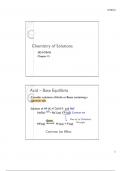
Consider solutions of Acids or Bases containing a
common salt:
Solution of HF (Ka=7.2x10⁻⁴) and NaF
HO
NaF(s) 2 Na+(aq) + F-(aq) Common Ion
Due to Le Châtelier’s
Principle
HF(aq) H+(aq) + F-(aq)
Common Ion Effect
2
1%
, 6/14/14%
HA A
if add It
Calculate [H+] and the % dissociation of HF in a
solution containing 1.3 M HF (Ka=7.2x10⁻⁴) and 2.0 M ifaddOlt
NaF.
Major species in solution are: Na+, F-, HF, H2O
Set up an ICE table HF(aq) H+(aq) + F-(aq) B BH
[Initial] 1.3 M 0M 2.0 M
Pon
[Change] -x +x +x H
[Equil.] 1.3-x xM 2.0+x M
Ka =
[H+][F-] (2.0+x)x
= = 7.2x10⁻⁴
[HF] 1.3-x
3
HF(aq) H+(aq) + F-(aq)
[Initial] 1.3 M 0M 2.0 M
[Change] -x +x +x
[Equil.] 1.3-x xM 2.0+x M
Assume [H+][F-] (2.0+x)x
Ka = = = 7.2x10⁻⁴ Check
2.0+x=2.0 M [HF] 1.3-x
assumption< 5%
1.3-x=1.3 M
x = 4.7x10⁻⁴ M Common ion effect reduces the
[H+] = 4.7x10⁻⁴ M % dissociation.
pH = -log4.7x10-4 M = 3.33
[H+] 4.7x10⁻⁴
% dissoc. = x100% = x100% = 0.036%
[HF] 1.3 4
2%
, 6/14/14%
Buffers:
A buffered solution resists a change in pH.
5
Buffers are solutions that resist change in pH
when acids or bases are added
Buffers usually contain:
1. A weak acid and its salt (CH3COOH/CH3COONa)
itsconjugate
or
2. A weak base and its salt (NH3/NH4Cl)
Buffers are an important application of solutions containing a
common ion
6
3%
, 6/14/14%
Consider a buffer containing a weak acid & its salt.
We can adjust the buffer pH by adjusting the ratios of
the weak acid and the salt:
0.50 M HC2H3O2 (Ka = 1.8x10⁻⁵) and 0.50 M NaC2H3O2. What is the
pH?
Set up an ICE table
HC2H3O2(aq) H+(aq) + C2H3O2-(aq)
[Initial] 0.50 M 0M 0.50 M
[Change] -x +x +x
[Equil.] 0.50-x xM 0.50+x M
[H+][C2H3O2-] (0.50+x)x
Ka = = = 1.8x10⁻⁵
[HC2H3O2] 0.50-x 7
HC2H3O2(aq) H+(aq) + C2H3O2-(aq)
[Initial] 0.50 M 0M 0.50 M
[Change] -x +x +x
[Equil.] 0.50-x xM 0.50+x M
Assume [H+][C2H3O2-] (0.50+x)x
0.50+x=0.50 M Ka = [HC H O ] = 0.50-x = 1.8x10⁻⁵
2 3 2
0.50-x=0.50 M Check
x = 1.8x10⁻⁵ M assumption< 5%
[H+] = 1.8x10⁻⁵ M
pH = -log1.8x10-5 M = 4.74
What happens if 0.010 mol of solid NaOH is added to 1.0L of
this solution?
8
4%
202-NYB-05
Chapter 15
Consider solutions of Acids or Bases containing a
common salt:
Solution of HF (Ka=7.2x10⁻⁴) and NaF
HO
NaF(s) 2 Na+(aq) + F-(aq) Common Ion
Due to Le Châtelier’s
Principle
HF(aq) H+(aq) + F-(aq)
Common Ion Effect
2
1%
, 6/14/14%
HA A
if add It
Calculate [H+] and the % dissociation of HF in a
solution containing 1.3 M HF (Ka=7.2x10⁻⁴) and 2.0 M ifaddOlt
NaF.
Major species in solution are: Na+, F-, HF, H2O
Set up an ICE table HF(aq) H+(aq) + F-(aq) B BH
[Initial] 1.3 M 0M 2.0 M
Pon
[Change] -x +x +x H
[Equil.] 1.3-x xM 2.0+x M
Ka =
[H+][F-] (2.0+x)x
= = 7.2x10⁻⁴
[HF] 1.3-x
3
HF(aq) H+(aq) + F-(aq)
[Initial] 1.3 M 0M 2.0 M
[Change] -x +x +x
[Equil.] 1.3-x xM 2.0+x M
Assume [H+][F-] (2.0+x)x
Ka = = = 7.2x10⁻⁴ Check
2.0+x=2.0 M [HF] 1.3-x
assumption< 5%
1.3-x=1.3 M
x = 4.7x10⁻⁴ M Common ion effect reduces the
[H+] = 4.7x10⁻⁴ M % dissociation.
pH = -log4.7x10-4 M = 3.33
[H+] 4.7x10⁻⁴
% dissoc. = x100% = x100% = 0.036%
[HF] 1.3 4
2%
, 6/14/14%
Buffers:
A buffered solution resists a change in pH.
5
Buffers are solutions that resist change in pH
when acids or bases are added
Buffers usually contain:
1. A weak acid and its salt (CH3COOH/CH3COONa)
itsconjugate
or
2. A weak base and its salt (NH3/NH4Cl)
Buffers are an important application of solutions containing a
common ion
6
3%
, 6/14/14%
Consider a buffer containing a weak acid & its salt.
We can adjust the buffer pH by adjusting the ratios of
the weak acid and the salt:
0.50 M HC2H3O2 (Ka = 1.8x10⁻⁵) and 0.50 M NaC2H3O2. What is the
pH?
Set up an ICE table
HC2H3O2(aq) H+(aq) + C2H3O2-(aq)
[Initial] 0.50 M 0M 0.50 M
[Change] -x +x +x
[Equil.] 0.50-x xM 0.50+x M
[H+][C2H3O2-] (0.50+x)x
Ka = = = 1.8x10⁻⁵
[HC2H3O2] 0.50-x 7
HC2H3O2(aq) H+(aq) + C2H3O2-(aq)
[Initial] 0.50 M 0M 0.50 M
[Change] -x +x +x
[Equil.] 0.50-x xM 0.50+x M
Assume [H+][C2H3O2-] (0.50+x)x
0.50+x=0.50 M Ka = [HC H O ] = 0.50-x = 1.8x10⁻⁵
2 3 2
0.50-x=0.50 M Check
x = 1.8x10⁻⁵ M assumption< 5%
[H+] = 1.8x10⁻⁵ M
pH = -log1.8x10-5 M = 4.74
What happens if 0.010 mol of solid NaOH is added to 1.0L of
this solution?
8
4%


