

History and ethics
Confidence Confident
Moment of lecture @February 14, 2024
Review @February 15, 2024
Materials 2. history - ethics .pptx
Last Edited @March 12, 2025 10:19 AM
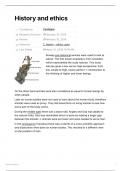
Already pre-historical animals were used to look at
nature. The first known example is from Aristotles
which represented the scala naturae. This scala
naturae gives a low versus high perspective: from
low, simple to high, nearly perfect → introduction to
the thinking of higher and lower beings.
On the other hand animals were also considered as equal to human beings by
other people.
Later on human bodies were not used to learn about the human body, therefore
animals were used as proxy. They did dissections on living animals to see how
every part of the body works.
During the middle ages there was a stand-still, Angles and God was added to
the natural order, God was resembled which is done by making a larger gap
between the animals → animals were put lower and were needed to serve man.
In the renaissance (Vesalius) there was a rebirth of a more scientific approach
and dissections were done on human bodies. This resulted in a different view
on the position of man.
History and ethics 1
, In the age of Enlightement Descartes
made a distinction between humans
and all the rest, the rest was looked
at as machines because they could
not express their feelings or do math
etc. In these days doing experiments
on conscious animals was normal
(Kalen).
Hogarth defined four stages of cruelty, he drew the story of the life of Tom
Nero who was cruel to animals: Tom Nero as a kid was cruel to animals, also as
an adult, and then he killed his girlfriend and eventually he was put on trial and
tortured → if you’re cruel to animals, you are a shit person.
Bentham and Mill were also against Descartes, their way of thinking: if you can
think and speak you are somebody to take into consideration but they also
added if you can suffer than that should be taken into consideration. And also
you should try to maximize happiness.
Kant (deontology) was influenced by Descartes and considered reasoning as
important but stated that because animals has no reasoning humans should be
responsible for animals.
Bentham and Mill: a sentient being should be take into consideration, they did
not look at reasoning but at suffering. Nowadays happiness is still a priority.
They came up with utilism: do harm benefit analysis, it is the current prevailing
view. We still try to maximize happiness, finding a cure for a very severe
disease to make humanity happier but with minimum suffering of animals.
In modern times, Charles Darwin made the origin of species in which it became
clear that humans are related to animals.
Claus Bernard builded a foundation of animal experiments (should be properly
controlled). He elaborated on setting up animal experiments, with control group
and treatment groups but also highly debated.
In the UK the first act cruelty against animals was published (1867), for animal
research certain criteria were set up:
Prosecution is possible
History and ethics 2
, Vertebrates
Anesthesia
Use only 1 x
Kill immediately after the experiment
Only when necessary to advance human health
Meanwhile in Belgium there was no change, there was no influence from the
UK (there was no way of thinking as in the UK). Professors and researchers
were from Germany and France and a very strong catholic tradition. In 1994,
there were still books that stated animal exists to serve men because there was
no specification of laboratory animals or animal experimentation. Along with
this there was a rise in animal experiments due to different aspects:
There were more infections
To scientifically tested drugs
…
At first there was a switch to using more rodent species justified by them being
pest animals and will be killed anyway.
There was a strong national anti-vivisection society, they gave a carte blanche
by using anesthetics if people wanted to use animals although this often failed
to work.
Russel and Burch run animal experiments and wanted to give more guidance on
how to progress from a point of animal welfare. They wrote a book in which
they introduced the 3R principle, if you want to do an animal experiment you
should ask yourself 3 questions:
Replace the animal with a another alternative if possible (non-vertebrate,
computer, in silico, etc)
Reduce the number of animals that you are using (sample size calculations,
re-use, etc)
Refine the procedure to make the animal suffer less of happier → example:
can I put things in the cage to express a normal animal behaviour and
environment (cage enrichment, in vivo imaging, etc)
Recent another R should be included: respect
History and ethics 3
, Tom Regan is an animal right activist (not the same as animal welfare activist).
He said that every animal has some fundamental rights and people should
respect those rights. If you comprehend with this you can not eat them, hold
them, use them for research, etc. He made a distinction between:
Moral agents are those who have full autonomy and are capable (=
possessing the necessary cognitive skills) in making decisions.
Moral patients are individuals who have desires, longings, known emotions,
etc.
Peter Singer introduced speciesism: people considered themselve as a higher
level which is discriminating to them → people should think about everything at
a same line (precautionary principle). Animal experimentation should aim to
reduce suffering as much as possible for all species.
Very late a Belgian law on animal welfare was made (1986), long after the law
that was followed in the UK. It mentioned:
Mentions laboratory animal
Mentions animal experiment
Registration
KB’s (implementation)
In 2010 there was a new European Directive refinement which was
implemented in KB in 2013. The animal welfare switched from KB to ‘gewesten’
in 2014.
After the implementation of these refinements it took some time but the number
of animals use dropped, they estimated that at the year 2000 no animals would
have to be used animals which obviously did not happen. The animals that are
mostly used are rodents and the expertise is fundamental research.
History and ethics 4
, Legislation part 1
Confidence Confident
Moment of lecture @February 15, 2024
Review @February 18, 2024
Materials 2. legislation part 1(1).pdf
Last Edited @March 12, 2025 10:21 AM
There are 2 different types of legislation:
European level: here we don’t speak about laws but about directives and
this European directive is agreed on at a European level and the member
states can decide if they rectify it or not. If they rectify the directive they
promise to fit it in their national legislation.
Animal welfare moved from federal to regional level (in 2014). There is an
animal welfare law on Belgium level but putting in to practice depends on the
region (Flanders, Luxemburg, etc) so there can be small differences.
⇒ The legislation is the animal welfare law and everything is put into details into
decree’s.
Laboratory animals
In the animal welfare law it starts by giving definitions on what we consider a
laboratory animal. They also detail from which development stage it can be
used.
Laboratory animal = a living non-human vertebrate or cephalopod → when
these species are used in a laboratory they are considered as laboratory
animals and you should obey in how you work with these animals to the
legislation specific for laboratory animals. If you have a pet you should
follow the animal welfare legislation but not on the laboratory animal level
(certain decree’s you do not have to take into consideration).
Level of usage = if the stage is self-feeding larval forms (not depending on
the yolk) as well as fetal forms of mammals from entry of the last third of
their normal development. If they survive after these stages and have the
possability of suffering then it is a laboratory animal.
Legislation part 1 1
Confidence Confident
Moment of lecture @February 14, 2024
Review @February 15, 2024
Materials 2. history - ethics .pptx
Last Edited @March 12, 2025 10:19 AM
Already pre-historical animals were used to look at
nature. The first known example is from Aristotles
which represented the scala naturae. This scala
naturae gives a low versus high perspective: from
low, simple to high, nearly perfect → introduction to
the thinking of higher and lower beings.
On the other hand animals were also considered as equal to human beings by
other people.
Later on human bodies were not used to learn about the human body, therefore
animals were used as proxy. They did dissections on living animals to see how
every part of the body works.
During the middle ages there was a stand-still, Angles and God was added to
the natural order, God was resembled which is done by making a larger gap
between the animals → animals were put lower and were needed to serve man.
In the renaissance (Vesalius) there was a rebirth of a more scientific approach
and dissections were done on human bodies. This resulted in a different view
on the position of man.
History and ethics 1
, In the age of Enlightement Descartes
made a distinction between humans
and all the rest, the rest was looked
at as machines because they could
not express their feelings or do math
etc. In these days doing experiments
on conscious animals was normal
(Kalen).
Hogarth defined four stages of cruelty, he drew the story of the life of Tom
Nero who was cruel to animals: Tom Nero as a kid was cruel to animals, also as
an adult, and then he killed his girlfriend and eventually he was put on trial and
tortured → if you’re cruel to animals, you are a shit person.
Bentham and Mill were also against Descartes, their way of thinking: if you can
think and speak you are somebody to take into consideration but they also
added if you can suffer than that should be taken into consideration. And also
you should try to maximize happiness.
Kant (deontology) was influenced by Descartes and considered reasoning as
important but stated that because animals has no reasoning humans should be
responsible for animals.
Bentham and Mill: a sentient being should be take into consideration, they did
not look at reasoning but at suffering. Nowadays happiness is still a priority.
They came up with utilism: do harm benefit analysis, it is the current prevailing
view. We still try to maximize happiness, finding a cure for a very severe
disease to make humanity happier but with minimum suffering of animals.
In modern times, Charles Darwin made the origin of species in which it became
clear that humans are related to animals.
Claus Bernard builded a foundation of animal experiments (should be properly
controlled). He elaborated on setting up animal experiments, with control group
and treatment groups but also highly debated.
In the UK the first act cruelty against animals was published (1867), for animal
research certain criteria were set up:
Prosecution is possible
History and ethics 2
, Vertebrates
Anesthesia
Use only 1 x
Kill immediately after the experiment
Only when necessary to advance human health
Meanwhile in Belgium there was no change, there was no influence from the
UK (there was no way of thinking as in the UK). Professors and researchers
were from Germany and France and a very strong catholic tradition. In 1994,
there were still books that stated animal exists to serve men because there was
no specification of laboratory animals or animal experimentation. Along with
this there was a rise in animal experiments due to different aspects:
There were more infections
To scientifically tested drugs
…
At first there was a switch to using more rodent species justified by them being
pest animals and will be killed anyway.
There was a strong national anti-vivisection society, they gave a carte blanche
by using anesthetics if people wanted to use animals although this often failed
to work.
Russel and Burch run animal experiments and wanted to give more guidance on
how to progress from a point of animal welfare. They wrote a book in which
they introduced the 3R principle, if you want to do an animal experiment you
should ask yourself 3 questions:
Replace the animal with a another alternative if possible (non-vertebrate,
computer, in silico, etc)
Reduce the number of animals that you are using (sample size calculations,
re-use, etc)
Refine the procedure to make the animal suffer less of happier → example:
can I put things in the cage to express a normal animal behaviour and
environment (cage enrichment, in vivo imaging, etc)
Recent another R should be included: respect
History and ethics 3
, Tom Regan is an animal right activist (not the same as animal welfare activist).
He said that every animal has some fundamental rights and people should
respect those rights. If you comprehend with this you can not eat them, hold
them, use them for research, etc. He made a distinction between:
Moral agents are those who have full autonomy and are capable (=
possessing the necessary cognitive skills) in making decisions.
Moral patients are individuals who have desires, longings, known emotions,
etc.
Peter Singer introduced speciesism: people considered themselve as a higher
level which is discriminating to them → people should think about everything at
a same line (precautionary principle). Animal experimentation should aim to
reduce suffering as much as possible for all species.
Very late a Belgian law on animal welfare was made (1986), long after the law
that was followed in the UK. It mentioned:
Mentions laboratory animal
Mentions animal experiment
Registration
KB’s (implementation)
In 2010 there was a new European Directive refinement which was
implemented in KB in 2013. The animal welfare switched from KB to ‘gewesten’
in 2014.
After the implementation of these refinements it took some time but the number
of animals use dropped, they estimated that at the year 2000 no animals would
have to be used animals which obviously did not happen. The animals that are
mostly used are rodents and the expertise is fundamental research.
History and ethics 4
, Legislation part 1
Confidence Confident
Moment of lecture @February 15, 2024
Review @February 18, 2024
Materials 2. legislation part 1(1).pdf
Last Edited @March 12, 2025 10:21 AM
There are 2 different types of legislation:
European level: here we don’t speak about laws but about directives and
this European directive is agreed on at a European level and the member
states can decide if they rectify it or not. If they rectify the directive they
promise to fit it in their national legislation.
Animal welfare moved from federal to regional level (in 2014). There is an
animal welfare law on Belgium level but putting in to practice depends on the
region (Flanders, Luxemburg, etc) so there can be small differences.
⇒ The legislation is the animal welfare law and everything is put into details into
decree’s.
Laboratory animals
In the animal welfare law it starts by giving definitions on what we consider a
laboratory animal. They also detail from which development stage it can be
used.
Laboratory animal = a living non-human vertebrate or cephalopod → when
these species are used in a laboratory they are considered as laboratory
animals and you should obey in how you work with these animals to the
legislation specific for laboratory animals. If you have a pet you should
follow the animal welfare legislation but not on the laboratory animal level
(certain decree’s you do not have to take into consideration).
Level of usage = if the stage is self-feeding larval forms (not depending on
the yolk) as well as fetal forms of mammals from entry of the last third of
their normal development. If they survive after these stages and have the
possability of suffering then it is a laboratory animal.
Legislation part 1 1


