

Written by students who passed Immediately available after payment Read online or as PDF Wrong document? Swap it for free 4.6 TrustPilot
logo-home
Document preview thumbnail
Preview 2 out of 14 pages
Exam (elaborations)

Maternity and Pediatric Nursing 4th Edit

Document preview thumbnail
Preview 2 out of 14 pages

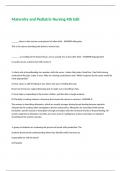
Maternity and Pediatric Nursing 4th Edit ______ refers to the uterine contractions felt after birth - ANSWER-Afterpains This is the uterus shrinking back down to normal size .______, or swelling of the breast tissue, occurs usually 2 to 4 days after birth - ANSWER-Engorgement It usually occurs as the breast milk comes in .A client who is breastfeeding her newborn tells the nurse, I notice that when I feed him, I feel fairly strong contraction-like pain. Labor is over. Why am I having contractions now? Which response by the nurse would be most appropriate? A) Your uterus is still shrinking in size; that's why you're feeling this pain. B) Let me check your vaginal discharge just to make sure everything is fine. C) Your body is responding to the events of labor, just like after a tough workout. D) The baby's sucking releases a hormone that causes the uterus to contract - ANSWER-D The woman is describing afterpains, which are usually stronger during breast-feeding because oxytocin released by the sucking reflex strengthens uterine contractions. Afterpains are associated with uterine involution, but the woman's description strongly correlates with the hormonal events of breast-feeding. All women experience afterpains, but they are more acute in multiparous women secondary to repeated stretching of the uterine muscles. .A group of students are reviewing the process of breast milk production. The students demonstrate understanding when they identify which hormone as responsible for milk let-down? A) Prolactin B) Estrogen C) Progesterone D) Oxytocin - ANSWER-D Don't let this confuse you! Milk let-down/stimulation vs milk production (prolactin) Oxytocin is released from the posterior pituitary to promote milk let-down. Prolactin levels increase at term with a decrease in estrogen and progesterone; estrogen and progesterone levels decrease after the placenta is delivered. Prolactin is released from the anterior pituitary gland and initiates milk production. .A mother choosing to breastfeed or lactate requires an additional ______ calories per day. - ANSWER-500 .A multipara client develops thrombophlebitis after delivery. Which of the following would alert the nurse to the need for immediate intervention? A) Dyspnea, diaphoresis, hypotension, and chest pain B) Dyspnea, bradycardia, hypertension, and confusion C) Weakness, anorexia, change in the level of consciousness, and coma D) Pallor, tachycardia, seizures, and jaundice - ANSWER-A Sudden unexplained shortness of breath and complaints of chest pain along with diaphoresis and hypotension suggest pulmonary embolism, which requires immediate action. Other signs and symptoms include tachycardia, apprehension, hemoptysis, syncope, and sudden change in the woman's mental status secondary to hypoxemia. Anorexia, seizures, and jaundice are unrelated to a pulmonary embolism. .A nurse is assessing a postpartum client who is at home. Which statement by the client would lead the nurse to suspect that the client may be developing postpartum depression? A) I just feel so overwhelmed and tired. B) I'm feeling so guilty and worthless lately. C) It's strange, one minute I'm happy, the next I'm sad. D) I keep hearing voices telling me to take my baby to the river. - ANSWER-B Indicators for postpartum depression include feelings related to restlessness, worthlessness, guilt, hopeless, and sadness along with loss of enjoyment, low energy level, and loss of libido. Thus, the statement by the mother about feeling guilty and worthless suggest postpartum depression. The statements about being overwhelmed and fatigued and changing moods suggest postpartum blues. The statement about hearing voices suggests postpartum psychosis. .A nurse is completing a postpartum assessment. Which finding would alert the nurse to a potential problem? A) Lochia rubra with a fleshy odor B) Respiratory rate of 20 breaths per minute C) Temperature of 101 F D) Pain rating of 4 on a scale from 0 to 10 - ANSWER-C Typically, the new mother's temperature during the first 24 hours postpartum is within the normal range. Some women experience a slight fever, up to 100.4º F (38º C), during the first 24 hours. A temperature above 100.4º F (38º C) at any time or an abnormal temperature after the first 24 hours may indicate infection and must be reported. Foul-smelling lochia or lochia with an unexpected change in color or amount, shortness of breath, or respiratory rate below 16 or above 20 breaths per minute would also be a cause for concern. The goal of pain management is to have the woman's pain scale rating maintained between 0 to 2 points at all times, especially after breast-feeding .A nurse is developing a plan of care for a woman who is at risk for thromboembolism. Which of the following would the nurse include as the most cost-effective method for prevention? A) Prophylactic heparin administration B) Compression stocking C) Early ambulation D) Warm compresses - ANSWER-C Although compression stockings and prophylactic heparin administration may be appropriate, the most cost-effective preventive method is early ambulation. It is also the easiest method. Warm compresses are used to treat superficial venous thrombosis. .A nurse is developing a teaching plan for a postpartum woman who is breast- feeding about sexuality and contraception. Which of the following would the nurse most likely include? (Select all that apply.) A) Resumption of sexual intercourse about two weeks after delivery B) Possible experience of fluctuations in sexual interest C) Use of a water-based lubricant to ease vaginal discomfort D) Use of combined hormonal contraceptives for the first three weeks E) Possibility of increased breast sensitivity during sexual activity - ANSWER-B, C, E Typically, sexual intercourse can be resumed once bright-red bleeding has stopped and the perineum is healed from an episiotomy or lacerations. This is usually by the third to the sixth week postpartum. Fluctuations in sexual interest are normal. In addition, breastfeeding women may notice a let-down reflex during orgasm and find that breasts are very sensitive when touched by their partner. Precoital vaginal lubrication may be impaired during the postpartum period, especially in breastfeeding women. The use of water-based gel lubricants can help. .A nurse is observing a postpartum client interacting with her newborn and notes that the mother is engaging with the newborn in the en face position. Which of the following would the nurse be observing? A) Mother placing the newborn next to bare breast. B) Mother making eye-to-eye contact with the newborn C) Mother gently stroking the newborns face D) Mother holding the newborn upright at the shoulder - ANSWER-B The en-face position is characterized by the mother interacting with the newborn through eye-to-eye contact while holding the newborn. Bonding is a vital component of the attachment process for establishing parent-infant attachment and a healthy, loving relationship. During this early period of acquaintance, mothers touch their infants in a characteristic manner. Mothers visually and physically "explore" their infants, initially using their fingertips on the infant's face and extremities and progressing to massaging and stroking the infant with their fingers. This is followed by palm contact on the trunk. Eventually, mothers draw their infant toward them and hold the infant. Kangaroo care refers to skin-to-skin contact between the mother and newborn. .A nurse is reviewing the medical record of a postpartum client. The nurse identifies that the woman is at risk for a postpartum infection based on which of the following? (Select all that apply.) A) History of diabetes B) Labor of 12 hours C) Rupture of membranes for 16 hours D) Hemoglobin level 10 mg/dL E) Placenta requiring manual extraction - ANSWER-A, D, E Risk factors for postpartum infection include history of diabetes, labor over 24 hours, hemoglobin less than 10.5 mg/dL, prolonged rupture of membranes (more than 24 hours), and manual extraction of the placenta .A nurse suspects that a postpartum client is experiencing postpartum psychosis. Which of the following would most likely lead the nurse to suspect this condition? A) Delirium B) Feelings of anxiety C) Sadness D) Insomnia - ANSWER-A Postpartum psychosis is at the severe end of the continuum of postpartum emotional disorders. It is manifested by depression that escalates to delirium, hallucinations, anger toward self and infant, bizarre behavior, mania, and thoughts of hurting herself and the infant. Feelings of anxiety, sadness, and insomnia are associated with postpartum depression. .A nursing student is preparing a class presentation about changes in the various body systems during the postpartum period and their effects. Which of the following would the student include as influencing a postpartum woman's ability to void? (Select all that apply.) A) Use of an opioid anesthetic during labor B) Generalized swelling of the perineum C) Decreased bladder tone from regional anesthesia D) Use of oxytocin to augment labor E) Need for an episiotomy - ANSWER-B, C, D Many women have difficulty feeling the sensation to void after giving birth if they received an anesthetic block during labor (which inhibits neural functioning of the bladder) or if they received oxytocin to induce or augment their labor (antidiuretic effect). These women will be at risk for incomplete emptying, bladder distention, difficulty voiding, and urinary retention. In addition, urination may be impeded by perineal lacerations; generalized swelling and bruising of the perineum and tissues surrounding the urinary meatus; hematomas; decreased bladder tone as a result of regional anesthesia; and diminished sensation of bladder pressure as a result of swelling, poor bladder tone, and numbing effects of regional anesthesia used during labor .A postpartum client is experiencing subinvolution. When reviewing the woman's labor and birth history, which of the following would the nurse identify as being least significant to this condition? A) Early ambulation B) Prolonged labor C) Large fetus D) Pulse rate of 60 beats/minute - ANSWER-A Factors that inhibit involution include prolonged labor and difficult birth, incomplete expulsion of amniotic membranes and placenta, uterine infection, overdistention of uterine muscles (such as by multiple gestation, hydramnios, or large singleton fetus), full bladder (which displaces the uterus and interferes with contractions), anesthesia(which relaxes uterine muscles), and close childbirth spacing. Factors that facilitate uterine involution include complete expulsion of amniotic membranes and placenta at birth, complication-free labor and birth process, breast-feeding, and early ambulation. .A postpartum woman is ordered to receive oxytocin to stimulate the uterus to contract. Which of the following would be most important for the nurse to do? A) Administer the drug as an IV bolus injection. B) Give as a vaginal or rectal suppository. C) Piggyback the IV infusion into a primary line. D) Withhold the drug if the woman is hypertensive. - ANSWER-C When giving oxytocin, it should be diluted in a liter of IV solution and the infusion set up to be piggy-backed into a primary line to ensure that the medication can be discontinued readily if hyperstimulation or adverse effects occur. It should never be given as an IV bolus injection. Methylergonovine is not given if the woman is hypertensive. Dinoprostone is available as a vaginal or rectal suppository. .A primipara client gave birth vaginally to a healthy newborn girl 48 hours ago. The nurse palpates the client's fundus, expecting it to be at which location? A) Two fingerbreadths above the umbilicus B) At the level of the umbilicus C) Two fingerbreadths below the umbilicus D) Four fingerbreadths below the umbilicus - ANSWER-C During the first few days after birth, the uterus typically descends downward from the level of the umbilicus at a rate of 1 cm (1 fingerbreadth) per day so that by day 2, it is about 2 fingerbreadths below the umbilicus. .A prolapse of the uterine fundus to or through the cervix so that the uterus is turned inside out after birth is called uterine __________. - ANSWER-Inversion .A slight temperature elevation is normal during the first 24 hours after delivery. True or False and WHY - ANSWER-True Greater than 100.4 indicates infection (especially 24 hours pp), but a slight fever is acceptable due to dehydration. .A soft, boggy uterus that deviates from the midline suggests a full bladder interfering with uterine involution. True or False? - ANSWER-True It deviates to the right .A woman who gave birth 24 hours ago tells the nurse, I've been urinating so much over the past several hours. Which response by the nurse would be most appropriate? A) You must have an infection, so let me get a urine specimen. B) Your body is undergoing many changes that cause your bladder to fill quickly. C) Your uterus is not contracting as quickly as it should. D) The anesthesia that you received is wearing off and your bladder is working again. - ANSWER-B Postpartum diuresis occurs as a result of several mechanisms: the large amounts of IV fluids given during labor, a decreasing antidiuretic effect of oxytocin as its level declines, the buildup and retention of extra fluids during pregnancy, and a decreasing production of aldosterone—the hormone that decreases sodium retention and increases urine production. All these factors contribute to rapid filling of the bladder within 12 hours of birth. Diuresis begins within 12 hours after childbirth and continues throughout the first week postpartum. Rapid bladder filling, possible infection, or effects of anesthesia are not involved. .A woman who is 2 weeks postpartum calls the clinic and says, My left breast hurts. After further assessment on the phone, the nurse suspects the woman has mastitis. In addition to pain, the nurse would assess for which of the following? A) An inverted nipple on the affected breast B) No breast milk in the affected breast C) An ecchymotic area on the affected breast D) Hardening of an area in the affected breast - ANSWER-D Mastitis is characterized by a tender, hot, red, painful area on the affected breast. An inverted nipple is not associated with mastitis. With mastitis, the breast is distended with milk, the area is inflamed (not ecchymotic), and there is breast tenderness. .A woman who is bottle-feeding should use _____ packs to alleviate the discomfort of engorgement. - ANSWER-Ice Or warmth. the book honestly lists both .After normal labor and birth, a client is discharged from the hospital 12 hours later. When the community health nurse makes a home visit 2 days later, which finding would alert the nurse to the need for further intervention? A) Presence of lochia serosa B) Frequent scant voidings C) Fundus firm, below umbilicus D) Milk filling in both breasts - ANSWER-B Infrequent or insufficient voiding may be a sign of infection and is not a normal finding on the second postpartum day. Lochia serosa, a firm fundus below the umbilicus, and milk filling the breasts are expected findings.

Content preview

Maternity and Pediatric Nursing 4th Edit


______ refers to the uterine contractions felt after birth - ANSWER-Afterpains

This is the uterus shrinking back down to normal size


.______, or swelling of the breast tissue, occurs usually 2 to 4 days after birth - ANSWER-Engorgement

It usually occurs as the breast milk comes in


.A client who is breastfeeding her newborn tells the nurse, I notice that when I feed him, I feel fairly strong
contraction-like pain. Labor is over. Why am I having contractions now? Which response by the nurse would be
most appropriate?

A) Your uterus is still shrinking in size; that's why you're feeling this pain.

B) Let me check your vaginal discharge just to make sure everything is fine.

C) Your body is responding to the events of labor, just like after a tough workout.

D) The baby's sucking releases a hormone that causes the uterus to contract - ANSWER-D

The woman is describing afterpains, which are usually stronger during breast-feeding because oxytocin
released by the sucking reflex strengthens uterine contractions. Afterpains are associated with uterine
involution, but the woman's description strongly correlates with the hormonal events of breast-feeding. All
women experience afterpains, but they are more acute in multiparous women secondary to repeated
stretching of the uterine muscles.


.A group of students are reviewing the process of breast milk production. The

students demonstrate understanding when they identify which hormone as

responsible for milk let-down?

A) Prolactin

, B) Estrogen

C) Progesterone

D) Oxytocin - ANSWER-D

Don't let this confuse you! Milk let-down/stimulation vs milk production (prolactin)

Oxytocin is released from the posterior pituitary to promote milk let-down. Prolactin levels increase at term
with a decrease in estrogen and progesterone; estrogen and progesterone levels decrease after the placenta is
delivered. Prolactin is released from the anterior pituitary gland and initiates milk production.


.A mother choosing to breastfeed or lactate requires an additional ______ calories per day. - ANSWER-500


.A multipara client develops thrombophlebitis after delivery. Which of the

following would alert the nurse to the need for immediate intervention?

A) Dyspnea, diaphoresis, hypotension, and chest pain

B) Dyspnea, bradycardia, hypertension, and confusion

C) Weakness, anorexia, change in the level of consciousness, and coma

D) Pallor, tachycardia, seizures, and jaundice - ANSWER-A

Sudden unexplained shortness of breath and complaints of chest pain along with diaphoresis and hypotension
suggest pulmonary embolism, which requires immediate action. Other signs and symptoms include
tachycardia, apprehension, hemoptysis, syncope, and sudden change in the woman's mental status secondary
to hypoxemia. Anorexia, seizures, and jaundice are unrelated to a pulmonary embolism.


.A nurse is assessing a postpartum client who is at home. Which statement by the client would lead the nurse
to suspect that the client may be developing

postpartum depression?

A) I just feel so overwhelmed and tired.

B) I'm feeling so guilty and worthless lately.

C) It's strange, one minute I'm happy, the next I'm sad.

D) I keep hearing voices telling me to take my baby to the river. - ANSWER-B

Indicators for postpartum depression include feelings related to restlessness, worthlessness, guilt, hopeless,


Document information

Uploaded on
March 10, 2025
Number of pages
14
Written in
2024/2025
Type
Exam (elaborations)
Contains
Questions & answers
$8.49

Wrong document? Swap it for free Within 14 days of purchase and before downloading, you can choose a different document. You can simply spend the amount again.
Written by students who passed
Immediately available after payment
Read online or as PDF

Seller avatar
Reputation scores are based on the amount of documents a seller has sold for a fee and the reviews they have received for those documents. There are three levels: Bronze, Silver and Gold. The better the reputation, the more your can rely on the quality of the sellers work.
Docwyne6
3.5
(6)
Sold
33
Followers
11
Items
1701
Last sold
2 weeks ago


Why students choose Stuvia

Created by fellow students, verified by reviews

Quality you can trust: written by students who passed their tests and reviewed by others who've used these notes.

Didn't get what you expected? Choose another document

No worries! You can instantly pick a different document that better fits what you're looking for.

Pay as you like, start learning right away

No subscription, no commitments. Pay the way you're used to via credit card and download your PDF document instantly.

Student with book image

“Bought, downloaded, and aced it. It really can be that simple.”

Alisha Student

Working on your references?

Create accurate citations in APA, MLA and Harvard with our free citation generator.

Working on your references?

Frequently asked questions
