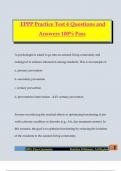
EPPP Practice Test 4 Questions and
Answers 100% Pass
A psychologist is asked to go into an assisted living community and
redesign it to enhance interaction among residents. This is an example of:
a. primary prevention
b. secondary prevention
c. tertiary prevention
d. preventative intervention - ✔✔c. tertiary prevention
Focuses on reducing the residual effects or optimizing functioning of pts
with a chronic condition or disorder (e.g., AA, day treatment centers). In
this scenario, the goal is to optimize functioning by reducing the isolation
of the residents in the assisted living community.
1
100% Pass Guarantee Katelyn Whitman, All Rights
,a. Primary prevention --> preventing the onset of a disease or disorder,
thereby reducing its incidence (e.g., vaccinations).
b. Secondary prevention --> focuses on early identification and prompt
treatment of an illness or disorder that already exists, with the goal of
improving or curing the illness/disorder (e.g., mammograms).
An example of cluster sampling is:
a. Dividing the California population into groups based on income levels
and then randomly selecting equal-sized samples from the groups.
b. Randomly selecting Californians from different income levels in
proportion to their representation in the population.
c. Dividing the population into groups based on California counties and
then randomly selecting samples from randomly selected counties.
d. Selecting from the population of California such that each person has an
equal likelihood of being selected. - ✔✔c. Dividing the population into
2
100% Pass Guarantee Katelyn Whitman, All Rights
,groups based on California counties and then randomly selecting samples
from randomly selected counties.
Involves identifying naturally occurring groups or clusters (e.g., schools in
a school district, counties in a state) and then randomly selecting certain
subsets of these clusters. Typically, all the subjects within the selected
clusters are then sampled. Alternatively, subjects may be randomly
selected from the clusters.
Which of the following statements is true regarding the course of ADHD?
a. Persons diagnosed with the disorder as children continue to experience
the full disorder in adulthood.
b. Children with ADHD that are treated with stimulants are at increased
risk for drug and alcohol problems.
c. Use of stimulant medications improves the long-term course of the
disorder.
3
100% Pass Guarantee Katelyn Whitman, All Rights
, d. Children with aggression or unremitting severe symptoms of ADHD are
at increased risk for developing antisocial personality disorder. - ✔✔d.
Children with aggression or unremitting severe symptoms of ADHD are at
increased risk for developing antisocial personality disorder.
Risk of developing ASPD is greater for kids w/ ADHD and concomitant
aggressive sxs or sxs of ADHD that severely impair fx.
A researcher is studying the effect of different txs for hyperactivity. First
graders receive one of two txs. Group A's pre-tx mean is 15, and the post-tx
mean is 13. Group B's pre-tx mean is 27, and the post-tx mean is 24. The
most likely threat to this research is:
a. maturation
b. regression.
c. selection
d. demand characteristics - ✔✔c. selection
4
100% Pass Guarantee Katelyn Whitman, All Rights
Answers 100% Pass
A psychologist is asked to go into an assisted living community and
redesign it to enhance interaction among residents. This is an example of:
a. primary prevention
b. secondary prevention
c. tertiary prevention
d. preventative intervention - ✔✔c. tertiary prevention
Focuses on reducing the residual effects or optimizing functioning of pts
with a chronic condition or disorder (e.g., AA, day treatment centers). In
this scenario, the goal is to optimize functioning by reducing the isolation
of the residents in the assisted living community.
1
100% Pass Guarantee Katelyn Whitman, All Rights
,a. Primary prevention --> preventing the onset of a disease or disorder,
thereby reducing its incidence (e.g., vaccinations).
b. Secondary prevention --> focuses on early identification and prompt
treatment of an illness or disorder that already exists, with the goal of
improving or curing the illness/disorder (e.g., mammograms).
An example of cluster sampling is:
a. Dividing the California population into groups based on income levels
and then randomly selecting equal-sized samples from the groups.
b. Randomly selecting Californians from different income levels in
proportion to their representation in the population.
c. Dividing the population into groups based on California counties and
then randomly selecting samples from randomly selected counties.
d. Selecting from the population of California such that each person has an
equal likelihood of being selected. - ✔✔c. Dividing the population into
2
100% Pass Guarantee Katelyn Whitman, All Rights
,groups based on California counties and then randomly selecting samples
from randomly selected counties.
Involves identifying naturally occurring groups or clusters (e.g., schools in
a school district, counties in a state) and then randomly selecting certain
subsets of these clusters. Typically, all the subjects within the selected
clusters are then sampled. Alternatively, subjects may be randomly
selected from the clusters.
Which of the following statements is true regarding the course of ADHD?
a. Persons diagnosed with the disorder as children continue to experience
the full disorder in adulthood.
b. Children with ADHD that are treated with stimulants are at increased
risk for drug and alcohol problems.
c. Use of stimulant medications improves the long-term course of the
disorder.
3
100% Pass Guarantee Katelyn Whitman, All Rights
, d. Children with aggression or unremitting severe symptoms of ADHD are
at increased risk for developing antisocial personality disorder. - ✔✔d.
Children with aggression or unremitting severe symptoms of ADHD are at
increased risk for developing antisocial personality disorder.
Risk of developing ASPD is greater for kids w/ ADHD and concomitant
aggressive sxs or sxs of ADHD that severely impair fx.
A researcher is studying the effect of different txs for hyperactivity. First
graders receive one of two txs. Group A's pre-tx mean is 15, and the post-tx
mean is 13. Group B's pre-tx mean is 27, and the post-tx mean is 24. The
most likely threat to this research is:
a. maturation
b. regression.
c. selection
d. demand characteristics - ✔✔c. selection
4
100% Pass Guarantee Katelyn Whitman, All Rights