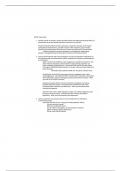
N3481 Study Guide
1. Identify specific muscarinic receptor blockade effects and dopamine blocking effects of
psychotropic drugs and identify important teaching for your patient.
Dopamine-blocking effects include a decrease in dopamine, decrease in the mania/
schizophrenia characteristics, possible increase in EPS symptoms, gynecomastia,
galactorrhea (inappropriate milk production) amenorrhea (absence of menstruation).
If affects primarily the positive symptoms of schizophrenia: hallucination,
delusion. Disorganized speech (associative looseness), and bizarre behavior.
2. Discuss the therapeutic effect and mechanism of action of psychiatric medications on
the following major neurotransmitters (GABA, Acetylcholine, Dopamine, Norepinephrine
and serotonin).
GABA- involved with inhibitions, reduce aggression, excitation and anxiety. Also
deals with pain perception, anticonvulsant, muscle relaxing properties; can
impair cognition and psychomotor. Decreased GABA=anxiety disorder, mania,
Huntington’s INCREASE GABA=reduction of anxiety. When you think GABA think
stress & anxiety.
Glutamate helps synthesis GABA: the “feel good” elevates mood
Acetylcholine- involved with learning and memory; regulated mood, mania,
sexual aggression. Stimulates the PNS. Increased ACH= depression; Decreased
ACH= Alzheimer’s disease, Huntington’s disease and Parkinson disease. When
you think of ACH think of memory.
Dopamine-Involved with fine muscle movements, integration of emotions,
thoughts & decision making. Increased Dopa=schizophrenia and mania.
Decreased dopa= Parkinson and depression. When you think Dopa think
schizophrenia patients.
Serotonin- play a role in sleep regulation, hunger, mood states, aggression, pain
perception & sexual activity. Increased Serotonin=Anxiety: Decreased =
depression. When you think serotonin think depression.
3. Discuss symptoms you should assess for when acetylcholine is inhibited by
anticholinergic drugs.
Associate with DRY you are “turning off” Parasympathetic effects
Dry as a bone (dry mouth)
Blind as a bat (blurred vision)
Full as a flask ( constipation, urinary hesitance/ retention)
Mad as a hatter (memory dysfunction)
Red as a beet (facial flushing)
, Sinus tachycardia
4. Define and give examples of characteristics such as rapport, trust, genuineness and
unconditional positive regard giving example of each.
Rapport- major emphasis during the first few encounters with the patient is on
providing an atmosphere in which trust and understanding can grow.
Ex: find out how they would like to be addressed.
Trust: enhances the relationship on part that the patient and the patient’s active
participation in the nurse-patient relationship.
Examples: Lack of contact, infrequent meetings, meetings in the hallway)
on the nurse or patient or both.
Genuineness: or self awareness of ones feelings as they arise within the
relationship and the ability to communicate them when appropriate, is a key
ingredients in building trust. Being genuine in a therapeutic relationship implies
the ability to use therapeutic communication tools in an appropriately
spontaneous manner rather than rigidly or in a parrot-like fashion.
Unconditional positive regard- a nonjudgmental caring for the client. IN this
therapy, the counselor’s attitude and nonverbal communication are crucial-
emotional investment. Example: true caring in the client is also essential.
5. Define and give examples of transference, countertransference and boundary crossing
and blurring.
Transference: is a phenomenon originally identified by Sigmund Freud when he
used psychoanalysis to treat patients. Transference is the process whereby a
person unconsciously and inappropriately displaces (transfers) onto individuals in
his or her current life those patterns of behavior and emotional reactions that
originated in relations to significant figures in childhood.
Ex: You remind me of my _____ (mother, sister, father, brother.)
Cigarettes, water, extra tine in the session are examples.
Countertransference: refers to the tendency of the nurse to displace onto the
patient feelings related to people in his or her past. Frequently the patients
transference to the nurse evokes countertransference feelings in the nurse.
Ex: it is normal to feel angry when persistently attacked, annoyed, when
unreasonably frustrated, or flattered when idealized. The nurse who is struggling
with an alcoholic family member may feel disinterested, cold, or disgusted,
toward and alcoholic patient.
Boundary crossing and blurring: The nurses’ role in the therapeutic relationship
is theoretically rather well defined, The patients needs are separated form the
nurses needs, and the patients role is different from that of the nurse. Examples
, that can include boundary blurring and crossing is as followed; when the
relationship slips into a social context. When the nurse needs are met at the
expense of the patients needs. Such as overhelping,(doing for the patient what
they should be doing) controlling (asserting authority and assuming control of
the patient. Narcissism- Having to find weakness, helplessness, and or disease in
the patient to feel helpful.
6. Discuss and define the attributes of attending, caring, and positive regard in nursing and
give examples.
Attending: refers to an intensity of presence, being there for and in tune with the
patient. The experience of emotional or physical suffering can be isolating.
When the patient perceives that the nurse is there for them, a human
connection is made and the patient senses of isolation is minimized or
eliminated.
Ex: active listening skills such as body posture, eye contact, touching, or
giving attentive physical care.
Caring is the most natural and most fundamental aspect of human existence.
Ex: empathetic understanding, actions, and patience on another behalf
Caring for another through actions, words, and being present
leads to happiness and touches the heart, Caring is giving of self.
Positive regard implies respect. It is the ability to view another person as being
worthy of caring about and as someone who has strengths and achievement
potential. Usually communicated indirectly by actions than by words.
Ex: Attitudes (willing to work with the patient) Actions (attending,
suspending value judgements, and helping patients develop their own resources)
Attending (Paying attention to their patients).
7. Give examples of both verbal and nonverbal communication and provide examples of
congruency and incongruency.
Verbal Communication- is words that are actually spoken.
Nonverbal communication- Posture body movements, gestures, gait, frowns,
smiles, grimaces, raised eyebrows, pursed lips, licking lips, tongue movements,
angry, suspicious and accusatory looks, tone, pitch and level intensity of the
patients speech.
Congruency-
8. Define and give examples of communication techniques such as giving broad openings,
open-ended questions, offering self, general leads, restating, clarifying, accepting,
reflection, active listening, focusing, summarizing and be able to state why each is
effective and give an example of each.
1. Identify specific muscarinic receptor blockade effects and dopamine blocking effects of
psychotropic drugs and identify important teaching for your patient.
Dopamine-blocking effects include a decrease in dopamine, decrease in the mania/
schizophrenia characteristics, possible increase in EPS symptoms, gynecomastia,
galactorrhea (inappropriate milk production) amenorrhea (absence of menstruation).
If affects primarily the positive symptoms of schizophrenia: hallucination,
delusion. Disorganized speech (associative looseness), and bizarre behavior.
2. Discuss the therapeutic effect and mechanism of action of psychiatric medications on
the following major neurotransmitters (GABA, Acetylcholine, Dopamine, Norepinephrine
and serotonin).
GABA- involved with inhibitions, reduce aggression, excitation and anxiety. Also
deals with pain perception, anticonvulsant, muscle relaxing properties; can
impair cognition and psychomotor. Decreased GABA=anxiety disorder, mania,
Huntington’s INCREASE GABA=reduction of anxiety. When you think GABA think
stress & anxiety.
Glutamate helps synthesis GABA: the “feel good” elevates mood
Acetylcholine- involved with learning and memory; regulated mood, mania,
sexual aggression. Stimulates the PNS. Increased ACH= depression; Decreased
ACH= Alzheimer’s disease, Huntington’s disease and Parkinson disease. When
you think of ACH think of memory.
Dopamine-Involved with fine muscle movements, integration of emotions,
thoughts & decision making. Increased Dopa=schizophrenia and mania.
Decreased dopa= Parkinson and depression. When you think Dopa think
schizophrenia patients.
Serotonin- play a role in sleep regulation, hunger, mood states, aggression, pain
perception & sexual activity. Increased Serotonin=Anxiety: Decreased =
depression. When you think serotonin think depression.
3. Discuss symptoms you should assess for when acetylcholine is inhibited by
anticholinergic drugs.
Associate with DRY you are “turning off” Parasympathetic effects
Dry as a bone (dry mouth)
Blind as a bat (blurred vision)
Full as a flask ( constipation, urinary hesitance/ retention)
Mad as a hatter (memory dysfunction)
Red as a beet (facial flushing)
, Sinus tachycardia
4. Define and give examples of characteristics such as rapport, trust, genuineness and
unconditional positive regard giving example of each.
Rapport- major emphasis during the first few encounters with the patient is on
providing an atmosphere in which trust and understanding can grow.
Ex: find out how they would like to be addressed.
Trust: enhances the relationship on part that the patient and the patient’s active
participation in the nurse-patient relationship.
Examples: Lack of contact, infrequent meetings, meetings in the hallway)
on the nurse or patient or both.
Genuineness: or self awareness of ones feelings as they arise within the
relationship and the ability to communicate them when appropriate, is a key
ingredients in building trust. Being genuine in a therapeutic relationship implies
the ability to use therapeutic communication tools in an appropriately
spontaneous manner rather than rigidly or in a parrot-like fashion.
Unconditional positive regard- a nonjudgmental caring for the client. IN this
therapy, the counselor’s attitude and nonverbal communication are crucial-
emotional investment. Example: true caring in the client is also essential.
5. Define and give examples of transference, countertransference and boundary crossing
and blurring.
Transference: is a phenomenon originally identified by Sigmund Freud when he
used psychoanalysis to treat patients. Transference is the process whereby a
person unconsciously and inappropriately displaces (transfers) onto individuals in
his or her current life those patterns of behavior and emotional reactions that
originated in relations to significant figures in childhood.
Ex: You remind me of my _____ (mother, sister, father, brother.)
Cigarettes, water, extra tine in the session are examples.
Countertransference: refers to the tendency of the nurse to displace onto the
patient feelings related to people in his or her past. Frequently the patients
transference to the nurse evokes countertransference feelings in the nurse.
Ex: it is normal to feel angry when persistently attacked, annoyed, when
unreasonably frustrated, or flattered when idealized. The nurse who is struggling
with an alcoholic family member may feel disinterested, cold, or disgusted,
toward and alcoholic patient.
Boundary crossing and blurring: The nurses’ role in the therapeutic relationship
is theoretically rather well defined, The patients needs are separated form the
nurses needs, and the patients role is different from that of the nurse. Examples
, that can include boundary blurring and crossing is as followed; when the
relationship slips into a social context. When the nurse needs are met at the
expense of the patients needs. Such as overhelping,(doing for the patient what
they should be doing) controlling (asserting authority and assuming control of
the patient. Narcissism- Having to find weakness, helplessness, and or disease in
the patient to feel helpful.
6. Discuss and define the attributes of attending, caring, and positive regard in nursing and
give examples.
Attending: refers to an intensity of presence, being there for and in tune with the
patient. The experience of emotional or physical suffering can be isolating.
When the patient perceives that the nurse is there for them, a human
connection is made and the patient senses of isolation is minimized or
eliminated.
Ex: active listening skills such as body posture, eye contact, touching, or
giving attentive physical care.
Caring is the most natural and most fundamental aspect of human existence.
Ex: empathetic understanding, actions, and patience on another behalf
Caring for another through actions, words, and being present
leads to happiness and touches the heart, Caring is giving of self.
Positive regard implies respect. It is the ability to view another person as being
worthy of caring about and as someone who has strengths and achievement
potential. Usually communicated indirectly by actions than by words.
Ex: Attitudes (willing to work with the patient) Actions (attending,
suspending value judgements, and helping patients develop their own resources)
Attending (Paying attention to their patients).
7. Give examples of both verbal and nonverbal communication and provide examples of
congruency and incongruency.
Verbal Communication- is words that are actually spoken.
Nonverbal communication- Posture body movements, gestures, gait, frowns,
smiles, grimaces, raised eyebrows, pursed lips, licking lips, tongue movements,
angry, suspicious and accusatory looks, tone, pitch and level intensity of the
patients speech.
Congruency-
8. Define and give examples of communication techniques such as giving broad openings,
open-ended questions, offering self, general leads, restating, clarifying, accepting,
reflection, active listening, focusing, summarizing and be able to state why each is
effective and give an example of each.