Managing Peripheral IV Therapy Complications
Intravenous therapy, commonly administered through peripheral venous catheters,
often leads to catheter removal due to complications, completion of treatment, or lack of use. Local
complications such as hematoma, thrombosis, phlebitis, thrombophlebitis, infiltration, and
extravasation are frequently associated with peripheral IV catheters. Nurses need to possess strong
technical and medical knowledge of evidence-based practices. This ensures treatment efficacy, high-
quality care, and informed decision-making regarding the appropriate use of peripheral venous
catheters in patients undergoing intravenous therapy.
This article provides a guide for managing local and systemic complications and provides general
nursing considerations for preventing these complications.
Risk Factors for Peripheral IV Site Complications
Each risk factor requires careful consideration and appropriate nursing interventions, such as using
the correct catheter size, securing the IV properly, rotating sites regularly, and closely monitoring
patients for early signs of complications.
Patient factors (age, vein quality, chronic illness). Older patients or those with poor vein
quality (e.g., fragile or sclerotic veins) are more susceptible to complications like infiltration,
extravasation, and thrombophlebitis. Chronic illnesses such as diabetes or vascular diseases
can also compromise vein integrity.
Dehydration. Dehydration can lead to poor vein filling, making veins more fragile
and prone to rupture during catheter insertion, increasing the risk of hematoma formation or
phlebitis.
, Improper catheter size. Using a catheter that is too large for the vein can cause irritation,
increasing the risk of phlebitis and thrombosis. Larger catheters cause more mechanical
irritation and trauma to the vein walls, leading to inflammation.
Inadequate site monitoring. Failure to regularly assess and monitor the IV site for early
signs of complications like redness, swelling, or discomfort increases the risk of more severe
issues like infection, infiltration, or extravasation.
Poor aseptic technique. Failure to use proper hand hygiene and aseptic technique during
insertion, dressing changes, or IV site maintenance can introduce bacteria, leading to
infection at the insertion site or systemic complications like catheter-related bloodstream
infections (CR-BSI).
Prolonged use of the same IV site. Keeping an IV catheter in place for an extended period
increases the risk of phlebitis, thrombophlebitis, and infection. Guidelines recommend
rotating IV sites every 72-96 hours to reduce these risks.
Frequent movement of the catheter. Movement of the catheter within the vein, caused by
patient activity or improper securement, can lead to irritation of the vein lining, increasing
the risk of phlebitis and infiltration.
Use of irritant or vesicant medications. Administering irritating or vesicant medications
(e.g., chemotherapy drugs) through a peripheral IV increases the risk of phlebitis, infiltration,
and extravasation. Vesicant drugs can damage surrounding tissues if leakage occurs.
Local Complications of Peripheral IV Therapy
Peripheral IV therapy can lead to localized issues at the insertion site, such as irritation, swelling, or
inflammation. These complications require careful monitoring to prevent escalation and provide
patient comfort.
Hematoma
A hematoma is the accumulation of blood outside the blood vessel, usually caused by the vein being
punctured during catheter insertion or removal. This can occur due to improper insertion technique,
using a catheter that is too large for the vein, or failing to apply sufficient pressure after IV removal.
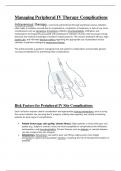
Hematoma from failed IV attempt. Notice the signs of hematoma including swelling, bruising,
tenderness, and discoloration around the IV site.
Intravenous therapy, commonly administered through peripheral venous catheters,
often leads to catheter removal due to complications, completion of treatment, or lack of use. Local
complications such as hematoma, thrombosis, phlebitis, thrombophlebitis, infiltration, and
extravasation are frequently associated with peripheral IV catheters. Nurses need to possess strong
technical and medical knowledge of evidence-based practices. This ensures treatment efficacy, high-
quality care, and informed decision-making regarding the appropriate use of peripheral venous
catheters in patients undergoing intravenous therapy.
This article provides a guide for managing local and systemic complications and provides general
nursing considerations for preventing these complications.
Risk Factors for Peripheral IV Site Complications
Each risk factor requires careful consideration and appropriate nursing interventions, such as using
the correct catheter size, securing the IV properly, rotating sites regularly, and closely monitoring
patients for early signs of complications.
Patient factors (age, vein quality, chronic illness). Older patients or those with poor vein
quality (e.g., fragile or sclerotic veins) are more susceptible to complications like infiltration,
extravasation, and thrombophlebitis. Chronic illnesses such as diabetes or vascular diseases
can also compromise vein integrity.
Dehydration. Dehydration can lead to poor vein filling, making veins more fragile
and prone to rupture during catheter insertion, increasing the risk of hematoma formation or
phlebitis.
, Improper catheter size. Using a catheter that is too large for the vein can cause irritation,
increasing the risk of phlebitis and thrombosis. Larger catheters cause more mechanical
irritation and trauma to the vein walls, leading to inflammation.
Inadequate site monitoring. Failure to regularly assess and monitor the IV site for early
signs of complications like redness, swelling, or discomfort increases the risk of more severe
issues like infection, infiltration, or extravasation.
Poor aseptic technique. Failure to use proper hand hygiene and aseptic technique during
insertion, dressing changes, or IV site maintenance can introduce bacteria, leading to
infection at the insertion site or systemic complications like catheter-related bloodstream
infections (CR-BSI).
Prolonged use of the same IV site. Keeping an IV catheter in place for an extended period
increases the risk of phlebitis, thrombophlebitis, and infection. Guidelines recommend
rotating IV sites every 72-96 hours to reduce these risks.
Frequent movement of the catheter. Movement of the catheter within the vein, caused by
patient activity or improper securement, can lead to irritation of the vein lining, increasing
the risk of phlebitis and infiltration.
Use of irritant or vesicant medications. Administering irritating or vesicant medications
(e.g., chemotherapy drugs) through a peripheral IV increases the risk of phlebitis, infiltration,
and extravasation. Vesicant drugs can damage surrounding tissues if leakage occurs.
Local Complications of Peripheral IV Therapy
Peripheral IV therapy can lead to localized issues at the insertion site, such as irritation, swelling, or
inflammation. These complications require careful monitoring to prevent escalation and provide
patient comfort.
Hematoma
A hematoma is the accumulation of blood outside the blood vessel, usually caused by the vein being
punctured during catheter insertion or removal. This can occur due to improper insertion technique,
using a catheter that is too large for the vein, or failing to apply sufficient pressure after IV removal.
Hematoma from failed IV attempt. Notice the signs of hematoma including swelling, bruising,
tenderness, and discoloration around the IV site.