

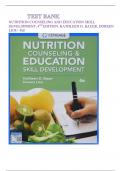
NUTRITION COUNSELING AND EDUCATION SKILL
DEVELOPMENT, 4TH EDITION, KATHLEEN D. BAUER, DOREEN
LIOU- Pdf
, NUTRITION COUNSELING AND EDUCATION SKILL DEVELOPMENT, 4TH EDITION,
KATHLEEN D. BAUER, DOREEN LIOU-TEST BANK
1. What is defined as a supportive process aimed at guiding a patient toward nutritional health and well-being?
A. Goal setting
B. Counseling relationship
C. Nutrition education
D. Nutrition counseling
E. Both nutrition education and counseling
ANSWER: D
2. What is defined as a combination of educational strategies, accompanied by environmental support, designed
to facilitate voluntary adoption of food choices and nutrition-related behaviors conducive to health and well-
being?
A. Goal setting
B. Counseling relationship
C. Nutrition education
D. Nutrition counseling
E. Both nutrition education and counseling
ANSWER: C
3. What should you consider when thinking about how sensory appeal affects food behavior?
A. Taste is generally the least important determinant of food choices.
B. Biological taste preferences evolve from childhood based on availability and societal norms.
C. Taste preferences cannot be modified, making dietary behavior change difficult.
D. Illness does not modify food preferences.
E. Generally, young children favor sourer tastes compared to adults.
ANSWER: B
4. Your patient tells you that eating donuts for breakfast is a habit for him because his wife always buys a dozen
donuts and leaves them on the counter by the coffeepot. He typically eats what is left after his wife and kids eat.
What advice could you offer your patient to help him improve his eating habits?
A. Put the donuts in the pantry or cabinet.
B. Only buy 1/2 dozen donuts and leave them on the counter by the coffeepot.
C. Leave 1 donut out on the counter by the coffeepot.
D. Put a large bowl of fruit on the counter by the coffeepot each morning.
E. Leave a serving of fruit by the coffeepot each morning.
DEVELOPMENT, 4TH EDITION, KATHLEEN D. BAUER, DOREEN
LIOU- Pdf
, NUTRITION COUNSELING AND EDUCATION SKILL DEVELOPMENT, 4TH EDITION,
KATHLEEN D. BAUER, DOREEN LIOU-TEST BANK
1. What is defined as a supportive process aimed at guiding a patient toward nutritional health and well-being?
A. Goal setting
B. Counseling relationship
C. Nutrition education
D. Nutrition counseling
E. Both nutrition education and counseling
ANSWER: D
2. What is defined as a combination of educational strategies, accompanied by environmental support, designed
to facilitate voluntary adoption of food choices and nutrition-related behaviors conducive to health and well-
being?
A. Goal setting
B. Counseling relationship
C. Nutrition education
D. Nutrition counseling
E. Both nutrition education and counseling
ANSWER: C
3. What should you consider when thinking about how sensory appeal affects food behavior?
A. Taste is generally the least important determinant of food choices.
B. Biological taste preferences evolve from childhood based on availability and societal norms.
C. Taste preferences cannot be modified, making dietary behavior change difficult.
D. Illness does not modify food preferences.
E. Generally, young children favor sourer tastes compared to adults.
ANSWER: B
4. Your patient tells you that eating donuts for breakfast is a habit for him because his wife always buys a dozen
donuts and leaves them on the counter by the coffeepot. He typically eats what is left after his wife and kids eat.
What advice could you offer your patient to help him improve his eating habits?
A. Put the donuts in the pantry or cabinet.
B. Only buy 1/2 dozen donuts and leave them on the counter by the coffeepot.
C. Leave 1 donut out on the counter by the coffeepot.
D. Put a large bowl of fruit on the counter by the coffeepot each morning.
E. Leave a serving of fruit by the coffeepot each morning.


