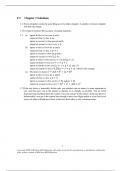
F.1 Chapter 1 Solutions
1.1 Every computer can do the same thing as every other computer. A smaller or slower computer
will just take longer.
1.3 It is hard to increase the accuracy of analog machines.
1.5 (a) inputs to first (x) box are a and x
output of first (x) box is ax
inputs to second (+) box are ax and b
output of second (+) box is ax + b
(b) inputs to first (+) box are w and x
output of first (+) box is w + x
inputs to second (+) box are y and z
output of second (+) box is y + z
inputs to third (+) box are (w + x) and (y + z)
output of third (+) box is w + x + y + z
inputs to fourth (x) box are (w + x + y + z) and .25
output of fourth (x) box is 0.25(w + x + y + z), which is the average
(c) The key is to factor a2 + 2ab + b2 = (a + b)2
inputs to first (+) box are a and b
output of first (+) box is a + b
inputs to second (x) box are (a + b) and (a + b)
output of second (x) box is (a + b)2 = a2 + 2ab + b2
1.7 If the taxi driver is honorable, he/she asks you whether time or money is more important to
you, and then gets you to the airport as quickly or as cheaply as possible. You are freed
from knowing anything about the various ways one can get to the airport. If the taxi driver is
dishonorable, you get to the airport late enough to miss your flight and/or at a taxi fare far in
excess of what it should have been, as the taxi driver takes a very circuitous route.
1
Copyright 2020 © McGraw-Hill Education. All rights reserved. No reproduction or distribution without the
prior written consent of McGraw-Hill Education.
, 2 APPENDIX F. SELECTED SOLUTIONS
1.9 Yes, if phrased in a way that is definite and lacks ambiguity.
1.11 (a) Lacks definiteness: Go south on Main St. for a mile or so.
(b) Lacks effective computability: Find the integer that is the square root of 14.
(c) Lacks finiteness: Do something. Repeat forever.
1.13 Both computers, A and B, are capable of solving the same problems. Computer B can perform
subtraction by taking the negative of the second number and adding it to the first one. As A
and B are otherwise identical, they are capable of solving the same problems.
1.15 Advantages of a higher level language: Fewer instructions are required to do the same amount
of work. This usually means it takes less time for a programmer to write a program to solve a
problem. High level language programs are generally easier to read and therefore know what
is going on. Disadvantages of a higher level language: Each instruction has less control over
the underlying hardware that actually performs the computation that the program frequently
executes less fficiently.
NOTE: this problem is beyond the scope of Chapter 1 or most students.
1.17 An ISA describes the interface to the computer from the perspective of the 0s and 1s of
the program. For example, it describes the operations, data types, and addressing modes
a programmer can use on that particular computer. It doesn’t specify the actual physical
implementation. The microarchitecture does that. Using the car analogy, the ISA is what the
driver sees, and the microarchitecture is what goes on under the hood.
1.19 (a) Problem: For example, what is the sum of the ten smallest positive integers.
(b) Algorithm: Any procedure is fine as long as it has definiteness, effective computability,
and finiteness.
(c) Language: For example, C, C++, Fortran, IA-32 Assembly Language.
(d) ISA: For example, IA-32, PowerPC, Alpha, SPARC.
(e) Microarchitecture: For example, Pentium III, Compaq 21064.
(f) Circuits: For example, a circuit to add two numbers together.
(g) Devices: For example, CMOS, NMOS, gallium arsenide.
1.21 It is in the ISA of the computer that will run it. We know this because if the word procesing
software were in a high- or low-level programming language, then the user would need to
compile it or assemble it before using it. This never happens. The user just needs to copy the
files to run the program, so it must already be in the correct machine language, or ISA.
1.23 ISA’s don’t change much between successive generations, because of the need for backward
compatibility. You’d like your new computer to still run all your old software.
Copyright 2020 © McGraw-Hill Education. All rights reserved. No reproduction or distribution without the
prior written consent of McGraw-Hill Education.
,F.2 Chapter 2 Solutions
n
2.1 The answer is 2
2.3 (a) For 400 students, we need at least 9 bits.
9
(b) 2 = 512, so 112 more students could enter.
2.5 If each number is represented with 5 bits,
7 = 00111 in all three systems
-7 = 11000 (1's complement)
= 10111 (signed magnitude)
= 11001 (2's complement)
2.7 Refer to the following table:
0000 0
0001 1
0010 2
0011 3
0100 4
0101 5
0110 6
0111 7
1000 -8
1001 -7
1010 -6
1011 -5
1100 -4
1101 -3
1110 -2
1111 -1
23
2.9 Avogadro's number (6.02 x 10 ) requires 80 bits to be represented in two's
complement binary representation.
1
Copyright 2020 © McGraw-Hill Education. All rights reserved. No reproduction or distribution without the prior
written consent of McGraw-Hill Education.
, 2 APPENDIX F. SELECTED SOLUTIONS
2.11 (a) 01100110
(b) 01000000
(c) 00100001
(d) 10000000
(e) 01111111
2.13 (a) 11111010
(b) 00011001
(c) 11111000
(d) 00000001
2.15 Dividing the number by two.
2.17 (a) 1100 (binary) or -4 (decimal)
(b) 01010100 (binary) or 84 (decimal)
(c) 0011 (binary) or 3 (decimal)
(d) 11 (binary) or -1 (decimal)
2.19 11100101, 1111111111100101, 11111111111111111111111111100101. Sign
extension does not affect the value represented.
2.21 Overflow has occurred if both operands are positive and the result is negative, or if both
operands are negative and the result is positive.
2.23 Overflow has occurred in an unsigned addition when you get a carry out of the leftmost
bits.
2.25 Because their sum will be a number which if positive, will have a lower magnitude (less
positive) than the original positive number (because a negative number is being added
to it), and vice versa.
2.27 The problem here is that overflow has occurred as adding 2 positive numbers has
resulted in a negative number.
2.29 Refer to the following table:
X Y XANDY
0 0 0
0 1 0
1 0 0
1 1 1
2.31 When at least one of the inputs is 1.
Copyright 2020 © McGraw-Hill Education. All rights reserved. No reproduction or distribution without the prior
written consent of McGraw-Hill Education.
1.1 Every computer can do the same thing as every other computer. A smaller or slower computer
will just take longer.
1.3 It is hard to increase the accuracy of analog machines.
1.5 (a) inputs to first (x) box are a and x
output of first (x) box is ax
inputs to second (+) box are ax and b
output of second (+) box is ax + b
(b) inputs to first (+) box are w and x
output of first (+) box is w + x
inputs to second (+) box are y and z
output of second (+) box is y + z
inputs to third (+) box are (w + x) and (y + z)
output of third (+) box is w + x + y + z
inputs to fourth (x) box are (w + x + y + z) and .25
output of fourth (x) box is 0.25(w + x + y + z), which is the average
(c) The key is to factor a2 + 2ab + b2 = (a + b)2
inputs to first (+) box are a and b
output of first (+) box is a + b
inputs to second (x) box are (a + b) and (a + b)
output of second (x) box is (a + b)2 = a2 + 2ab + b2
1.7 If the taxi driver is honorable, he/she asks you whether time or money is more important to
you, and then gets you to the airport as quickly or as cheaply as possible. You are freed
from knowing anything about the various ways one can get to the airport. If the taxi driver is
dishonorable, you get to the airport late enough to miss your flight and/or at a taxi fare far in
excess of what it should have been, as the taxi driver takes a very circuitous route.
1
Copyright 2020 © McGraw-Hill Education. All rights reserved. No reproduction or distribution without the
prior written consent of McGraw-Hill Education.
, 2 APPENDIX F. SELECTED SOLUTIONS
1.9 Yes, if phrased in a way that is definite and lacks ambiguity.
1.11 (a) Lacks definiteness: Go south on Main St. for a mile or so.
(b) Lacks effective computability: Find the integer that is the square root of 14.
(c) Lacks finiteness: Do something. Repeat forever.
1.13 Both computers, A and B, are capable of solving the same problems. Computer B can perform
subtraction by taking the negative of the second number and adding it to the first one. As A
and B are otherwise identical, they are capable of solving the same problems.
1.15 Advantages of a higher level language: Fewer instructions are required to do the same amount
of work. This usually means it takes less time for a programmer to write a program to solve a
problem. High level language programs are generally easier to read and therefore know what
is going on. Disadvantages of a higher level language: Each instruction has less control over
the underlying hardware that actually performs the computation that the program frequently
executes less fficiently.
NOTE: this problem is beyond the scope of Chapter 1 or most students.
1.17 An ISA describes the interface to the computer from the perspective of the 0s and 1s of
the program. For example, it describes the operations, data types, and addressing modes
a programmer can use on that particular computer. It doesn’t specify the actual physical
implementation. The microarchitecture does that. Using the car analogy, the ISA is what the
driver sees, and the microarchitecture is what goes on under the hood.
1.19 (a) Problem: For example, what is the sum of the ten smallest positive integers.
(b) Algorithm: Any procedure is fine as long as it has definiteness, effective computability,
and finiteness.
(c) Language: For example, C, C++, Fortran, IA-32 Assembly Language.
(d) ISA: For example, IA-32, PowerPC, Alpha, SPARC.
(e) Microarchitecture: For example, Pentium III, Compaq 21064.
(f) Circuits: For example, a circuit to add two numbers together.
(g) Devices: For example, CMOS, NMOS, gallium arsenide.
1.21 It is in the ISA of the computer that will run it. We know this because if the word procesing
software were in a high- or low-level programming language, then the user would need to
compile it or assemble it before using it. This never happens. The user just needs to copy the
files to run the program, so it must already be in the correct machine language, or ISA.
1.23 ISA’s don’t change much between successive generations, because of the need for backward
compatibility. You’d like your new computer to still run all your old software.
Copyright 2020 © McGraw-Hill Education. All rights reserved. No reproduction or distribution without the
prior written consent of McGraw-Hill Education.
,F.2 Chapter 2 Solutions
n
2.1 The answer is 2
2.3 (a) For 400 students, we need at least 9 bits.
9
(b) 2 = 512, so 112 more students could enter.
2.5 If each number is represented with 5 bits,
7 = 00111 in all three systems
-7 = 11000 (1's complement)
= 10111 (signed magnitude)
= 11001 (2's complement)
2.7 Refer to the following table:
0000 0
0001 1
0010 2
0011 3
0100 4
0101 5
0110 6
0111 7
1000 -8
1001 -7
1010 -6
1011 -5
1100 -4
1101 -3
1110 -2
1111 -1
23
2.9 Avogadro's number (6.02 x 10 ) requires 80 bits to be represented in two's
complement binary representation.
1
Copyright 2020 © McGraw-Hill Education. All rights reserved. No reproduction or distribution without the prior
written consent of McGraw-Hill Education.
, 2 APPENDIX F. SELECTED SOLUTIONS
2.11 (a) 01100110
(b) 01000000
(c) 00100001
(d) 10000000
(e) 01111111
2.13 (a) 11111010
(b) 00011001
(c) 11111000
(d) 00000001
2.15 Dividing the number by two.
2.17 (a) 1100 (binary) or -4 (decimal)
(b) 01010100 (binary) or 84 (decimal)
(c) 0011 (binary) or 3 (decimal)
(d) 11 (binary) or -1 (decimal)
2.19 11100101, 1111111111100101, 11111111111111111111111111100101. Sign
extension does not affect the value represented.
2.21 Overflow has occurred if both operands are positive and the result is negative, or if both
operands are negative and the result is positive.
2.23 Overflow has occurred in an unsigned addition when you get a carry out of the leftmost
bits.
2.25 Because their sum will be a number which if positive, will have a lower magnitude (less
positive) than the original positive number (because a negative number is being added
to it), and vice versa.
2.27 The problem here is that overflow has occurred as adding 2 positive numbers has
resulted in a negative number.
2.29 Refer to the following table:
X Y XANDY
0 0 0
0 1 0
1 0 0
1 1 1
2.31 When at least one of the inputs is 1.
Copyright 2020 © McGraw-Hill Education. All rights reserved. No reproduction or distribution without the prior
written consent of McGraw-Hill Education.