

WGU - D291 Pre-Assessment Review questions with verfied answers
Study online at https://quizlet.com/_grooe4
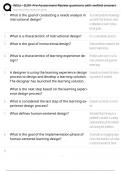
1. What is the goal of conducting a needs analysis in To understand the knowledge
instructional design? and skills that learners need
to develop to reach instruc-
tional goals.
2. What is a characteristic of instructional design? It is a consultative process.
3. What is the goal of instructional design? Solve problems related to the
learner experience.
4. What is a characteristic of learning experience de- It helps users learn in a hu-
sign? man-centered and goal-ori-
ented way.
5. A designer is using the learning experience design Evaluate and revise the learn-
process to design and develop a learning solution. ing solution if needed.
The designer has launched the learning solution.
What is the next step based on the learning experi-
ence design process?
6. What is considered the last step of the learning ex- Evaluate and revise as need-
perience design process? ed.
7. What defines human-centered design? The belief that the key to a
problem's solution is a deep
understanding of the individ-
uals facing the problem.
8. What is the goal of the implementation phase of To provide an engaging expe-
human-centered learning design? rience that learners can relate
to and that works for them.
9.
1/9
, WGU - D291 Pre-Assessment Review questions with verfied answers
Study online at https://quizlet.com/_grooe4
Which question would be appropriate in guiding a How will I measure the suc-
designer during the implementation phase of the cess of my solution?
human-centered learning design process?
10. A designer creates technical support documenta- Develop
tion to ensure students are comfortable using the
software in the course. Which step of ADDIE is this
designer on?
11. A designer discusses with the design team that only Design
multiple-choice questions should be used for a foun-
dations course. Which step of ADDIE is the designer
on?
12. A designer reviews feedback and data from learners Evaluate
who completed a course. Which step of ADDIE is this
designer on?
13. What is a key difference between the Successive Ap- The SAM approach is a more
proximation Model (SAM) and the ADDIE approach? iterative process than the AD-
DIE approach.
14. What is a key difference between the Successive Ap- SAM uses feedback and
proximation Model (SAM) and the Understanding by repetitive prototype improve-
Design (UbD) approach? ment to drive the process,
whereas the UbD approach
uses the desired learning out-
comes.
15. What is a key characteristic that distinguishes the Constant iterative process
Successive Approximation Model (SAM) from both
ADDIE and the Understanding of Design (UbD) ap-
proach?
2/9
Study online at https://quizlet.com/_grooe4
1. What is the goal of conducting a needs analysis in To understand the knowledge
instructional design? and skills that learners need
to develop to reach instruc-
tional goals.
2. What is a characteristic of instructional design? It is a consultative process.
3. What is the goal of instructional design? Solve problems related to the
learner experience.
4. What is a characteristic of learning experience de- It helps users learn in a hu-
sign? man-centered and goal-ori-
ented way.
5. A designer is using the learning experience design Evaluate and revise the learn-
process to design and develop a learning solution. ing solution if needed.
The designer has launched the learning solution.
What is the next step based on the learning experi-
ence design process?
6. What is considered the last step of the learning ex- Evaluate and revise as need-
perience design process? ed.
7. What defines human-centered design? The belief that the key to a
problem's solution is a deep
understanding of the individ-
uals facing the problem.
8. What is the goal of the implementation phase of To provide an engaging expe-
human-centered learning design? rience that learners can relate
to and that works for them.
9.
1/9
, WGU - D291 Pre-Assessment Review questions with verfied answers
Study online at https://quizlet.com/_grooe4
Which question would be appropriate in guiding a How will I measure the suc-
designer during the implementation phase of the cess of my solution?
human-centered learning design process?
10. A designer creates technical support documenta- Develop
tion to ensure students are comfortable using the
software in the course. Which step of ADDIE is this
designer on?
11. A designer discusses with the design team that only Design
multiple-choice questions should be used for a foun-
dations course. Which step of ADDIE is the designer
on?
12. A designer reviews feedback and data from learners Evaluate
who completed a course. Which step of ADDIE is this
designer on?
13. What is a key difference between the Successive Ap- The SAM approach is a more
proximation Model (SAM) and the ADDIE approach? iterative process than the AD-
DIE approach.
14. What is a key difference between the Successive Ap- SAM uses feedback and
proximation Model (SAM) and the Understanding by repetitive prototype improve-
Design (UbD) approach? ment to drive the process,
whereas the UbD approach
uses the desired learning out-
comes.
15. What is a key characteristic that distinguishes the Constant iterative process
Successive Approximation Model (SAM) from both
ADDIE and the Understanding of Design (UbD) ap-
proach?
2/9


