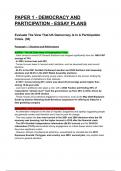
PAPER 1 - DEMOCRACY AND
PARTICIPATION - ESSAY PLANS
Evaluate The View That UK Democracy Is In A Participation
Crisis. (30)
Paragraph 1 - Elections and Referendums
AGREE - The UK Does Have A Participation Crisis:
. Voter turnout in recent UK General Elections has dropped significantly from the 1945-1997
average of 76%
. In 2024, turnout was just 60%
. Turnout is even lower in 'second order' elections, such as devolved body and council
elections
. 63.5% in the 2021 Scottish Parliament election and 2022 Northern Irish Assembly
elections and 46.6% in the 2021 Welsh Assembly elections
. Political apathy, especially among young voters, contributes to low turnout, limiting the
responsiveness of institutions to their interests
. In 2017, turnout among 65+ voters was about 25 percentage points higher than
among 18-24-year-olds
. Low trust in politicians also plays a role, with a 2024 YouGov poll finding 49% of
respondents "almost never" trust the government, up from 26% in 2019, driven by
scandals since the 2019 election
. These include 23 by-elections triggered by misconduct, such as the May 2024 Blackpool
South by-election following Scott Benntons suspension for offering to lobby for a
fake gambling company
DISAGREE - The UK Doesn’t Have A Participation Crisis:
. An alternative viewpoint is the idea of 'hapathy' (happiness and apathy) suggesting people
are generally content and therefore don't need to push for change
. This may explain the low voter turnout in the 2001 and 2005 elections when the UK
economy was booming, but the higher turnout in 2010 after the financial crash
. The 2014 Scottish Independence referendum (84.6% turnout) and the 2016 EU
referendum (72.2%) demonstrate strong engagement on critical issues where voters feel
they have significant control
. However, distrust of professional politicians, exacerbated by scandals like the 2010
Expenses Scandal, Partygate, and scrutiny over MPs’ second jobs, may explain lower
turnout in general elections
,Paragraph 2 - Party Membership
AGREE - The UK Does Have A Participation Crisis:
. Only 1.6% of the electorate belongs to a political party, down from 3.8% in 1983
. Conservative membership has dropped from 400,000 in the 1990s to around 100,000
today
. Labour membership has fallen from 500,000 under Corbyn to 370,000 under Keir
Starmer, partly due to dissatisfaction with his centrist policies
. Declining party membership may reflect negative perceptions of MPs, linked to scandals
and broken promises
. If one takes a ‘developmental’ perspective on democracy, which sees regular active
political engagement from the public as key to the successful functioning of democracy, then
this lack of party membership can be seen as a major problem for democracy in the UK
DISAGREE - The UK Doesn’t Have A Participation Crisis:
. Labour membership surged to over 500,000 in 2015 after Milliband reduced the
joining fee to £3
. SNP membership also spiked after the Scottish Independence Referendum, reaching
125,000 by 2018 in a population of just 5 million
. UKIP grew to nearly 50,000 members by the 2015 General Election
. Reform UK now have over 200,000 members in 2025
. These examples show the public engages with parties proposing radical change, indicating
a shift toward single-issue politics
. The ‘protective’ view of democracy argues that mass participation isn’t essential, only
enough to ensure legitimacy
. Democracy is a system where leaders compete for support within a framework that
respects individual freedoms
. As long as these freedoms are upheld, democracy remains stable
,Paragraph Three - Other Methods Of Political Participation
AGREE - The UK Does Have A Participation Crisis:
. Other forms of political involvement are certainly important but are arguably less impactful
and important than voting and party membership
. Voting in elections and party membership is crucial to granting the UK’s democratic system
legitimacy, whilst if pressure groups and demonstrations often aren’t listened to by
professional politicians, then this could be seen as undermining UK democracy and showing
there is a participation crisis
DISAGREE - The UK Doesn’t Have A Participation Crisis:
. Pressure group membership is rising, with many, especially young people, engaging in
politics via social media
. Protests on issues like the Iraq war (1 million attended), Brexit, Black Lives Matter,
climate change, and Gaza have drawn large crowds, reflecting frustration with
conventional politics
. In 2024, Gaza ceasefire protests pressured Labour to back a ‘humanitarian ceasefire’
and the Conservative foreign Secretary David Cameron called for de-escalation
. E-petitions are also impactful as if they reach 100,000 signatures they have to be
considered for debate
. For example, the 2019 Revoke Article 50 petition receive 5.5M signatures
. Also, the 2023 maternity pay petition (38,000 signatures), led to a 10% maternity pay
increase after a government debate
, Evaluate The Argument That Direct Democracy Is Superior To
Representative Democracy (30)
Paragraph 1 - Involving The People In Decision-Making
AGREE - direct democracy directly involves people in decision-making:
. Direct democracy empowers people by involving them directly in decision-making, ensuring
their voices are heard
. It fulfils the principle of "rule by the people" more effectively than representative democracy
and encourages participation, as votes directly influence outcomes
. Recent examples include the 2014 Scottish Independence referendum (84.6% turnout),
praised for addressing various issues like economic impacts, and the 2016 Brexit
referendum (72.2% turnout), which engaged disillusioned voters and raised awareness
about sovereignty and trade
. In contrast, UK General Election turnout remains low, with only 60% in 2024 compared to
the 1945-1997 average of 76%
. Direct democracy in the UK is also seen in citizen assemblies, which act as a check on
Parliament
. In 2019, the Climate Assembly UK was formed to explore public views on achieving
net-zero emissions by 2050
. The 108 members were selected through a lottery to reflect the wider public
. Their report led to policy changes, including advancing the new petrol and diesel car
sales ban and expanding renewable energy
DISAGREE - The Public Are Open To Manipulation And Representative Democracy Is
Practical:
. Direct democracy involves the people in decision-making but can be manipulated by skilled
speakers who sway public opinion
. For example, in the 2016 EU referendum, the Leave campaign lied in the misleading
claim that leaving the EU would free up £350 million a week to fund the NHS
. They focused on emotional issues like sovereignty and immigration, playing on fears
. These simplified, fear-driven messages swayed many voters, despite the complex
long-term consequences of leaving the EU
. In contrast, representative democracy relies on professional politicians, who are less likely
to be manipulated due to the ministerial code
. While direct democracy is useful in occasional referendums, it’s impractical for large,
complex states that require swift decision-making, such as during the COVID-19 pandemic
PARTICIPATION - ESSAY PLANS
Evaluate The View That UK Democracy Is In A Participation
Crisis. (30)
Paragraph 1 - Elections and Referendums
AGREE - The UK Does Have A Participation Crisis:
. Voter turnout in recent UK General Elections has dropped significantly from the 1945-1997
average of 76%
. In 2024, turnout was just 60%
. Turnout is even lower in 'second order' elections, such as devolved body and council
elections
. 63.5% in the 2021 Scottish Parliament election and 2022 Northern Irish Assembly
elections and 46.6% in the 2021 Welsh Assembly elections
. Political apathy, especially among young voters, contributes to low turnout, limiting the
responsiveness of institutions to their interests
. In 2017, turnout among 65+ voters was about 25 percentage points higher than
among 18-24-year-olds
. Low trust in politicians also plays a role, with a 2024 YouGov poll finding 49% of
respondents "almost never" trust the government, up from 26% in 2019, driven by
scandals since the 2019 election
. These include 23 by-elections triggered by misconduct, such as the May 2024 Blackpool
South by-election following Scott Benntons suspension for offering to lobby for a
fake gambling company
DISAGREE - The UK Doesn’t Have A Participation Crisis:
. An alternative viewpoint is the idea of 'hapathy' (happiness and apathy) suggesting people
are generally content and therefore don't need to push for change
. This may explain the low voter turnout in the 2001 and 2005 elections when the UK
economy was booming, but the higher turnout in 2010 after the financial crash
. The 2014 Scottish Independence referendum (84.6% turnout) and the 2016 EU
referendum (72.2%) demonstrate strong engagement on critical issues where voters feel
they have significant control
. However, distrust of professional politicians, exacerbated by scandals like the 2010
Expenses Scandal, Partygate, and scrutiny over MPs’ second jobs, may explain lower
turnout in general elections
,Paragraph 2 - Party Membership
AGREE - The UK Does Have A Participation Crisis:
. Only 1.6% of the electorate belongs to a political party, down from 3.8% in 1983
. Conservative membership has dropped from 400,000 in the 1990s to around 100,000
today
. Labour membership has fallen from 500,000 under Corbyn to 370,000 under Keir
Starmer, partly due to dissatisfaction with his centrist policies
. Declining party membership may reflect negative perceptions of MPs, linked to scandals
and broken promises
. If one takes a ‘developmental’ perspective on democracy, which sees regular active
political engagement from the public as key to the successful functioning of democracy, then
this lack of party membership can be seen as a major problem for democracy in the UK
DISAGREE - The UK Doesn’t Have A Participation Crisis:
. Labour membership surged to over 500,000 in 2015 after Milliband reduced the
joining fee to £3
. SNP membership also spiked after the Scottish Independence Referendum, reaching
125,000 by 2018 in a population of just 5 million
. UKIP grew to nearly 50,000 members by the 2015 General Election
. Reform UK now have over 200,000 members in 2025
. These examples show the public engages with parties proposing radical change, indicating
a shift toward single-issue politics
. The ‘protective’ view of democracy argues that mass participation isn’t essential, only
enough to ensure legitimacy
. Democracy is a system where leaders compete for support within a framework that
respects individual freedoms
. As long as these freedoms are upheld, democracy remains stable
,Paragraph Three - Other Methods Of Political Participation
AGREE - The UK Does Have A Participation Crisis:
. Other forms of political involvement are certainly important but are arguably less impactful
and important than voting and party membership
. Voting in elections and party membership is crucial to granting the UK’s democratic system
legitimacy, whilst if pressure groups and demonstrations often aren’t listened to by
professional politicians, then this could be seen as undermining UK democracy and showing
there is a participation crisis
DISAGREE - The UK Doesn’t Have A Participation Crisis:
. Pressure group membership is rising, with many, especially young people, engaging in
politics via social media
. Protests on issues like the Iraq war (1 million attended), Brexit, Black Lives Matter,
climate change, and Gaza have drawn large crowds, reflecting frustration with
conventional politics
. In 2024, Gaza ceasefire protests pressured Labour to back a ‘humanitarian ceasefire’
and the Conservative foreign Secretary David Cameron called for de-escalation
. E-petitions are also impactful as if they reach 100,000 signatures they have to be
considered for debate
. For example, the 2019 Revoke Article 50 petition receive 5.5M signatures
. Also, the 2023 maternity pay petition (38,000 signatures), led to a 10% maternity pay
increase after a government debate
, Evaluate The Argument That Direct Democracy Is Superior To
Representative Democracy (30)
Paragraph 1 - Involving The People In Decision-Making
AGREE - direct democracy directly involves people in decision-making:
. Direct democracy empowers people by involving them directly in decision-making, ensuring
their voices are heard
. It fulfils the principle of "rule by the people" more effectively than representative democracy
and encourages participation, as votes directly influence outcomes
. Recent examples include the 2014 Scottish Independence referendum (84.6% turnout),
praised for addressing various issues like economic impacts, and the 2016 Brexit
referendum (72.2% turnout), which engaged disillusioned voters and raised awareness
about sovereignty and trade
. In contrast, UK General Election turnout remains low, with only 60% in 2024 compared to
the 1945-1997 average of 76%
. Direct democracy in the UK is also seen in citizen assemblies, which act as a check on
Parliament
. In 2019, the Climate Assembly UK was formed to explore public views on achieving
net-zero emissions by 2050
. The 108 members were selected through a lottery to reflect the wider public
. Their report led to policy changes, including advancing the new petrol and diesel car
sales ban and expanding renewable energy
DISAGREE - The Public Are Open To Manipulation And Representative Democracy Is
Practical:
. Direct democracy involves the people in decision-making but can be manipulated by skilled
speakers who sway public opinion
. For example, in the 2016 EU referendum, the Leave campaign lied in the misleading
claim that leaving the EU would free up £350 million a week to fund the NHS
. They focused on emotional issues like sovereignty and immigration, playing on fears
. These simplified, fear-driven messages swayed many voters, despite the complex
long-term consequences of leaving the EU
. In contrast, representative democracy relies on professional politicians, who are less likely
to be manipulated due to the ministerial code
. While direct democracy is useful in occasional referendums, it’s impractical for large,
complex states that require swift decision-making, such as during the COVID-19 pandemic