comprehensive
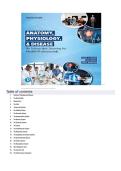
test bank for Anatomy, Physiology, & Disease: An Interactive Journey for Health Professionals, 4th Edition by Bruce J. Colbert, Jeff J. Ankney, and Karen T. Lee.
Table of contents
1. Anatomy, Physiology, and Disease
2. The Human Body
3. Biochemistry
4. The Cells
5. Tissues and Systems
6. The Skeletal System
7. The Muscular System
8. The Integumentary System
9. The Nervous System
10. The Endocrine System
11. The Senses
12. The Cardiovascular System
13. The Respiratory System
14. The Lymphatic and Immune Systems
15. The Gastrointestinal System
16. The Urinary System
17. The Reproductive System
18. Basic Diagnostic Tests
19. The Journey’s End
20. The Study Success Companion
,Ch 01
It includes exam-style questions and answers covering major anatomy, physiology, and disease concepts across body systems. The material is designed to help nursing and health science
students prepare for exams, reinforce key physiological processes, and practice assessment-style questions used in coursework.
1. The cause of a disease is called:
A) Prognosis
B) Etiology
C) Syndrome
D) Pathology
Correct Answer: B — Etiology
Rationale:
Etiology refers to the underlying cause or origin of a disease. Determining etiology
helps clinicians understand how a disease develops and how it should be treated.
Prognosis predicts outcomes, pathology studies disease processes, and syndrome
refers to a group of associated signs and symptoms.
2. Which system is considered the mathematical language of medicine?
A) English system
B) Metric system
C) Customary system
D) National system
Correct Answer: B — Metric system
Rationale:
The metric system uses decimal-based measurements such as grams, meters, and
liters. Because it is standardized and easy to convert between units by moving decimal
points, it is widely used in healthcare for medication dosages, laboratory values, and
physiological measurements.
3. Gross anatomy is also called:
A) Microscopic anatomy
B) Pathologic anatomy
C) Macroscopic anatomy
D) Diagnostic anatomy
Correct Answer: C — Macroscopic anatomy
Rationale:
Gross anatomy examines structures visible without magnification. It studies organs,
bones, and tissues that can be observed with the naked eye. Microscopic anatomy
requires microscopes to examine cells and tissues, making macroscopic anatomy the
correct synonym.
4. The normal adult heart rate is:
A) 10–30 bpm
B) 70–120 bpm
C) 90–170 bpm
D) 60–100 bpm
Correct Answer: D — 60–100 bpm
Rationale:
A resting adult heart rate normally ranges from 60 to 100 beats per minute. Values
,above this range indicate tachycardia, while values below indicate bradycardia.
Monitoring heart rate helps healthcare providers assess cardiovascular health and
detect abnormalities.
5. Which is NOT a vital sign?
A) Temperature
B) Respiratory rate
C) Heart rate
D) Odor
Correct Answer: D — Odor
Rationale:
Vital signs are objective measurements used to assess basic body function. These
include temperature, pulse (heart rate), respiratory rate, and blood pressure. Odor
may provide clinical clues but is not a standardized physiological measurement used
to evaluate patient stability.
6. The study of disease is known as:
A) Pathology
B) Cytology
C) Microbiology
D) Neurology
Correct Answer: A — Pathology
Rationale:
Pathology focuses on the causes, development, and effects of diseases on the body. It
examines structural and functional changes occurring in tissues and organs. Other
disciplines study specific areas such as cells, microorganisms, or the nervous system.
7. A positive feedback loop occurs in:
A) Blood pressure regulation
B) Childbirth
C) Temperature control
D) Blood glucose regulation
Correct Answer: B — Childbirth
Rationale:
Positive feedback amplifies a physiological response. During childbirth, uterine
contractions stimulate hormone release that increases contraction strength until
delivery occurs. Most body systems use negative feedback to maintain balance, but
childbirth requires positive feedback to complete the process.
8. The suffix -oma means:
A) Pain
B) Tumor
C) Inflammation
D) Enlargement
Correct Answer: B — Tumor
Rationale:
The suffix -oma refers to tumors or abnormal growths. Examples include lymphoma
and osteoma. Medical suffixes provide information about diseases, procedures, or
conditions. Understanding these suffixes allows healthcare professionals to interpret
medical terminology accurately.
,9. The abbreviation RBC refers to:
A) Red blood cells
B) Ruptured blood clot
C) Rapid blood circulation
D) Respiratory blood control
Correct Answer: A — Red blood cells
Rationale:
Red blood cells transport oxygen from the lungs to body tissues and carry carbon
dioxide back to the lungs for removal. They contain hemoglobin and are essential for
cellular respiration and energy production within body tissues.
10. The prediction of the outcome of a disease is called:
A) Etiology
B) Prognosis
C) Diagnosis
D) Pathogenesis
Correct Answer: B — Prognosis
Rationale:
Prognosis refers to the anticipated course and outcome of a disease, including
chances of recovery or complications. Diagnosis identifies the disease, while etiology
explains the cause. Prognosis helps guide treatment planning and patient counseling.
11. Which term refers to fast heart rate?
A) Bradycardia
B) Tachycardia
C) Arrhythmia
D) Cardiology
Correct Answer: B — Tachycardia
Rationale:
Tachycardia occurs when the heart beats faster than the normal range, typically above
100 beats per minute in adults. The prefix “tachy-” means rapid, and “cardia” refers to
the heart. Bradycardia describes an abnormally slow heart rate.
12.
The body's ability to maintain a stable internal environment is called:
A) Metabolism
B) Homeostasis
C) Pathology
D) Adaptation
Correct Answer: B — Homeostasis
Rationale:
Homeostasis ensures internal stability in factors such as body temperature, blood
pressure, and pH levels. The body constantly adjusts physiological processes through
feedback mechanisms to maintain this balance, which is essential for survival and
proper cellular function.
13.
Which of the following is a symptom?
, A) Blood pressure
B) Temperature
C) Pain
D) Heart rate
Correct Answer: C — Pain
Rationale:
Symptoms are subjective experiences reported by patients, such as pain, nausea, or
dizziness. Signs, on the other hand, are objective measurements observed by
healthcare professionals. Pain cannot be directly measured and must be described by
the patient.
14. The suffix -algia means:
A) Pain
B) Tumor
C) Inflammation
D) Study of
Correct Answer: A — Pain
Rationale:
The suffix -algia indicates pain or painful conditions. For example, neuralgia means
nerve pain and myalgia means muscle pain. Medical suffixes are essential for
interpreting clinical terminology used in diagnoses and documentation.
15. A disease that develops slowly over time is called:
A) Acute
B) Chronic
C) Relapse
D) Remission
Correct Answer: B — Chronic
Rationale:
Chronic diseases develop gradually and persist for long periods, often requiring
long-term management. Examples include diabetes and hypertension. Acute diseases
appear suddenly and usually resolve within a short time.
16. The body's first line of defense against infection is the:
A) Skin
B) Immune system
C) Inflammatory response
D) Antibody production
Correct Answer: A — Skin
Rationale:
The skin provides a protective barrier that prevents pathogens from entering the
body. It works alongside mucous membranes and protective secretions to form the
body's first defense against infection before immune responses become activated.
17. Which abbreviation means twice a day?
A) t.i.d.
B) b.i.d.
C) q.i.d.
D) p.r.n.
Correct Answer: B — b.i.d.
test bank for Anatomy, Physiology, & Disease: An Interactive Journey for Health Professionals, 4th Edition by Bruce J. Colbert, Jeff J. Ankney, and Karen T. Lee.
Table of contents
1. Anatomy, Physiology, and Disease
2. The Human Body
3. Biochemistry
4. The Cells
5. Tissues and Systems
6. The Skeletal System
7. The Muscular System
8. The Integumentary System
9. The Nervous System
10. The Endocrine System
11. The Senses
12. The Cardiovascular System
13. The Respiratory System
14. The Lymphatic and Immune Systems
15. The Gastrointestinal System
16. The Urinary System
17. The Reproductive System
18. Basic Diagnostic Tests
19. The Journey’s End
20. The Study Success Companion
,Ch 01
It includes exam-style questions and answers covering major anatomy, physiology, and disease concepts across body systems. The material is designed to help nursing and health science
students prepare for exams, reinforce key physiological processes, and practice assessment-style questions used in coursework.
1. The cause of a disease is called:
A) Prognosis
B) Etiology
C) Syndrome
D) Pathology
Correct Answer: B — Etiology
Rationale:
Etiology refers to the underlying cause or origin of a disease. Determining etiology
helps clinicians understand how a disease develops and how it should be treated.
Prognosis predicts outcomes, pathology studies disease processes, and syndrome
refers to a group of associated signs and symptoms.
2. Which system is considered the mathematical language of medicine?
A) English system
B) Metric system
C) Customary system
D) National system
Correct Answer: B — Metric system
Rationale:
The metric system uses decimal-based measurements such as grams, meters, and
liters. Because it is standardized and easy to convert between units by moving decimal
points, it is widely used in healthcare for medication dosages, laboratory values, and
physiological measurements.
3. Gross anatomy is also called:
A) Microscopic anatomy
B) Pathologic anatomy
C) Macroscopic anatomy
D) Diagnostic anatomy
Correct Answer: C — Macroscopic anatomy
Rationale:
Gross anatomy examines structures visible without magnification. It studies organs,
bones, and tissues that can be observed with the naked eye. Microscopic anatomy
requires microscopes to examine cells and tissues, making macroscopic anatomy the
correct synonym.
4. The normal adult heart rate is:
A) 10–30 bpm
B) 70–120 bpm
C) 90–170 bpm
D) 60–100 bpm
Correct Answer: D — 60–100 bpm
Rationale:
A resting adult heart rate normally ranges from 60 to 100 beats per minute. Values
,above this range indicate tachycardia, while values below indicate bradycardia.
Monitoring heart rate helps healthcare providers assess cardiovascular health and
detect abnormalities.
5. Which is NOT a vital sign?
A) Temperature
B) Respiratory rate
C) Heart rate
D) Odor
Correct Answer: D — Odor
Rationale:
Vital signs are objective measurements used to assess basic body function. These
include temperature, pulse (heart rate), respiratory rate, and blood pressure. Odor
may provide clinical clues but is not a standardized physiological measurement used
to evaluate patient stability.
6. The study of disease is known as:
A) Pathology
B) Cytology
C) Microbiology
D) Neurology
Correct Answer: A — Pathology
Rationale:
Pathology focuses on the causes, development, and effects of diseases on the body. It
examines structural and functional changes occurring in tissues and organs. Other
disciplines study specific areas such as cells, microorganisms, or the nervous system.
7. A positive feedback loop occurs in:
A) Blood pressure regulation
B) Childbirth
C) Temperature control
D) Blood glucose regulation
Correct Answer: B — Childbirth
Rationale:
Positive feedback amplifies a physiological response. During childbirth, uterine
contractions stimulate hormone release that increases contraction strength until
delivery occurs. Most body systems use negative feedback to maintain balance, but
childbirth requires positive feedback to complete the process.
8. The suffix -oma means:
A) Pain
B) Tumor
C) Inflammation
D) Enlargement
Correct Answer: B — Tumor
Rationale:
The suffix -oma refers to tumors or abnormal growths. Examples include lymphoma
and osteoma. Medical suffixes provide information about diseases, procedures, or
conditions. Understanding these suffixes allows healthcare professionals to interpret
medical terminology accurately.
,9. The abbreviation RBC refers to:
A) Red blood cells
B) Ruptured blood clot
C) Rapid blood circulation
D) Respiratory blood control
Correct Answer: A — Red blood cells
Rationale:
Red blood cells transport oxygen from the lungs to body tissues and carry carbon
dioxide back to the lungs for removal. They contain hemoglobin and are essential for
cellular respiration and energy production within body tissues.
10. The prediction of the outcome of a disease is called:
A) Etiology
B) Prognosis
C) Diagnosis
D) Pathogenesis
Correct Answer: B — Prognosis
Rationale:
Prognosis refers to the anticipated course and outcome of a disease, including
chances of recovery or complications. Diagnosis identifies the disease, while etiology
explains the cause. Prognosis helps guide treatment planning and patient counseling.
11. Which term refers to fast heart rate?
A) Bradycardia
B) Tachycardia
C) Arrhythmia
D) Cardiology
Correct Answer: B — Tachycardia
Rationale:
Tachycardia occurs when the heart beats faster than the normal range, typically above
100 beats per minute in adults. The prefix “tachy-” means rapid, and “cardia” refers to
the heart. Bradycardia describes an abnormally slow heart rate.
12.
The body's ability to maintain a stable internal environment is called:
A) Metabolism
B) Homeostasis
C) Pathology
D) Adaptation
Correct Answer: B — Homeostasis
Rationale:
Homeostasis ensures internal stability in factors such as body temperature, blood
pressure, and pH levels. The body constantly adjusts physiological processes through
feedback mechanisms to maintain this balance, which is essential for survival and
proper cellular function.
13.
Which of the following is a symptom?
, A) Blood pressure
B) Temperature
C) Pain
D) Heart rate
Correct Answer: C — Pain
Rationale:
Symptoms are subjective experiences reported by patients, such as pain, nausea, or
dizziness. Signs, on the other hand, are objective measurements observed by
healthcare professionals. Pain cannot be directly measured and must be described by
the patient.
14. The suffix -algia means:
A) Pain
B) Tumor
C) Inflammation
D) Study of
Correct Answer: A — Pain
Rationale:
The suffix -algia indicates pain or painful conditions. For example, neuralgia means
nerve pain and myalgia means muscle pain. Medical suffixes are essential for
interpreting clinical terminology used in diagnoses and documentation.
15. A disease that develops slowly over time is called:
A) Acute
B) Chronic
C) Relapse
D) Remission
Correct Answer: B — Chronic
Rationale:
Chronic diseases develop gradually and persist for long periods, often requiring
long-term management. Examples include diabetes and hypertension. Acute diseases
appear suddenly and usually resolve within a short time.
16. The body's first line of defense against infection is the:
A) Skin
B) Immune system
C) Inflammatory response
D) Antibody production
Correct Answer: A — Skin
Rationale:
The skin provides a protective barrier that prevents pathogens from entering the
body. It works alongside mucous membranes and protective secretions to form the
body's first defense against infection before immune responses become activated.
17. Which abbreviation means twice a day?
A) t.i.d.
B) b.i.d.
C) q.i.d.
D) p.r.n.
Correct Answer: B — b.i.d.