46
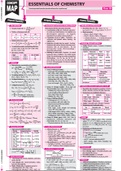
CONCEPT ESSENTIALS OF CHEMISTRY
CHEMISTRY TODAY | MAY '15
Some important formulae, trends and terms for a 'quick recap'. Class XII
Physical Che Inorganic Che Organic Che
mistry mis try m istry
The Solid State General Principles and Processes of Isolation of Elements Haloalkanes and Haloarenes
Z´M
l Density of unit cell : d = g cm -3 Main steps involved in extraction of metals : l Reactivity order : RI > RBr > RCl; 3° > 2° > 1°;
a3 ´ NA l Concentration of the ore : Hydraulic separation : SN1 reaction : 3° > 2° > 1°; SN2 reaction : 1° > 2° > 3°
l Total no. of atoms per unit cell : for oxide ores; Froth floatation : for sulphide ores; l Dipole moments :
sc bcc fcc Electromagnetic separation : for magnetic – CH3Cl > CH3F > CH3Br > CH3I
1 1 1 1 impurities/ores; Leaching : chemical method – CH3Cl > CH2Cl2 > CHCl3 > CCl4(zero)
8´ =1 8 ´ +1´1 = 2 8 ´ + 6 ´ = 4 l Conversion of ore to oxide : Calcination : for Adsorption>Isotherms
– o -Dichlorobenzene m -dichlorobenzene
8 8 8 2
carbonates and hydrated oxides; Roasting : for ~ chlorobenzene > p-dichlorobenzene (zero)
l Relation between d, a and r sulphide ores.
d a d a
sc : r = = ; fcc : r = = ; bcc : r = d = 3a l Reduction of oxide into free metal : Smelting : Alcohols, Phenols and Ethers
2 2 2 2 2 2 4 Reduction with carbon; Alumino-thermite process :
l Coordination number and packing efficiency l Acidity : Phenols > water > 1° alcohol > 2° alcohol >
Reduction with Al; Auto-reduction : for less
3° alcohol
sc : CN = 6, PE = 52.4%; bcc : CN = 8, PE = 68%; electropositive metals; Electrometallurgy :
l Distinction test of alcohols :
fcc : CN = 12, PE = 74% Electrolysis of fused oxide
l Refining of crude metal : Liquation : for metals
Alcohol Dichromate Victor Lucas
l Size and no. of voids :
(Oxidation) test Meyer’s test test
Type Size No. of Voids having low b.pts.; Distillation : for volatile metals;
1° Acid Blood red No
Octahedral 0.414 R N Poling : for metals having own oxides as impurities;
(Orange solution colour turbidity
Electrorefining : for Cu, Ag, Au, Ni, Cr, Al;
Tetrahedral 0.225 R 2N becomes green)
Zone refining : for Si, Ge, Ga.; van-Arkel method : 2° Ketone Blue Turbidity
for Ti, Zr; Chromatography : for elements available (Orange solution colour in 5 minutes
Solutions
in minute quantities. becomes green)
l Expression for concentration of a solution : 3° No reaction Colourless Turbidity
w2 ´ 1000 w ´ 1000 The p-Block Elements
M= ;N= 2 immediately
M2 ´ V(in mL) E2 ´ V(in mL) l Group 15 (Nitrogen family) : l Distinction test of phenol :
n2 n1 w2
x2 = ,x = ; ppm = ´ 106 – Bond angle, Thermal stability and Basic strength : Test Observation
n1 + n2 1 n1 + n2 Msoln. NH3 > PH3 > AsH3 > SbH3 > BiH3 FeCl3 test Violet colour
l On mixing solutions : N1V1 + N2V2 = N3(V1 + V2) ; – B.Pt. : PH3 < AsH3 < NH3 < SbH3 < BiH3 Br2 – H2O test White ppt.
M1V1 + M2V2 = M3(V1 + V2) – M.Pt.: PH3 < AsH3 < SbH3 < NH3 Liebermann's nitroso test Deep green/blue
l For liquid solutions : pA = xA × p A° ; pB = xB × p B° ; – Reducing nature : NH3 < PH3 < AsH3 < SbH3 < BiH3 (NaNO2 + conc. H2SO4) colour which changes
pA – Bond angle : PF3 < PCl3 < PBr3 < PI3 into red on dilution.
Ptotal = pA + pB; yA = , y = 1 – yA
p A + pB B – Lewis acid strength : PCl3 > AsCl3 > SbCl3; Azo dye test Orange colour
l Colligative properties : DTb = iK b ´ m PF3 > PCl3 > PBr3 > PI3
Aldehydes, Ketones and Carboxylic Acids
n p° - ps l Group 16 (Oxygen family) : Bond angle and
DTf = iK f ´ m; p = i RT ; = ix2
V p° Thermal stability : H2O > H2S > H2Se > H2Te l Reactivity order towards SN reactions : HCHO >
i -1 n – Volatility : H2S > H2Se > H2Te > H2O RCHO > PhCHO > RCOR > RCOPh > PhCOPh
a(disso.) = ;a = (1 - i)
n - 1 (asso.) n -1 – Acidic strength and Reducing nature : l Distinction test of aldehydes & ketones :
M C
i = c or o (where M = molar mass, H2O < H2S < H2Se < H2Te Test Aldehydes
Adsorption Isotherms Ketones
Mo Cc C = colligative property) – Stability : SF6 > SeF6 > TeF6 Schiff 's reagent Pink colour No colour
l Group 17 (Halogen family) : Adsorption
Fehling's solution Red ppt. Isotherms No ppt.
Electrochemistry – Oxidizing power : F2 > Cl2 > Br2 > I2 Tollens' reagent Silver mirror No ppt.
V 1 a l – B.Pt. and M.Pt. : HF > HCl < HBr < HI
l R= ; G = ; r = R ;k = G ´ l Acidity : Carboxylic acids > Phenols > Alcohols
I R l a – Dipole moment and Thermal stability :
HF > HCl > HBr > HI l Distinction test of carboxylic acids :
1000 1000
l Leq = k ´ V = k ´ ; Lm = k ´ V = k ´ – Bond length, Acidic strength and Reducing Test Carboxylic acids
Adsorption Phenols
Isotherms
N M
nature : HF < HCl < HBr < HI NaHCO3 Brisk effervescence of No reaction
¥ ¥
l
c
Lm = Lm - b C ; Leq = lc¥ + la¥ ; L m
¥
= x lc¥ + y la¥ CO2 gas
– Acidic strength : HClO < HClO2 < HClO3 < HClO4;
Lcm HOCl > HOBr > HOI; HClO4 > HBrO4 > HIO4 FeCl3 Buff coloured ppt. Violet colour
l a= ¥
; DG ° = -nFEcell
° = - RT ln K
c
Lm – Oxidizing power : HClO > HClO2 > HClO3 > HClO4
W1 E1 ° l Group 18 (Noble gases): M.Pt., B.Pt., Ease of Amines
lW = ZIt ; = ; E = E(cathode)
° - E(anode)
°
W2 E2 cell liquefaction, Solubility, Adsor ption and l Basic nature : Aliphatic amine > NH3 > aromatic
0.0591 1 0.0591 Polarizability : He < Ne < Ar < Kr < Xe amine; 3° > 2° > 1° > NH3 [in gas phase/in non-aq.
l Ecell = Ecell
° - ° =
log n+ ; Ecell log K c
n [M ] n – Thermal conductivity : He > Ne > Ar > Kr > Xe solvent]; 2° > 1° > 3° > NH3 [in aq. phase, only —CH3 subs.
amines]; 2° > 3° > 1° > NH3 [in aq. phase, only —C2H5
Chemical Kinetics d- and f-Block Elements subs. amines]
l Expressions for different orders : l d-block elements : (n –1)d1–10ns0–2 l Distinction test (Hinsberg's test):
Rate law Integrated rate law Half-life – 3d series : 21Sc – 30Zn C6H5SO2Cl + 1°, 2° or 3° amines
Rate = k[A]0 [A]t = –kt + [A]0 t1/2 = [A]0/2k – 4d series : 39Y – 48Cd; 5d series : 57La, 72Hf – 80Hg KOH
Clear solution Soluble salt [1° amine]
[0 order] – 6d series : 89Ac, 104Rf – 112Cn KOH
Rate = k[A]1 ln[A]t = –kt + ln[A]0 t1/2 = 0.693 k ppt. No reaction [2° amine]
– Acidic character : MnO < Mn3O4 < Mn2O3 < MnO2 No reaction [3° amine]
[1st order]
Rate = k[A]2 < Mn2O7; Ionic character : MnO > Mn3O4 > Mn2O3
1/[A]t = kt + 1/[A]0 t1/2 = 1/k[A]0 – ArN2+X– are more stable than RN2+X–.
[2nd order] > MnO2 > Mn3O7
1 [B] [ A] – EDGs stabilise while EWGs destabilise the
Rate = k[A][B] kt = ln 0
[ A]0 - [B]0 [ A]0[B] 1/2
t = 1/k[A]0 l f-block elements : (n –2)f1–14(n –1)d0–1ns2
[2nd order] – La(OH)3 to Lu(OH)3 : Basicity decreases; La3+ diazonium salts.
1
(n - 1)kt = n-1 -
1 2n-1 - 1
Rate = k[A]n t =
to Lu3+ : Tendency to form complexes increases
[ A] [ A0 ]n-1 1/2 k(n - 1)[ A]n-1
[nth order] 0
Biomolecules
l Arrhenius equation : Coordination Compounds l Reducing sugars : All monosaccharides
Ea é T2 - T1 ù
CHEMISTRY TODAY | MAY '15
k Ligand
k = Ae - Ea /RT ; log 2 =
Central metal ion l Non reducing sugars : All polysaccharides and
ê ú
k1 2.303 R ë T1T2 û K4 [Fe(CN) 6 ] disaccharides like sucrose.
Counter ion Coordination number l Fat soluble vitamins : A, D, E and K.
Coordination sphere/entity
Surface Chemistry l Water soluble vitamins : B1, B2, B6, B12 and C
l –vely charged sols : Metals, sulphides, acidic dyes, l Spectrochemical series :
starch, clay, silk. I– < Br– < SCN– < Cl– < S2– < F– < OH– < C2O42– < Polymers
l +vely charged sols : Metal hydroxides, oxides, H2O < NCS– < edta4– < NH3 < en < NO2– < CN– < CO l Addition homopolymers : Polythene, polystyrene
basic dyes, haemoglobin. 4 l Condensation homopolymers : Nylon-6, PHB
l m = n(n + 2) B.M.; Dt = D o ;
l Hardy–Schulze rule : Coagulation power for 9 l Addition copolymers : Buna-S, Buna-N
–vely charged sols : Al3+ > Ba2+ > Na+ l CFSE = (– 0.4x + 0.6y)Do where, x = no. of e–s in t2g l Condensation copolymers : Nylon-6, 6, Nylon-6, 10
+vely charged sols : [Fe(CN)6]4– > PO43– > SO42– > Cl– orbitals, y = no. of e–s in eg orbitals. l Biodegradable copolymers : PHBV, Nylon 2- nylon 6.
47
,CONCEPT Alcohols, phenols and ethers are the basic
ALCOHOLS, PHENOLS compounds of organic chemistry and they
find wide applications in industry as well as
in day-to-day life.
AND ETHERS
Chemical properties
l Cleavage of O—H bond : Ease of reaction depends on stability
Physical properties of alkoxide ion.
B.pt. µ No. of C-atoms Acidity : Phenols > Water > 1° alcohol > 2° alcohol > 3° alcohol
l Cleavage of C—OH bond : Ease of reaction depends on stability of
Solubility µ Branching carbocations.
Order of reactivity : 3° alcohol > 2° alcohol > 1° alcohol
ALCOHOLS l Reactions involving whole alcohol molecule :
443 K
(CnH2n+1OH) C C
413 K
Dehydration : R—OH + conc. H2SO4 ROR
142 pm
:O: 96 pm 383 K
RO—SO2OH
H 513 K
ROR
C 108.9° H Preparation R—OH + Al2O3 633 K
H sp3 l RX + KOH(aq.) ® ROH + KX C C
H conc. H2SO4/H2O [O] [O]
Oxidation : Alcohol Aldehyde/Ketone Carboxylic acid
(Markovnikov's addition)
Cu/273 K
l C C RCH2OH Dehydrogenation : 1° alcohol Aldehyde
Alkene (i) B2H6 in THF
Cu/273 K
(ii) H2O2, OH – 2° alcohol Ketone
(Anti-Markovnikov's addition) Cu/273 K
Dehydration : 3° alcohol C C
l HCHO H2/Pt or Pd or Ni
RCH2OH
Reduction
or 1° Alcohol
RCHO
NaBH4 or LiAlH4
or Distinction tests
or R CH R l Dichromate test (oxidation) : 1° alcohol ® Acid with same
or Na/C2H5OH
Grignard's
R number of C-atoms; 2° alcohol ® Ketone with same number of
reagent
C O OH
R
Carbonyl 2° Alcohol C-atoms; 3° alcohol ® No reaction under normal conditions.
(i) RMgX/Dry ether
compounds or l Victor Meyer’s test : 1° alcohol ® Blood red colour;
(ii) H2O/H + R3C—OH
2° alcohol ® Blue colour; 3° alcohol ® Colourless.
3° Alcohol
(i) LiAlH4 or B2H6/ether l Lucas test : 1° alcohol ® No turbidity; 2° alcohol ® Turbidity in
l RCOOH RCH2OH
PHENOLS Carboxylic acids
(ii) H3O + 5 minutes; 3° alcohol ® Turbidity appears immediately.
(C6H5OH)
109° Some important alcohols
H Methanol : Prepared by catalytic hydrogenation of carbon
: :
l
O
136 pm monoxide or water gas. It is used as a solvent, preservative,
Physical properties
sp2 substitute for petrol, etc.
l Pure phenols are colourless liquids or solids.
l Form intermolecular hydrogen bonds hence, soluble in water. l Ethanol : Prepared by the hydration of ethene or by the fermentation
of molasses. It is used as an antiseptic, power alcohol, in beverages, etc.
Preparation
NaOH NaOH dil. HCl Chemical properties
l C6H5SO3H –H O C6H5SO3Na 573-623 K, C6H5ONa –NaCl
2 l Electrophilic substitution of phenols : Halogenation,
–Na2SO3, –H2O
dil. H2SO4, D
sulphonation, nitration, Friedel—Crafts alkylation, etc. occur at
– +
C6H5 N2Cl + H2O C6H5OH o- and p- positions due to activating effect of —OH group.
–N2, –HCl
Phenol
623 K, 320 atm dil. HCl
C6H5Cl + NaOH C6H5ONa –NaCl
–NaCl, –H2O
1. O2 Tests to distinguish phenols from alcohols
C6H5CH(CH3)2 FeCl3 test : Gives violet colour
2. H+, H2O l
Cumene
l Br2 – H2O test : Gives white ppt.
ETHERS l Liebermann’s nitroso test : Gives blue colour which turns red on
(CnH2n + 2O dilution
l Ammonia/Sodium hypochlorite test : Gives blue colour
where n > 1)
141 pm
:O: Classification l Azo dye test : Gives orange colour
H H l Simple or symmetrical : Same alkyl groups are attached to
H C 111.7° C H oxygen, ROR.
H sp3 H Physical properties
l Mixed or unsymmetrical : Different alkyl groups are l Dipolar due to slightly polar C—O bonds.
attached to oxygen, ROR¢.
l B.pts. are lower than isomeric alcohols due to lack of hydrogen
l Aliphatic ethers : R and R¢ both are alkyl groups.
l Aromatic ethers : Either one or both R and R¢ are aryl groups. bonding.
l Solubility in water (soluble due to formation of
H–bonds with water)
l Fairly soluble in organic solvents.
Chemical properties
l Reaction of ethereal oxygen :
l Lighter than water.
R +
ROR + HCl(conc.) O – H Cl– Preparation
R
:
conc. H2SO4, 413 K
2ROH
l Cleavage of C – O bond : or Al2O3, 523 K ROR
373 K
R – OR + HX R – OH + R – X D Ether
RX + RONa
– In case of alkyl aryl ethers, phenol and an alkyl halide are obtained. (Williamson synthesis) –NaX
dil. H2SO4 l Williamson synthesis involves SN2 mechanism in case of 1° alkyl
ROR + H2O 2R – OH halides.
D
ROR + PCl5 D 2R – Cl l In the case of 2° and 3° alkyl halides, elimination takes place.
l Reactions involving alkyl group : l Dehydration of alcohols for the formation of ethers follows the order :
– Formation of peroxides with air and light. 1° > 2° > 3°
– Substitution products obtained on halogenation.
l Electrophilic substitution reactions : Uses
Aryl alkyl ethers give o- and p-substituted products due to +R effect of Ethers are used as industrial solvents, heat transfer medium (diphenyl
alkoxy group (–OR). ether), flavouring agents and in perfumes.
,
, 46
CHEMISTRY TODAY | JUNE '15
CONCEPT SOME BASIC CONCEPTS OF CHEMISTRY
Introduction of most fundamental and important tools of chemistry which help in various calculations.
SI Units Law of Conservation of Mass Masses
SI system has seven base units pertaining to Matter can neither be created nor destroyed. Atomic mass unit (amu or u) : Mass exactly
seven fundamental scientific quantities : equal to 1/12th of the mass of an atom of
C-12 isotope.
Physical quantity SI unit Law of Definite Proportions
Atomic mass of an element : Average
Length (l) metre (m) A given compound always contains exactly the relative mass of its atoms as compared to an
same proportion of elements by weight.
Mass (m) kilogram (kg) atom of C-12.
Average atomic mass : Given for isotopes.
Time (t) second (s) Xi Ai where Xi = % abundance
Law of Multiple Proportions
Electric current (I) ampere (A) X i Ai = atomic mass
If two elements can combine to form more than Gram atomic mass : Atomic mass of an
Thermodynamic kelvin (K)
one compound, the masses of one element that element expressed in grams.
temperature (T)
combine with a fixed mass of the other element, Molecular mass : Sum of atomic masses of
Amount of substance (n) mole (mol) are in the ratio of small whole numbers. all the elements present in a molecule.
Luminous intensity (Iv) candela (cd)
Gay Lussac’s Law of Gaseous Volumes Mole Concept
SI system allows the use of prefixes to
indicate the multiples or submultiples of a When gases combine or are produced in a Mole : Collection of 6.022 × 10²³ particles
unit : chemical reaction they do so in a simple ratio In case of
by volume provided all gases are at same atomic substances :
deci - 10–1 deka - 101 temperature and pressure. 1 mole = Gram atomic mass = 1 gram atom
centi - 10–2 hecto - 102 = 6.022 × 10²³ atoms
molecular substances :
milli - 10–3 kilo - 103
Avogadro's Law 1 mole = Gram molecular mass
micro - 10–6 mega - 106 = 1 gram molecule
nano - 10–9 giga - 109 Equal volumes of gases at the same temperature = 6.022 × 10²³ molecules
pico - 10–12 tera - 1012 and pressure should contain equal number of gaseous substances :
molecules. 1 mole = 22.4 L at STP
Scientific Notation Dalton's Atomic Theory Percentage Composition
A number is represented as x × 10n Matter consists of indivisible atoms. It shows mass of a constituent in 100 parts of a
n is –ve if decimal is moved towards right All the atoms of a given element have compound.
and n is +ve if it is moved towards left. identical properties including identical Mass % of an element
mass. Atoms of different elements differ in Mass of that element in the compound
100
mass. Molar mass of the compound
Significant Figures Compounds are formed when atoms of
different elements combine in a fixed ratio.
These are all certain digits with last digit
Chemical reactions involve reorganisation
uncertain. Empirical Formula
of atoms. These are neither created nor
All non-zero digits are significant . It is the simplest whole number ratio of
destroyed in a chemical reaction.
Zeros preceding to first non-zero digit are different atoms present in a compound.
not significant. Steps to obtain empirical formula :
Zeros between two non-zero digits are
significant. Stoichiometry % age Change to
Molar ratio
Zeros on the right side of the decimal are At. mass
It deals with calculations based upon
significant.
chemical equations.
Molar ratio
Various steps involved in calculations are : Simplest molar ratio
Minimum molar ratio
Dimensional Analysis – Write balanced chemical equation.
– Write the relative number of moles or Change to
Required unit = Given value × conversion relative masses of reactants and products
factor Write the numbers below Simplest whole
involved below their formulae. number ratio =
the symbols of elements
Some useful conversion factors : – In case of gases write 22.4 L at STP in Simplest ratio × Integer
Length – 1Å = 10–8 cm = 10–10 m place of 1 mole. Empirical formula
1 nm = 10–9 m, 1 pm = 10–12 m – Apply unitary method to make required
Volume – 1 L = 1000 mL calculations.
= 1000 cm3 = 1 dm3 = 10–3 m3
Molecular Formula
Pressure – 1 atm = 760 mm or torr
= 101325 Pa It is the formula showing exact number of
Limiting Reagent
1 bar = 105 Nm–2 = 105 Pa atoms present in a molecule.
Energy – 1 calorie = 4.184 J The reactant which gets consumed completely Molecular formula = n × empirical formula
1 eV = 1.6022 × 10⁻¹⁹ J and limits the amount of product formed is
1 J = 10 7 ergs called limiting reagent.
CHEMISTRY TODAY | JUNE '15
Reactions in Solutions
wsolute
Mass percent (%) = 100
wsolution
HAVE A LOOK !
nA nB
Mole fraction (xA) = ,x
Mass is the quantity of matter contained in the substance and is constant whereas weight varies nA nB B nA nB
from place to place. w2 1000
Molarity (M) =
Exact numbers have an infinite number of significant figures. M2 V (in mL)
Molar volume of a gas is 22.7 L at 1 bar and 0°C. w2 1000
Molality (m) =
The number of molecules in 1 mL of a gas at STP is known as Loschmidt number. M2 w1(in g)
47
CONCEPT ESSENTIALS OF CHEMISTRY
CHEMISTRY TODAY | MAY '15
Some important formulae, trends and terms for a 'quick recap'. Class XII
Physical Che Inorganic Che Organic Che
mistry mis try m istry
The Solid State General Principles and Processes of Isolation of Elements Haloalkanes and Haloarenes
Z´M
l Density of unit cell : d = g cm -3 Main steps involved in extraction of metals : l Reactivity order : RI > RBr > RCl; 3° > 2° > 1°;
a3 ´ NA l Concentration of the ore : Hydraulic separation : SN1 reaction : 3° > 2° > 1°; SN2 reaction : 1° > 2° > 3°
l Total no. of atoms per unit cell : for oxide ores; Froth floatation : for sulphide ores; l Dipole moments :
sc bcc fcc Electromagnetic separation : for magnetic – CH3Cl > CH3F > CH3Br > CH3I
1 1 1 1 impurities/ores; Leaching : chemical method – CH3Cl > CH2Cl2 > CHCl3 > CCl4(zero)
8´ =1 8 ´ +1´1 = 2 8 ´ + 6 ´ = 4 l Conversion of ore to oxide : Calcination : for Adsorption>Isotherms
– o -Dichlorobenzene m -dichlorobenzene
8 8 8 2
carbonates and hydrated oxides; Roasting : for ~ chlorobenzene > p-dichlorobenzene (zero)
l Relation between d, a and r sulphide ores.
d a d a
sc : r = = ; fcc : r = = ; bcc : r = d = 3a l Reduction of oxide into free metal : Smelting : Alcohols, Phenols and Ethers
2 2 2 2 2 2 4 Reduction with carbon; Alumino-thermite process :
l Coordination number and packing efficiency l Acidity : Phenols > water > 1° alcohol > 2° alcohol >
Reduction with Al; Auto-reduction : for less
3° alcohol
sc : CN = 6, PE = 52.4%; bcc : CN = 8, PE = 68%; electropositive metals; Electrometallurgy :
l Distinction test of alcohols :
fcc : CN = 12, PE = 74% Electrolysis of fused oxide
l Refining of crude metal : Liquation : for metals
Alcohol Dichromate Victor Lucas
l Size and no. of voids :
(Oxidation) test Meyer’s test test
Type Size No. of Voids having low b.pts.; Distillation : for volatile metals;
1° Acid Blood red No
Octahedral 0.414 R N Poling : for metals having own oxides as impurities;
(Orange solution colour turbidity
Electrorefining : for Cu, Ag, Au, Ni, Cr, Al;
Tetrahedral 0.225 R 2N becomes green)
Zone refining : for Si, Ge, Ga.; van-Arkel method : 2° Ketone Blue Turbidity
for Ti, Zr; Chromatography : for elements available (Orange solution colour in 5 minutes
Solutions
in minute quantities. becomes green)
l Expression for concentration of a solution : 3° No reaction Colourless Turbidity
w2 ´ 1000 w ´ 1000 The p-Block Elements
M= ;N= 2 immediately
M2 ´ V(in mL) E2 ´ V(in mL) l Group 15 (Nitrogen family) : l Distinction test of phenol :
n2 n1 w2
x2 = ,x = ; ppm = ´ 106 – Bond angle, Thermal stability and Basic strength : Test Observation
n1 + n2 1 n1 + n2 Msoln. NH3 > PH3 > AsH3 > SbH3 > BiH3 FeCl3 test Violet colour
l On mixing solutions : N1V1 + N2V2 = N3(V1 + V2) ; – B.Pt. : PH3 < AsH3 < NH3 < SbH3 < BiH3 Br2 – H2O test White ppt.
M1V1 + M2V2 = M3(V1 + V2) – M.Pt.: PH3 < AsH3 < SbH3 < NH3 Liebermann's nitroso test Deep green/blue
l For liquid solutions : pA = xA × p A° ; pB = xB × p B° ; – Reducing nature : NH3 < PH3 < AsH3 < SbH3 < BiH3 (NaNO2 + conc. H2SO4) colour which changes
pA – Bond angle : PF3 < PCl3 < PBr3 < PI3 into red on dilution.
Ptotal = pA + pB; yA = , y = 1 – yA
p A + pB B – Lewis acid strength : PCl3 > AsCl3 > SbCl3; Azo dye test Orange colour
l Colligative properties : DTb = iK b ´ m PF3 > PCl3 > PBr3 > PI3
Aldehydes, Ketones and Carboxylic Acids
n p° - ps l Group 16 (Oxygen family) : Bond angle and
DTf = iK f ´ m; p = i RT ; = ix2
V p° Thermal stability : H2O > H2S > H2Se > H2Te l Reactivity order towards SN reactions : HCHO >
i -1 n – Volatility : H2S > H2Se > H2Te > H2O RCHO > PhCHO > RCOR > RCOPh > PhCOPh
a(disso.) = ;a = (1 - i)
n - 1 (asso.) n -1 – Acidic strength and Reducing nature : l Distinction test of aldehydes & ketones :
M C
i = c or o (where M = molar mass, H2O < H2S < H2Se < H2Te Test Aldehydes
Adsorption Isotherms Ketones
Mo Cc C = colligative property) – Stability : SF6 > SeF6 > TeF6 Schiff 's reagent Pink colour No colour
l Group 17 (Halogen family) : Adsorption
Fehling's solution Red ppt. Isotherms No ppt.
Electrochemistry – Oxidizing power : F2 > Cl2 > Br2 > I2 Tollens' reagent Silver mirror No ppt.
V 1 a l – B.Pt. and M.Pt. : HF > HCl < HBr < HI
l R= ; G = ; r = R ;k = G ´ l Acidity : Carboxylic acids > Phenols > Alcohols
I R l a – Dipole moment and Thermal stability :
HF > HCl > HBr > HI l Distinction test of carboxylic acids :
1000 1000
l Leq = k ´ V = k ´ ; Lm = k ´ V = k ´ – Bond length, Acidic strength and Reducing Test Carboxylic acids
Adsorption Phenols
Isotherms
N M
nature : HF < HCl < HBr < HI NaHCO3 Brisk effervescence of No reaction
¥ ¥
l
c
Lm = Lm - b C ; Leq = lc¥ + la¥ ; L m
¥
= x lc¥ + y la¥ CO2 gas
– Acidic strength : HClO < HClO2 < HClO3 < HClO4;
Lcm HOCl > HOBr > HOI; HClO4 > HBrO4 > HIO4 FeCl3 Buff coloured ppt. Violet colour
l a= ¥
; DG ° = -nFEcell
° = - RT ln K
c
Lm – Oxidizing power : HClO > HClO2 > HClO3 > HClO4
W1 E1 ° l Group 18 (Noble gases): M.Pt., B.Pt., Ease of Amines
lW = ZIt ; = ; E = E(cathode)
° - E(anode)
°
W2 E2 cell liquefaction, Solubility, Adsor ption and l Basic nature : Aliphatic amine > NH3 > aromatic
0.0591 1 0.0591 Polarizability : He < Ne < Ar < Kr < Xe amine; 3° > 2° > 1° > NH3 [in gas phase/in non-aq.
l Ecell = Ecell
° - ° =
log n+ ; Ecell log K c
n [M ] n – Thermal conductivity : He > Ne > Ar > Kr > Xe solvent]; 2° > 1° > 3° > NH3 [in aq. phase, only —CH3 subs.
amines]; 2° > 3° > 1° > NH3 [in aq. phase, only —C2H5
Chemical Kinetics d- and f-Block Elements subs. amines]
l Expressions for different orders : l d-block elements : (n –1)d1–10ns0–2 l Distinction test (Hinsberg's test):
Rate law Integrated rate law Half-life – 3d series : 21Sc – 30Zn C6H5SO2Cl + 1°, 2° or 3° amines
Rate = k[A]0 [A]t = –kt + [A]0 t1/2 = [A]0/2k – 4d series : 39Y – 48Cd; 5d series : 57La, 72Hf – 80Hg KOH
Clear solution Soluble salt [1° amine]
[0 order] – 6d series : 89Ac, 104Rf – 112Cn KOH
Rate = k[A]1 ln[A]t = –kt + ln[A]0 t1/2 = 0.693 k ppt. No reaction [2° amine]
– Acidic character : MnO < Mn3O4 < Mn2O3 < MnO2 No reaction [3° amine]
[1st order]
Rate = k[A]2 < Mn2O7; Ionic character : MnO > Mn3O4 > Mn2O3
1/[A]t = kt + 1/[A]0 t1/2 = 1/k[A]0 – ArN2+X– are more stable than RN2+X–.
[2nd order] > MnO2 > Mn3O7
1 [B] [ A] – EDGs stabilise while EWGs destabilise the
Rate = k[A][B] kt = ln 0
[ A]0 - [B]0 [ A]0[B] 1/2
t = 1/k[A]0 l f-block elements : (n –2)f1–14(n –1)d0–1ns2
[2nd order] – La(OH)3 to Lu(OH)3 : Basicity decreases; La3+ diazonium salts.
1
(n - 1)kt = n-1 -
1 2n-1 - 1
Rate = k[A]n t =
to Lu3+ : Tendency to form complexes increases
[ A] [ A0 ]n-1 1/2 k(n - 1)[ A]n-1
[nth order] 0
Biomolecules
l Arrhenius equation : Coordination Compounds l Reducing sugars : All monosaccharides
Ea é T2 - T1 ù
CHEMISTRY TODAY | MAY '15
k Ligand
k = Ae - Ea /RT ; log 2 =
Central metal ion l Non reducing sugars : All polysaccharides and
ê ú
k1 2.303 R ë T1T2 û K4 [Fe(CN) 6 ] disaccharides like sucrose.
Counter ion Coordination number l Fat soluble vitamins : A, D, E and K.
Coordination sphere/entity
Surface Chemistry l Water soluble vitamins : B1, B2, B6, B12 and C
l –vely charged sols : Metals, sulphides, acidic dyes, l Spectrochemical series :
starch, clay, silk. I– < Br– < SCN– < Cl– < S2– < F– < OH– < C2O42– < Polymers
l +vely charged sols : Metal hydroxides, oxides, H2O < NCS– < edta4– < NH3 < en < NO2– < CN– < CO l Addition homopolymers : Polythene, polystyrene
basic dyes, haemoglobin. 4 l Condensation homopolymers : Nylon-6, PHB
l m = n(n + 2) B.M.; Dt = D o ;
l Hardy–Schulze rule : Coagulation power for 9 l Addition copolymers : Buna-S, Buna-N
–vely charged sols : Al3+ > Ba2+ > Na+ l CFSE = (– 0.4x + 0.6y)Do where, x = no. of e–s in t2g l Condensation copolymers : Nylon-6, 6, Nylon-6, 10
+vely charged sols : [Fe(CN)6]4– > PO43– > SO42– > Cl– orbitals, y = no. of e–s in eg orbitals. l Biodegradable copolymers : PHBV, Nylon 2- nylon 6.
47
,CONCEPT Alcohols, phenols and ethers are the basic
ALCOHOLS, PHENOLS compounds of organic chemistry and they
find wide applications in industry as well as
in day-to-day life.
AND ETHERS
Chemical properties
l Cleavage of O—H bond : Ease of reaction depends on stability
Physical properties of alkoxide ion.
B.pt. µ No. of C-atoms Acidity : Phenols > Water > 1° alcohol > 2° alcohol > 3° alcohol
l Cleavage of C—OH bond : Ease of reaction depends on stability of
Solubility µ Branching carbocations.
Order of reactivity : 3° alcohol > 2° alcohol > 1° alcohol
ALCOHOLS l Reactions involving whole alcohol molecule :
443 K
(CnH2n+1OH) C C
413 K
Dehydration : R—OH + conc. H2SO4 ROR
142 pm
:O: 96 pm 383 K
RO—SO2OH
H 513 K
ROR
C 108.9° H Preparation R—OH + Al2O3 633 K
H sp3 l RX + KOH(aq.) ® ROH + KX C C
H conc. H2SO4/H2O [O] [O]
Oxidation : Alcohol Aldehyde/Ketone Carboxylic acid
(Markovnikov's addition)
Cu/273 K
l C C RCH2OH Dehydrogenation : 1° alcohol Aldehyde
Alkene (i) B2H6 in THF
Cu/273 K
(ii) H2O2, OH – 2° alcohol Ketone
(Anti-Markovnikov's addition) Cu/273 K
Dehydration : 3° alcohol C C
l HCHO H2/Pt or Pd or Ni
RCH2OH
Reduction
or 1° Alcohol
RCHO
NaBH4 or LiAlH4
or Distinction tests
or R CH R l Dichromate test (oxidation) : 1° alcohol ® Acid with same
or Na/C2H5OH
Grignard's
R number of C-atoms; 2° alcohol ® Ketone with same number of
reagent
C O OH
R
Carbonyl 2° Alcohol C-atoms; 3° alcohol ® No reaction under normal conditions.
(i) RMgX/Dry ether
compounds or l Victor Meyer’s test : 1° alcohol ® Blood red colour;
(ii) H2O/H + R3C—OH
2° alcohol ® Blue colour; 3° alcohol ® Colourless.
3° Alcohol
(i) LiAlH4 or B2H6/ether l Lucas test : 1° alcohol ® No turbidity; 2° alcohol ® Turbidity in
l RCOOH RCH2OH
PHENOLS Carboxylic acids
(ii) H3O + 5 minutes; 3° alcohol ® Turbidity appears immediately.
(C6H5OH)
109° Some important alcohols
H Methanol : Prepared by catalytic hydrogenation of carbon
: :
l
O
136 pm monoxide or water gas. It is used as a solvent, preservative,
Physical properties
sp2 substitute for petrol, etc.
l Pure phenols are colourless liquids or solids.
l Form intermolecular hydrogen bonds hence, soluble in water. l Ethanol : Prepared by the hydration of ethene or by the fermentation
of molasses. It is used as an antiseptic, power alcohol, in beverages, etc.
Preparation
NaOH NaOH dil. HCl Chemical properties
l C6H5SO3H –H O C6H5SO3Na 573-623 K, C6H5ONa –NaCl
2 l Electrophilic substitution of phenols : Halogenation,
–Na2SO3, –H2O
dil. H2SO4, D
sulphonation, nitration, Friedel—Crafts alkylation, etc. occur at
– +
C6H5 N2Cl + H2O C6H5OH o- and p- positions due to activating effect of —OH group.
–N2, –HCl
Phenol
623 K, 320 atm dil. HCl
C6H5Cl + NaOH C6H5ONa –NaCl
–NaCl, –H2O
1. O2 Tests to distinguish phenols from alcohols
C6H5CH(CH3)2 FeCl3 test : Gives violet colour
2. H+, H2O l
Cumene
l Br2 – H2O test : Gives white ppt.
ETHERS l Liebermann’s nitroso test : Gives blue colour which turns red on
(CnH2n + 2O dilution
l Ammonia/Sodium hypochlorite test : Gives blue colour
where n > 1)
141 pm
:O: Classification l Azo dye test : Gives orange colour
H H l Simple or symmetrical : Same alkyl groups are attached to
H C 111.7° C H oxygen, ROR.
H sp3 H Physical properties
l Mixed or unsymmetrical : Different alkyl groups are l Dipolar due to slightly polar C—O bonds.
attached to oxygen, ROR¢.
l B.pts. are lower than isomeric alcohols due to lack of hydrogen
l Aliphatic ethers : R and R¢ both are alkyl groups.
l Aromatic ethers : Either one or both R and R¢ are aryl groups. bonding.
l Solubility in water (soluble due to formation of
H–bonds with water)
l Fairly soluble in organic solvents.
Chemical properties
l Reaction of ethereal oxygen :
l Lighter than water.
R +
ROR + HCl(conc.) O – H Cl– Preparation
R
:
conc. H2SO4, 413 K
2ROH
l Cleavage of C – O bond : or Al2O3, 523 K ROR
373 K
R – OR + HX R – OH + R – X D Ether
RX + RONa
– In case of alkyl aryl ethers, phenol and an alkyl halide are obtained. (Williamson synthesis) –NaX
dil. H2SO4 l Williamson synthesis involves SN2 mechanism in case of 1° alkyl
ROR + H2O 2R – OH halides.
D
ROR + PCl5 D 2R – Cl l In the case of 2° and 3° alkyl halides, elimination takes place.
l Reactions involving alkyl group : l Dehydration of alcohols for the formation of ethers follows the order :
– Formation of peroxides with air and light. 1° > 2° > 3°
– Substitution products obtained on halogenation.
l Electrophilic substitution reactions : Uses
Aryl alkyl ethers give o- and p-substituted products due to +R effect of Ethers are used as industrial solvents, heat transfer medium (diphenyl
alkoxy group (–OR). ether), flavouring agents and in perfumes.
,
, 46
CHEMISTRY TODAY | JUNE '15
CONCEPT SOME BASIC CONCEPTS OF CHEMISTRY
Introduction of most fundamental and important tools of chemistry which help in various calculations.
SI Units Law of Conservation of Mass Masses
SI system has seven base units pertaining to Matter can neither be created nor destroyed. Atomic mass unit (amu or u) : Mass exactly
seven fundamental scientific quantities : equal to 1/12th of the mass of an atom of
C-12 isotope.
Physical quantity SI unit Law of Definite Proportions
Atomic mass of an element : Average
Length (l) metre (m) A given compound always contains exactly the relative mass of its atoms as compared to an
same proportion of elements by weight.
Mass (m) kilogram (kg) atom of C-12.
Average atomic mass : Given for isotopes.
Time (t) second (s) Xi Ai where Xi = % abundance
Law of Multiple Proportions
Electric current (I) ampere (A) X i Ai = atomic mass
If two elements can combine to form more than Gram atomic mass : Atomic mass of an
Thermodynamic kelvin (K)
one compound, the masses of one element that element expressed in grams.
temperature (T)
combine with a fixed mass of the other element, Molecular mass : Sum of atomic masses of
Amount of substance (n) mole (mol) are in the ratio of small whole numbers. all the elements present in a molecule.
Luminous intensity (Iv) candela (cd)
Gay Lussac’s Law of Gaseous Volumes Mole Concept
SI system allows the use of prefixes to
indicate the multiples or submultiples of a When gases combine or are produced in a Mole : Collection of 6.022 × 10²³ particles
unit : chemical reaction they do so in a simple ratio In case of
by volume provided all gases are at same atomic substances :
deci - 10–1 deka - 101 temperature and pressure. 1 mole = Gram atomic mass = 1 gram atom
centi - 10–2 hecto - 102 = 6.022 × 10²³ atoms
molecular substances :
milli - 10–3 kilo - 103
Avogadro's Law 1 mole = Gram molecular mass
micro - 10–6 mega - 106 = 1 gram molecule
nano - 10–9 giga - 109 Equal volumes of gases at the same temperature = 6.022 × 10²³ molecules
pico - 10–12 tera - 1012 and pressure should contain equal number of gaseous substances :
molecules. 1 mole = 22.4 L at STP
Scientific Notation Dalton's Atomic Theory Percentage Composition
A number is represented as x × 10n Matter consists of indivisible atoms. It shows mass of a constituent in 100 parts of a
n is –ve if decimal is moved towards right All the atoms of a given element have compound.
and n is +ve if it is moved towards left. identical properties including identical Mass % of an element
mass. Atoms of different elements differ in Mass of that element in the compound
100
mass. Molar mass of the compound
Significant Figures Compounds are formed when atoms of
different elements combine in a fixed ratio.
These are all certain digits with last digit
Chemical reactions involve reorganisation
uncertain. Empirical Formula
of atoms. These are neither created nor
All non-zero digits are significant . It is the simplest whole number ratio of
destroyed in a chemical reaction.
Zeros preceding to first non-zero digit are different atoms present in a compound.
not significant. Steps to obtain empirical formula :
Zeros between two non-zero digits are
significant. Stoichiometry % age Change to
Molar ratio
Zeros on the right side of the decimal are At. mass
It deals with calculations based upon
significant.
chemical equations.
Molar ratio
Various steps involved in calculations are : Simplest molar ratio
Minimum molar ratio
Dimensional Analysis – Write balanced chemical equation.
– Write the relative number of moles or Change to
Required unit = Given value × conversion relative masses of reactants and products
factor Write the numbers below Simplest whole
involved below their formulae. number ratio =
the symbols of elements
Some useful conversion factors : – In case of gases write 22.4 L at STP in Simplest ratio × Integer
Length – 1Å = 10–8 cm = 10–10 m place of 1 mole. Empirical formula
1 nm = 10–9 m, 1 pm = 10–12 m – Apply unitary method to make required
Volume – 1 L = 1000 mL calculations.
= 1000 cm3 = 1 dm3 = 10–3 m3
Molecular Formula
Pressure – 1 atm = 760 mm or torr
= 101325 Pa It is the formula showing exact number of
Limiting Reagent
1 bar = 105 Nm–2 = 105 Pa atoms present in a molecule.
Energy – 1 calorie = 4.184 J The reactant which gets consumed completely Molecular formula = n × empirical formula
1 eV = 1.6022 × 10⁻¹⁹ J and limits the amount of product formed is
1 J = 10 7 ergs called limiting reagent.
CHEMISTRY TODAY | JUNE '15
Reactions in Solutions
wsolute
Mass percent (%) = 100
wsolution
HAVE A LOOK !
nA nB
Mole fraction (xA) = ,x
Mass is the quantity of matter contained in the substance and is constant whereas weight varies nA nB B nA nB
from place to place. w2 1000
Molarity (M) =
Exact numbers have an infinite number of significant figures. M2 V (in mL)
Molar volume of a gas is 22.7 L at 1 bar and 0°C. w2 1000
Molality (m) =
The number of molecules in 1 mL of a gas at STP is known as Loschmidt number. M2 w1(in g)
47