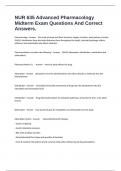
NUR 635 Advanced Pharmacology
Midterm Exam Questions And Correct
Answers.
Pharmacology - Answer the study of drugs and their structure, targets of action, mechanisms of action
(MOA), distribution (how the body disburses them throughout the body), desired physiologic effects
(efficacy) and undesirable side effects (toxicity).
Pharmacokinetics includes the following: - Answer ADME (absorption, distribution, metabolism and
elimination).
Pharmacokinetics is... - Answer How the body effects the drug
Absorption - Answer absorption from the administration site either directly or indirectly into the
blood/plasma.
Distribution - Answer reversibly/irreversibly movement of drug from the bloodstream into the
interstitial and intracellular fluid.
Metabolism - Answer drug biotransformation via metabolic pathways, primarily the liver, or by other
tissues.
Elimination - Answer how parent drug & its metabolites are eliminated from the body
Absorption factors - Answer · Gastrointestinal pH changes
· Gastric emptying
· Gastric/intestinal enzymes
· Bile acids & biliary function
· Gastrointestinal flora (type and quantity of bacteria)
· Food & nutrient interactions (most common interaction influencing GI drug absorption)
,· Lipid solubility of the drug
Distribution factors - Answer · Membrane permeability: Cross membranes to site of action
· Blood brain barrier reduces the speed of drug passage into and out of brain tissue
· Plasma protein binding: drugs bound to plasma proteins do not cross membranes (Note: Malnutrition =
âalbumin = á free drug = greater pharmacologic response)
· Aging cause a reduction in production of plasma proteins
· Lipophilicity of drug: lipophilic drugs concentrate in adipose tissue; remain in the body for a longer
period of time
Volume of distribution - Answer · Body Composition
- Increased Total body water and extracellular fluid
-Decreased Adipose tissue and skeletal muscle
· Protein Binding (changes with aging)
-Albumin, bilirubin, a1-acid glycoprotein
-Albumin affected by nutrition
-Low albumin (hypoalbuminemia) can cause less protein-bound drug reaching the tissue site of action.
· Tissue Binding
- Compositional changes
Metabolism factors - Answer o Drugs can undergo metabolism in the lungs, blood, liver, intestines and
kidney
o Volatile drugs are primarily excreted by the lungs
· The body changes drugs to more or less active forms (metabolites), increases water solubility to
increase elimination.
Phase 1 Metabolism - Answer · Cytochrome P450 system
· Located within the endoplasmic reticulum of hepatocytes.
· Through electron transport chain, a drug bound to the CYP450 system undergoes oxidation or
reduction.
,· Drug metabolism in the liver is also affected by:
-Enzyme induction
- Drug interactions
CYP450 - Answer · CYP: a set of isozymes primarily found in the liver and GI tract
· Convert lipophilic drugs into more polar (and soluble) molecules
· Considerable genetic variability exists across race and gender
· Results in CYP450 polymorphisms which have a direct effect on drug metabolism.
Four isozymes are responsible for the majority of Phase I Metabolism reactions - Answer 1. CYP3A4/5
2. CYP2D6
3. CYP2C8/9
4. CYP1A2
If you have a patient experiencing a pharmacokinetic drug interaction, consider...... - Answer CYP450.
· Some drugs or exogenous substances can induce CYP isozymes (less effect). Example.... - Answer St.
John's wort (CYP3A4) and hormonal birth control
CYP450-related drug interactions can make predicting blood plasma levels/steady state levels difficult.
Example.... - Answer If a drug inhibits enzymatic activity, a substrate drug for that enzyme system will
have a greater concentration in the blood.
If a drug inhibits CYP isozymes, what is the effect of the substrate drug - Answer The substrate drug will
have greater effect
Phase 2 Metabolism - Answer · Polar group is conjugated to the drug
· Results in increased polarity of the drug
Types of phase 2 metabolism reactions - Answer - Glycine conjugation
, -Glucuronide conjugation
-Sulfate conjugation
What is competitive antagonism? - Answer where one drug displaces another on cell receptors.
How is metabolism effected by different ethnic groups? - Answer Different ethnic groups may have
different hepatic metabolism rates
Routes of elimination - Answer 1. Pulmonary = expired in the air (volatile substances)
2. Bile = excreted in feces
3. Renal
-glomerular filtration
- tubular reabsorption
- tubular secretion
Glomerular filtration rate (GFR) (Normal) - Answer 90-125L/min
Most elimination involves..... - Answer renal function. (Renal blood flow, creatinine clearance (CrCl) )
Linear drug elimination - Answer Rate of elimination is proportional to amount of drug present
volatile drugs are excreted by the.... - Answer lungs
Bioavailability - Answer A measure of the extent of drug absorption for a given drug and route (from
0% to 100%).
Which route of administration has the greatest bioavailability - Answer intravenous, putting entire dose
into a patients vein and bypassing absorption.
Which route of administration bypasses first-pass metabolism in the liver - Answer intravenous
Midterm Exam Questions And Correct
Answers.
Pharmacology - Answer the study of drugs and their structure, targets of action, mechanisms of action
(MOA), distribution (how the body disburses them throughout the body), desired physiologic effects
(efficacy) and undesirable side effects (toxicity).
Pharmacokinetics includes the following: - Answer ADME (absorption, distribution, metabolism and
elimination).
Pharmacokinetics is... - Answer How the body effects the drug
Absorption - Answer absorption from the administration site either directly or indirectly into the
blood/plasma.
Distribution - Answer reversibly/irreversibly movement of drug from the bloodstream into the
interstitial and intracellular fluid.
Metabolism - Answer drug biotransformation via metabolic pathways, primarily the liver, or by other
tissues.
Elimination - Answer how parent drug & its metabolites are eliminated from the body
Absorption factors - Answer · Gastrointestinal pH changes
· Gastric emptying
· Gastric/intestinal enzymes
· Bile acids & biliary function
· Gastrointestinal flora (type and quantity of bacteria)
· Food & nutrient interactions (most common interaction influencing GI drug absorption)
,· Lipid solubility of the drug
Distribution factors - Answer · Membrane permeability: Cross membranes to site of action
· Blood brain barrier reduces the speed of drug passage into and out of brain tissue
· Plasma protein binding: drugs bound to plasma proteins do not cross membranes (Note: Malnutrition =
âalbumin = á free drug = greater pharmacologic response)
· Aging cause a reduction in production of plasma proteins
· Lipophilicity of drug: lipophilic drugs concentrate in adipose tissue; remain in the body for a longer
period of time
Volume of distribution - Answer · Body Composition
- Increased Total body water and extracellular fluid
-Decreased Adipose tissue and skeletal muscle
· Protein Binding (changes with aging)
-Albumin, bilirubin, a1-acid glycoprotein
-Albumin affected by nutrition
-Low albumin (hypoalbuminemia) can cause less protein-bound drug reaching the tissue site of action.
· Tissue Binding
- Compositional changes
Metabolism factors - Answer o Drugs can undergo metabolism in the lungs, blood, liver, intestines and
kidney
o Volatile drugs are primarily excreted by the lungs
· The body changes drugs to more or less active forms (metabolites), increases water solubility to
increase elimination.
Phase 1 Metabolism - Answer · Cytochrome P450 system
· Located within the endoplasmic reticulum of hepatocytes.
· Through electron transport chain, a drug bound to the CYP450 system undergoes oxidation or
reduction.
,· Drug metabolism in the liver is also affected by:
-Enzyme induction
- Drug interactions
CYP450 - Answer · CYP: a set of isozymes primarily found in the liver and GI tract
· Convert lipophilic drugs into more polar (and soluble) molecules
· Considerable genetic variability exists across race and gender
· Results in CYP450 polymorphisms which have a direct effect on drug metabolism.
Four isozymes are responsible for the majority of Phase I Metabolism reactions - Answer 1. CYP3A4/5
2. CYP2D6
3. CYP2C8/9
4. CYP1A2
If you have a patient experiencing a pharmacokinetic drug interaction, consider...... - Answer CYP450.
· Some drugs or exogenous substances can induce CYP isozymes (less effect). Example.... - Answer St.
John's wort (CYP3A4) and hormonal birth control
CYP450-related drug interactions can make predicting blood plasma levels/steady state levels difficult.
Example.... - Answer If a drug inhibits enzymatic activity, a substrate drug for that enzyme system will
have a greater concentration in the blood.
If a drug inhibits CYP isozymes, what is the effect of the substrate drug - Answer The substrate drug will
have greater effect
Phase 2 Metabolism - Answer · Polar group is conjugated to the drug
· Results in increased polarity of the drug
Types of phase 2 metabolism reactions - Answer - Glycine conjugation
, -Glucuronide conjugation
-Sulfate conjugation
What is competitive antagonism? - Answer where one drug displaces another on cell receptors.
How is metabolism effected by different ethnic groups? - Answer Different ethnic groups may have
different hepatic metabolism rates
Routes of elimination - Answer 1. Pulmonary = expired in the air (volatile substances)
2. Bile = excreted in feces
3. Renal
-glomerular filtration
- tubular reabsorption
- tubular secretion
Glomerular filtration rate (GFR) (Normal) - Answer 90-125L/min
Most elimination involves..... - Answer renal function. (Renal blood flow, creatinine clearance (CrCl) )
Linear drug elimination - Answer Rate of elimination is proportional to amount of drug present
volatile drugs are excreted by the.... - Answer lungs
Bioavailability - Answer A measure of the extent of drug absorption for a given drug and route (from
0% to 100%).
Which route of administration has the greatest bioavailability - Answer intravenous, putting entire dose
into a patients vein and bypassing absorption.
Which route of administration bypasses first-pass metabolism in the liver - Answer intravenous