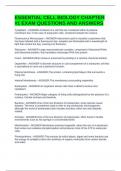
ESSENTIAL CELL BIOLOGY CHAPTER
#1 EXAM QUESTIONS AND ANSWERS
Cytoplasm - ANSWER-Contents of a cell that are contained within its plasma
membrane but, in the case of eukaryotic cells, contained outside the nucleus.
Fluorescence Microscopes - ANSWER-Instrument used to visualize a specimen that
has been labeled with a fluorescent dye; samples are illuminated with a wavelength of
light that excites the dye, causing it to fluoresce.
Ribosome - ANSWER-Large macromolecular complex, composed of ribosomal RNAs
and ribosomal proteins, that translates messenger RNA into protein.
Fixed - ANSWER-When tissue is preserved by pickling in a reactive chemical solution.
Organelles - ANSWER-A discrete structure or sub-compartment of a eukaryotic cell that
is specialized to carry out a particular function.
Plasma Membrane - ANSWER-The protein -containing lipid bilayer that surrounds a
living cell.
Internal Membranes - ANSWER-The membranes surrounding organelles.
Eukaryotes - ANSWER-An organism whose cells have a distinct nucleus and
cytoplasm.
Prokaryotes - ANSWER-Major category of living cells distinguished by the absence of a
nucleus. Include archaea and bacteria.
Bacteria - ANSWER-One of the two divisions of prokaryotes; some species cause
disease. The term is sometimes used to refer to any prokaryotic microorganism,
although the world of prokaryotes also includes archaea, which are only distantly
related.
Archaea - ANSWER-One of the two divisions of prokaryotes, often found in hostile
environments such as hot springs or concentrated brine.
Mitochondria - ANSWER-Membrane-enclosed organelle, about the size of a bacterium,
that carries out oxidative phosphorylation and produces most of the ATP in eukaryotic
cells.
Photosynthesis - ANSWER-The process by which plants, algae and some bacteria use
the energy of sunlight to drive the synthesis of organic molecules form carbon dioxide
and water.
, Chloroplasts - ANSWER-Specialized organelle in algae and plants that contains
chlorophyll and serves as the site in which photosynthesis takes place.
Nuclear Envelope - ANSWER-Double membrane surrounding the nucleus. Consists of
outer and inner membranes, perforated by nuclear pores.
Chromosomes - ANSWER-Long, threadlike structure composed of DNA and proteins
that carries the genetic information of an organism; becomes visible as a distinct entity
when a plant or animal cell prepares to divide.
ATP - ANSWER-Molecule that serves as the principle carrier of energy in cells; this
nucleoside triphosphate is composed of adenine, ribose, and three phosphates.
Symbiosis - ANSWER-Intimate association between two organisms of different species
from which both derive a long-term selective advantage.
Chlorophyll - ANSWER-Light-absorbing green pigment that plays a central part in
photosynthesis.
Endoplasmic Reticulum - ANSWER-Labyrinthine membrane-enclosed compartment in
the cytoplasm of eukaryotic cells where lipids and proteins are made.
Golgi Apparatus - ANSWER-Membrane-enclosed organelle in eukaryotic cells that
modifies the proteins and lipids made in the ER and sorts them for transport to other
sites.
Lysosomes - ANSWER-Membrane-enclosed organelle that breaks down worn-out
proteins and organelles and other waste materials, as well as molecules taken up by
endocytosis; contains digestive enzymes that are typically most active at the acid pH
found inside these organelles.
Peroxisomes - ANSWER-Small membrane-enclosed organelle that contains enzymes
that degrade lipids and destroy toxins.
Endocytosis - ANSWER-Process by which cells take in materials through an
invagination of the plasma membrane, which surrounds the ingested material in the
membrane-enclosed vesicle.
Exocytosis - ANSWER-Process by which most molecules are secreted from a
eukaryotic cell. These molecules are packaged in membrane-enclosed vesicles that
fuse with the plasma membrane, releasing their contents to the outside.
Cytosol - ANSWER-Contents of the main compartment of the cytoplasm, excluding the
membrane-enclosed organelles such as ER and mitochondria. The cell fraction
#1 EXAM QUESTIONS AND ANSWERS
Cytoplasm - ANSWER-Contents of a cell that are contained within its plasma
membrane but, in the case of eukaryotic cells, contained outside the nucleus.
Fluorescence Microscopes - ANSWER-Instrument used to visualize a specimen that
has been labeled with a fluorescent dye; samples are illuminated with a wavelength of
light that excites the dye, causing it to fluoresce.
Ribosome - ANSWER-Large macromolecular complex, composed of ribosomal RNAs
and ribosomal proteins, that translates messenger RNA into protein.
Fixed - ANSWER-When tissue is preserved by pickling in a reactive chemical solution.
Organelles - ANSWER-A discrete structure or sub-compartment of a eukaryotic cell that
is specialized to carry out a particular function.
Plasma Membrane - ANSWER-The protein -containing lipid bilayer that surrounds a
living cell.
Internal Membranes - ANSWER-The membranes surrounding organelles.
Eukaryotes - ANSWER-An organism whose cells have a distinct nucleus and
cytoplasm.
Prokaryotes - ANSWER-Major category of living cells distinguished by the absence of a
nucleus. Include archaea and bacteria.
Bacteria - ANSWER-One of the two divisions of prokaryotes; some species cause
disease. The term is sometimes used to refer to any prokaryotic microorganism,
although the world of prokaryotes also includes archaea, which are only distantly
related.
Archaea - ANSWER-One of the two divisions of prokaryotes, often found in hostile
environments such as hot springs or concentrated brine.
Mitochondria - ANSWER-Membrane-enclosed organelle, about the size of a bacterium,
that carries out oxidative phosphorylation and produces most of the ATP in eukaryotic
cells.
Photosynthesis - ANSWER-The process by which plants, algae and some bacteria use
the energy of sunlight to drive the synthesis of organic molecules form carbon dioxide
and water.
, Chloroplasts - ANSWER-Specialized organelle in algae and plants that contains
chlorophyll and serves as the site in which photosynthesis takes place.
Nuclear Envelope - ANSWER-Double membrane surrounding the nucleus. Consists of
outer and inner membranes, perforated by nuclear pores.
Chromosomes - ANSWER-Long, threadlike structure composed of DNA and proteins
that carries the genetic information of an organism; becomes visible as a distinct entity
when a plant or animal cell prepares to divide.
ATP - ANSWER-Molecule that serves as the principle carrier of energy in cells; this
nucleoside triphosphate is composed of adenine, ribose, and three phosphates.
Symbiosis - ANSWER-Intimate association between two organisms of different species
from which both derive a long-term selective advantage.
Chlorophyll - ANSWER-Light-absorbing green pigment that plays a central part in
photosynthesis.
Endoplasmic Reticulum - ANSWER-Labyrinthine membrane-enclosed compartment in
the cytoplasm of eukaryotic cells where lipids and proteins are made.
Golgi Apparatus - ANSWER-Membrane-enclosed organelle in eukaryotic cells that
modifies the proteins and lipids made in the ER and sorts them for transport to other
sites.
Lysosomes - ANSWER-Membrane-enclosed organelle that breaks down worn-out
proteins and organelles and other waste materials, as well as molecules taken up by
endocytosis; contains digestive enzymes that are typically most active at the acid pH
found inside these organelles.
Peroxisomes - ANSWER-Small membrane-enclosed organelle that contains enzymes
that degrade lipids and destroy toxins.
Endocytosis - ANSWER-Process by which cells take in materials through an
invagination of the plasma membrane, which surrounds the ingested material in the
membrane-enclosed vesicle.
Exocytosis - ANSWER-Process by which most molecules are secreted from a
eukaryotic cell. These molecules are packaged in membrane-enclosed vesicles that
fuse with the plasma membrane, releasing their contents to the outside.
Cytosol - ANSWER-Contents of the main compartment of the cytoplasm, excluding the
membrane-enclosed organelles such as ER and mitochondria. The cell fraction