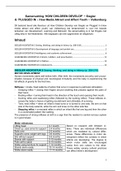
Samenvatting ‘HOW CHILDREN DEVELOP’ ~ Siegler
& ‘PLUGGED IN – How Media Attract and Affect Youth ~ Valkenburg
Dit bestand bevat alle literatuur uit How Children Develop van Siegler en Plugged In (How
media attract and affect youth) van Valkenburg dat tentamenstof is voor het tweede
tentamen van Development, Learning and Behavior. De samenvatting is in het Engels met
uitleg erbij in het Nederlands. Alle begrippen zijn erin opgenomen en dikgedrukt.
Inhoud
SIEGLER HOOFDSTUK 5 Seeing, thinking, and doing in infancy (p. 208-218)..........................................1
SIEGLER HOOFDSTUK 6 Development of language and symbol use.......................................................2
SIEGLER HOOFDSTUK 8 Intelligence and academic achievement...........................................................6
VALKENBURG HOOFDSTUK 4 Infants, toddlers, and preschoolers.......................................................11
VALKENBURG HOOFDSTUK 5 Children.................................................................................................13
VALKENBURG HOOFDSTUK 6 Adolescents...........................................................................................14
SIEGLER HOOFDSTUK 5 Seeing, thinking, and doing in infancy (p. 208-218)
MOTOR DEVELOPMENT
Human movements starts well before birth. After birth, the movements are jerky and uncoor-
dinated, because of physical and neurological immaturity and the baby is experiencing the
full effects of gravity for the first time.
Reflexes = innate, fixed patterns of action that occur in response to particular stimulation.
- Grasping reflex = closing their fingers around anything that presses against the palm of
their hand.
- Rooting reflex = turning their head in the direction of the touch and opening their mouth.
- Sucking reflex and swallowing reflex (followed by the sucking reflex). These reflexes in-
crease the baby’s chance of getting nourishment and ultimately of surviving.
- Tonic neck reflex = when an infant’s head turns or is turned to one side, the arm on that
side of the body extends, while the arm and knee on the other side flex.
- Stepping reflex = a neonatal reflex in which an infant lifts first one leg and then the other
in a coordinated pattern like walking.
The presence of strong reflexes at birth is a sign that the newborn’s central nervous system
is in good shape.
Motor milestones
Lifting head 0-1 month Based on research with Western in-
Chest up, uses arms for support 2-4 months fants. There are individual differences
Rolls over 2-5 months which are mediated by cultural differ-
Supports some weight with legs 3-6 months ences. These differences in motor de-
Sits without support 5-8 months velopment reflect the contexts in which
Stands with support 5-10 months infants are developing. The degree to
Pulls self to stand 6-10 months which motor skills are encouraged
Walks using furniture for support 7-12 months varies from one culture to the other.
Stands alone easily 10-14 months These widely varying cultural practices
Walks alone easily 11-14 months can affect infant’s development.
1
, Modern views of motor development
Current theories emphasize that early motor development results from a confluence of nu-
merous factors: developing neural mechanisms, infants’ strength, posture control, balance,
perceptual skills, body proportions and motivation.
The expanding world of the infant
Infants’ mastery of each of the milestones greatly expands their world.
- Reaching. Once infants can reach for and grasp objects, they no longer have to wait for
the world to come to them. Pre-reaching movements = clumsy swiping movements by
young infants toward the general vicinity of objects they see. At about 3 to 4 months of
age, infants begin successfully reaching for objects. At about 7 months, as infants gain
the ability to sit independently, their reaching becomes quite stable.
- Self-locomotion = the ability to move oneself around in the environment. Belly crawling
– hands-and-knees crawling – walking.
o Scale errors = the attempt by a young child to perform an action on a miniature ob-
ject that is impossible due to the large discrepancy in the relative sizes of the child
and the object.
SIEGLER HOOFDSTUK 6 Development of language and symbol use
Symbols = systems for representing our thoughts, feelings, and knowledge and for commu-
nicating them to other people.
LANGUAGE DEVELOPMENT
- Comprehension = with regard to language, understanding what others say (sign, write).
- Production = with regard to language, speaking (writing, signing) to others.
The components of language
Despite the fact that there are thousands of human languages, they share overarching simi-
larities. Generativity = refers to the idea that through the use of the finite set of words and
morphemes in humans’ vocabulary, we can put together an infinite number of sentences and
express an infinite number of ideas. The generative power of language carries a cost for
young language learners: they must deal with its complexity. Taal is opgebouwd uit klanken
die woorden vormen, woorden vormen zinnen en zinnen vormen verhalen, conversaties etc.
- Phonemes = the elementary units of meaningful sound used to produce language (de
kleinste klankeenheid die een betekenisverschil weergeeft). The first step in language de-
velopment is phonological development = the acquisition of knowledge about the
sound system of a language.
- Morphemes = the smallest units of meaning in a language, composed of one or more
phonemes (kleinste taaleenheden die een zelfstandige betekenis hebben). Semantic de-
velopment = the learning of the system for expressing meaning in language, including
word learning.
- Syntax = rules in language that specify how words form different categories (noun,
verbs, adjectives, and so on) can be combined. Syntactic development = the learning of
the syntax of a language.
- Pragmatic development = the acquisition of knowledge about how language is used.
Thus, learning language involves phonological, semantic, syntactic and pragmatic develop-
ment (also involved in learning a sign language).
- Bilingualism = the ability to use two languages.
What is required for language?
2
& ‘PLUGGED IN – How Media Attract and Affect Youth ~ Valkenburg
Dit bestand bevat alle literatuur uit How Children Develop van Siegler en Plugged In (How
media attract and affect youth) van Valkenburg dat tentamenstof is voor het tweede
tentamen van Development, Learning and Behavior. De samenvatting is in het Engels met
uitleg erbij in het Nederlands. Alle begrippen zijn erin opgenomen en dikgedrukt.
Inhoud
SIEGLER HOOFDSTUK 5 Seeing, thinking, and doing in infancy (p. 208-218)..........................................1
SIEGLER HOOFDSTUK 6 Development of language and symbol use.......................................................2
SIEGLER HOOFDSTUK 8 Intelligence and academic achievement...........................................................6
VALKENBURG HOOFDSTUK 4 Infants, toddlers, and preschoolers.......................................................11
VALKENBURG HOOFDSTUK 5 Children.................................................................................................13
VALKENBURG HOOFDSTUK 6 Adolescents...........................................................................................14
SIEGLER HOOFDSTUK 5 Seeing, thinking, and doing in infancy (p. 208-218)
MOTOR DEVELOPMENT
Human movements starts well before birth. After birth, the movements are jerky and uncoor-
dinated, because of physical and neurological immaturity and the baby is experiencing the
full effects of gravity for the first time.
Reflexes = innate, fixed patterns of action that occur in response to particular stimulation.
- Grasping reflex = closing their fingers around anything that presses against the palm of
their hand.
- Rooting reflex = turning their head in the direction of the touch and opening their mouth.
- Sucking reflex and swallowing reflex (followed by the sucking reflex). These reflexes in-
crease the baby’s chance of getting nourishment and ultimately of surviving.
- Tonic neck reflex = when an infant’s head turns or is turned to one side, the arm on that
side of the body extends, while the arm and knee on the other side flex.
- Stepping reflex = a neonatal reflex in which an infant lifts first one leg and then the other
in a coordinated pattern like walking.
The presence of strong reflexes at birth is a sign that the newborn’s central nervous system
is in good shape.
Motor milestones
Lifting head 0-1 month Based on research with Western in-
Chest up, uses arms for support 2-4 months fants. There are individual differences
Rolls over 2-5 months which are mediated by cultural differ-
Supports some weight with legs 3-6 months ences. These differences in motor de-
Sits without support 5-8 months velopment reflect the contexts in which
Stands with support 5-10 months infants are developing. The degree to
Pulls self to stand 6-10 months which motor skills are encouraged
Walks using furniture for support 7-12 months varies from one culture to the other.
Stands alone easily 10-14 months These widely varying cultural practices
Walks alone easily 11-14 months can affect infant’s development.
1
, Modern views of motor development
Current theories emphasize that early motor development results from a confluence of nu-
merous factors: developing neural mechanisms, infants’ strength, posture control, balance,
perceptual skills, body proportions and motivation.
The expanding world of the infant
Infants’ mastery of each of the milestones greatly expands their world.
- Reaching. Once infants can reach for and grasp objects, they no longer have to wait for
the world to come to them. Pre-reaching movements = clumsy swiping movements by
young infants toward the general vicinity of objects they see. At about 3 to 4 months of
age, infants begin successfully reaching for objects. At about 7 months, as infants gain
the ability to sit independently, their reaching becomes quite stable.
- Self-locomotion = the ability to move oneself around in the environment. Belly crawling
– hands-and-knees crawling – walking.
o Scale errors = the attempt by a young child to perform an action on a miniature ob-
ject that is impossible due to the large discrepancy in the relative sizes of the child
and the object.
SIEGLER HOOFDSTUK 6 Development of language and symbol use
Symbols = systems for representing our thoughts, feelings, and knowledge and for commu-
nicating them to other people.
LANGUAGE DEVELOPMENT
- Comprehension = with regard to language, understanding what others say (sign, write).
- Production = with regard to language, speaking (writing, signing) to others.
The components of language
Despite the fact that there are thousands of human languages, they share overarching simi-
larities. Generativity = refers to the idea that through the use of the finite set of words and
morphemes in humans’ vocabulary, we can put together an infinite number of sentences and
express an infinite number of ideas. The generative power of language carries a cost for
young language learners: they must deal with its complexity. Taal is opgebouwd uit klanken
die woorden vormen, woorden vormen zinnen en zinnen vormen verhalen, conversaties etc.
- Phonemes = the elementary units of meaningful sound used to produce language (de
kleinste klankeenheid die een betekenisverschil weergeeft). The first step in language de-
velopment is phonological development = the acquisition of knowledge about the
sound system of a language.
- Morphemes = the smallest units of meaning in a language, composed of one or more
phonemes (kleinste taaleenheden die een zelfstandige betekenis hebben). Semantic de-
velopment = the learning of the system for expressing meaning in language, including
word learning.
- Syntax = rules in language that specify how words form different categories (noun,
verbs, adjectives, and so on) can be combined. Syntactic development = the learning of
the syntax of a language.
- Pragmatic development = the acquisition of knowledge about how language is used.
Thus, learning language involves phonological, semantic, syntactic and pragmatic develop-
ment (also involved in learning a sign language).
- Bilingualism = the ability to use two languages.
What is required for language?
2