5.
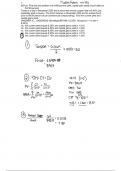
The stock for a start-up company probably will pay no dividends until exactly 7 years from today. At that
time it will pay $5.60 per year forever. You assess the intrinsic value of the stock with a 9.3% discount
rate. Find the stock’s intrinsic value today.
a. $47.01 b. $42.73 c. $38.85 d. $35.32 e. $32.11
6.
The company preferred stock just yesterday paid its annual dividend of $3.25 per share. Today’s share
price is $39.60 . You believe the dividend yield is abnormally high but that it will revert to its normal value
of 6.50%. Your strategy is to buy the stock today and receive annual dividends for 3 years. Upon
receiving the last dividend you expect the dividend yield will be normal. Your strategy is to sell the stock
at that time. Compute the expected annual rate of return for the strategy.
a. 17.3% b. 15.7% c. 23.0% d. 20.9% e. 19.0%
7.
The rates of return listed below for securities X and Y are equally likely. Find the standard deviation and
expected rates of return for securities X and Y, and also compare the two regarding dominance or
tradeoff.
X: 2.6% 5.3% 24.8% 14.7%
Y: 18.4% 10.1% 15.6% -4.0%
a. (Risk, return) equals (8.72%,11.85%) for X and (8.63%,10.03%) for Y; also X and Y coexist as
tradeoffs
b. (Risk, return) equals (8.63%,10.03%) for X and (9.59%,11.03%) for Y; also Y dominates X
c. (Risk, return) equals (8.72%,11.85%) for X and (8.63%,10.03%) for Y; also Y dominates X
d. (Risk, return) equals (9.59%,11.03%) for X and (8.63%,11.03%) for Y; also X and Y coexist as
tradeoffs
e. (Risk, return) equals (8.63%,10.03%) for X and (9.59%,11.03%) for Y; also X and Y coexist as
tradeoffs
8.
At the beginning of last month about 30% of your $6,250 portfolio was in stock X; stock Y accounted for
25% and stock Z for the rest. Monthly rates of return equaled -32% for stock X, -15% for Y, and -16% for
Z. Find last month’s percentage change in total portfolio wealth.
a. -18.7% b. -15.4% c. -20.6% d. -17.0% e. -14.0%
9.
You form a portfolio that invests 60% of total funds in stock X and 40% in stock Z. Two possible
outcomes exist. The probability is 30% that the first outcome occurs, in which case the rates of return
equal 20% for X and 40% for Z. The probability is 70% that the second outcome occurs, in which case
the rates of return equal 50% for X and 16% for Z.
Find the diversification benefit, measured as the standard deviation reduction in basis points (BP), that
the portfolio provides if the correlation coefficient is -1.
a. 1,065 BP b. 800 BP c. 880 BP d. 968 BP e. 727 BP
, 10.
The standard deviation of expected returns for investments X and Y equal 11.5% and 8.5%, respectively.
The correlation between returns for X and Y is 0.00.
How much risk reduction, that is diversification benefit in basis points, does the minimum risk portfolio
provide?
a. 248 b. 272 c. 225 d. 330 e. 300
11.
Find the combination of Alpha and Zed that yield the minimum risk portfolio given that each of the listed
paired-outcomes is equally likely:
%return Alpha 2.9% 10.2% 26.0% 16.5%
%return Zed 20.0% 22.1% 10.6% -5.3%
Which of the following statements about the minimum risk portfolio is most accurate?
a. the expected return is 13.0% and the standard deviation is 4.7%
b. the expected return is 9.9% and the standard deviation is 5.4%
c. the expected return is 13.0% and the standard deviation is 5.4%
d. the expected return is 11.3% and the standard deviation is 4.7%
e. the expected return is 11.3% and the standard deviation is 5.4%
The stock for a start-up company probably will pay no dividends until exactly 7 years from today. At that
time it will pay $5.60 per year forever. You assess the intrinsic value of the stock with a 9.3% discount
rate. Find the stock’s intrinsic value today.
a. $47.01 b. $42.73 c. $38.85 d. $35.32 e. $32.11
6.
The company preferred stock just yesterday paid its annual dividend of $3.25 per share. Today’s share
price is $39.60 . You believe the dividend yield is abnormally high but that it will revert to its normal value
of 6.50%. Your strategy is to buy the stock today and receive annual dividends for 3 years. Upon
receiving the last dividend you expect the dividend yield will be normal. Your strategy is to sell the stock
at that time. Compute the expected annual rate of return for the strategy.
a. 17.3% b. 15.7% c. 23.0% d. 20.9% e. 19.0%
7.
The rates of return listed below for securities X and Y are equally likely. Find the standard deviation and
expected rates of return for securities X and Y, and also compare the two regarding dominance or
tradeoff.
X: 2.6% 5.3% 24.8% 14.7%
Y: 18.4% 10.1% 15.6% -4.0%
a. (Risk, return) equals (8.72%,11.85%) for X and (8.63%,10.03%) for Y; also X and Y coexist as
tradeoffs
b. (Risk, return) equals (8.63%,10.03%) for X and (9.59%,11.03%) for Y; also Y dominates X
c. (Risk, return) equals (8.72%,11.85%) for X and (8.63%,10.03%) for Y; also Y dominates X
d. (Risk, return) equals (9.59%,11.03%) for X and (8.63%,11.03%) for Y; also X and Y coexist as
tradeoffs
e. (Risk, return) equals (8.63%,10.03%) for X and (9.59%,11.03%) for Y; also X and Y coexist as
tradeoffs
8.
At the beginning of last month about 30% of your $6,250 portfolio was in stock X; stock Y accounted for
25% and stock Z for the rest. Monthly rates of return equaled -32% for stock X, -15% for Y, and -16% for
Z. Find last month’s percentage change in total portfolio wealth.
a. -18.7% b. -15.4% c. -20.6% d. -17.0% e. -14.0%
9.
You form a portfolio that invests 60% of total funds in stock X and 40% in stock Z. Two possible
outcomes exist. The probability is 30% that the first outcome occurs, in which case the rates of return
equal 20% for X and 40% for Z. The probability is 70% that the second outcome occurs, in which case
the rates of return equal 50% for X and 16% for Z.
Find the diversification benefit, measured as the standard deviation reduction in basis points (BP), that
the portfolio provides if the correlation coefficient is -1.
a. 1,065 BP b. 800 BP c. 880 BP d. 968 BP e. 727 BP
, 10.
The standard deviation of expected returns for investments X and Y equal 11.5% and 8.5%, respectively.
The correlation between returns for X and Y is 0.00.
How much risk reduction, that is diversification benefit in basis points, does the minimum risk portfolio
provide?
a. 248 b. 272 c. 225 d. 330 e. 300
11.
Find the combination of Alpha and Zed that yield the minimum risk portfolio given that each of the listed
paired-outcomes is equally likely:
%return Alpha 2.9% 10.2% 26.0% 16.5%
%return Zed 20.0% 22.1% 10.6% -5.3%
Which of the following statements about the minimum risk portfolio is most accurate?
a. the expected return is 13.0% and the standard deviation is 4.7%
b. the expected return is 9.9% and the standard deviation is 5.4%
c. the expected return is 13.0% and the standard deviation is 5.4%
d. the expected return is 11.3% and the standard deviation is 4.7%
e. the expected return is 11.3% and the standard deviation is 5.4%