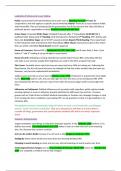
Legislation/Parliamentary Law Making
Public: Government & Private Members (20 a year) such as Abortion Act 1967 Private: By
Corporation’s and only apply to a specific area/community Hybrid: These are a cross between Public
and Private Bills. They are introduced by the government, but if they become law, they will affect a
particular person, organisation or place Various Crossrail and HS2 Acts.
Green Paper: Proposals White Paper: Detailed Proposals after 1st Consultation Draft Bill: Bill is
published after being made 1st Reading: Only introduced to Parliament 2nd Reading: MP’s debate and
then vote Committee Stage: Up to 50 MP’s examine details Report/Third Reading: They report back
to the Parliament with amendments then final debate Other House: Same process but in HoL where
they are all the committee Royal Assent: Crown’s approval
House of Commons- Elected MP’s, Parliament Act 1911 then 1949 said if more than 2, then 1 year
before 1st and 3rd reading it can go straight to royal assent.
House of Lords- Debating & revising chamber but cannot reject Finance Bills. Only delay bills but
only upto a year now but usually their objections are used or the bill is scraped if too bad.
The Crown- Formality never reject but may not come into force ASAP as training etc. Following the
Royal Assent, the Act will come into force on midnight of that day unless another date has been set.
However, very few are implemented immediately.
Judges cannot overrule an act as seen in Cheney v Conn 1968. Parliament is supreme but must abide
by the HRA 1998 (said in s.19). Acts can take ages to come into force or be introduced, HRA 1998
was introduced by the HoL and was 4 years from when the process began until it was brought into
force.
Influences on Parliament: Political influences such as parties with majorities, public opinion/media
pressing opinions is more an influence towards elections but still heavy if go viral etc., Pressure
groups such as Trade Unions or British Medical Association or Protests can campaign changes or stop
Act’s coming into force, Lobbyists is persuading MP’s to ask questions in HoC so it get publicity or to
introduce bills.
The legislative process is democratic, bring full reform to areas, carry broad policy and delegate
powers, certain and allow consultation. They are a long process and there is a lack of time to
consider all things, government also control private members bills which are moral, important
issues.
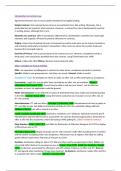
Statutory Interpretation
Judges sometimes need things to help them interpret statutes. In the Theft Act 1968 sections 1-6 it
defines key words. The Interpretation Act 1978 makes it clear on a few rods such as he meaning
also, she. Reasons their unclear could be:
Acts can be written badly because of a rush such as the Dangerous Dogs Act 1991.
Ambiguity where some words have more than one meaning Ponting 1985
Changing in word meaning as many acts are very old and meanings of words evolve over time.
Technological/Social changes such as Royal College of Nursing v DHSS 1981 where the Abortion Act
1967 was outdated as medical science had changed
, Unforeseen situations where the act cannot possibly cover all circumstances
Broad terms such as in Dangerous Dogs Act 1991 where ‘Pitbull type’ was used but dogs who were
half breed weren’t (now are) included thanks to a QBD precedent.
Literal Approach: The Literal Rule is where they take the dictionary meaning and rule the act does
not apply if they think the meanings do not fit the case, Berriman v LNER 1946. Avoids precedent,
gives certainty for lawyers etc. Assumes every act is perfect, words have multiple meanings as in
Dangerous Dogs Act 1991. Golden Rule is where they depart from literal if it would cause absurd
results if the words other meaning, they can be used such as in R v Allen 1871. Provides ‘escape
route’ whilst still respecting Parliament, only used limitedly
Purposive Approach: The Mischief Rule/Haydon’s Case Law 1584 they interpret the act in the way
that upholds the purpose of its creation, the questions they ask are what was the law before the act,
what was the problem, what remedy has Parliament intended to provide and what is the true reason
for adopting the remedy. More just and sets good precedent, Law Commissions fave they even
recommend it in 1969. Precedent, limited to old law, hard for lawyers. The approach as a whole
tried to uncover the purpose/intention of Parliament and the Mischief Rule, really just modern
Mischief Rule. Used in Royal Collage of Nursing v DHSS 1981. Lord Simmonds called it ‘a naked
usurpation of the legislative function under a guise of interpretation’. Allows for developments to be
included into updated law, avoids whole new acts wasting time. Difficult to find intention, precedent
and hard for lawyers.
Both Approaches ae bound by the Human Rights Act 1998 under section 3 as in the case of The Rent
Act 1977 discriminating against homosexuals where the ECHR said no to. EU Law is usually
interpreted in the purposive approach as is less detailed and UK law is based on it a lot. Marleasing
1992 ruled that including interpreting national law in light of EU law was in the Treaty of Rome.
Intrinsic Aids: The paragraph at the beginning (preamble), schedules of acts timings. Interpretation
sections given in acts, section headings & the long title are all given in the Sexual Offences Act 1985.
Extrinsic Aids: Dictionary, law reports, explanatory notes, previous acts, ECHR, international treaties,
law reform agency reports only allowed since Black Clawson 1975, Hansard but only government
ministers not opposition/backbench MP’s although they may not mention the hidden truth for the
act. Lord Denning said not using it is ‘like groping around in the dark without the light on’ in David v
Johnson 1978, first allowed in Pepper v Hart 1993
Purposive approach will probs be the one in future as EU law affected the way judges worked. Law is
inconsistent and some can use both approaches it isn’t very reliable. 1969 Law Commission said to
only use Purposive but was never implemented.
Delegated Legislation
Statutes, parent acts, can delegate powers to make law to other bodies. The Police and Criminal
Evidence Act 1984 gives the Home Secretary extended powers concerning crime and policing.
Order in council- Made by the Privy Council in times of emergency given through the Emergency
Powers Act 1920 mainly. Used to give effect to EU directives, in times of emergency/war and
epidemics. Statutory Instrument- Made by Ministers/Secretary of State concerning their
departments to bring in more detailed law. Bylaw- Made by local councils/bodies come from Local
Government Acts and concern certain areas such as congestion/emission charges. London
Underground banning smoking.
Public: Government & Private Members (20 a year) such as Abortion Act 1967 Private: By
Corporation’s and only apply to a specific area/community Hybrid: These are a cross between Public
and Private Bills. They are introduced by the government, but if they become law, they will affect a
particular person, organisation or place Various Crossrail and HS2 Acts.
Green Paper: Proposals White Paper: Detailed Proposals after 1st Consultation Draft Bill: Bill is
published after being made 1st Reading: Only introduced to Parliament 2nd Reading: MP’s debate and
then vote Committee Stage: Up to 50 MP’s examine details Report/Third Reading: They report back
to the Parliament with amendments then final debate Other House: Same process but in HoL where
they are all the committee Royal Assent: Crown’s approval
House of Commons- Elected MP’s, Parliament Act 1911 then 1949 said if more than 2, then 1 year
before 1st and 3rd reading it can go straight to royal assent.
House of Lords- Debating & revising chamber but cannot reject Finance Bills. Only delay bills but
only upto a year now but usually their objections are used or the bill is scraped if too bad.
The Crown- Formality never reject but may not come into force ASAP as training etc. Following the
Royal Assent, the Act will come into force on midnight of that day unless another date has been set.
However, very few are implemented immediately.
Judges cannot overrule an act as seen in Cheney v Conn 1968. Parliament is supreme but must abide
by the HRA 1998 (said in s.19). Acts can take ages to come into force or be introduced, HRA 1998
was introduced by the HoL and was 4 years from when the process began until it was brought into
force.
Influences on Parliament: Political influences such as parties with majorities, public opinion/media
pressing opinions is more an influence towards elections but still heavy if go viral etc., Pressure
groups such as Trade Unions or British Medical Association or Protests can campaign changes or stop
Act’s coming into force, Lobbyists is persuading MP’s to ask questions in HoC so it get publicity or to
introduce bills.
The legislative process is democratic, bring full reform to areas, carry broad policy and delegate
powers, certain and allow consultation. They are a long process and there is a lack of time to
consider all things, government also control private members bills which are moral, important
issues.
Statutory Interpretation
Judges sometimes need things to help them interpret statutes. In the Theft Act 1968 sections 1-6 it
defines key words. The Interpretation Act 1978 makes it clear on a few rods such as he meaning
also, she. Reasons their unclear could be:
Acts can be written badly because of a rush such as the Dangerous Dogs Act 1991.
Ambiguity where some words have more than one meaning Ponting 1985
Changing in word meaning as many acts are very old and meanings of words evolve over time.
Technological/Social changes such as Royal College of Nursing v DHSS 1981 where the Abortion Act
1967 was outdated as medical science had changed
, Unforeseen situations where the act cannot possibly cover all circumstances
Broad terms such as in Dangerous Dogs Act 1991 where ‘Pitbull type’ was used but dogs who were
half breed weren’t (now are) included thanks to a QBD precedent.
Literal Approach: The Literal Rule is where they take the dictionary meaning and rule the act does
not apply if they think the meanings do not fit the case, Berriman v LNER 1946. Avoids precedent,
gives certainty for lawyers etc. Assumes every act is perfect, words have multiple meanings as in
Dangerous Dogs Act 1991. Golden Rule is where they depart from literal if it would cause absurd
results if the words other meaning, they can be used such as in R v Allen 1871. Provides ‘escape
route’ whilst still respecting Parliament, only used limitedly
Purposive Approach: The Mischief Rule/Haydon’s Case Law 1584 they interpret the act in the way
that upholds the purpose of its creation, the questions they ask are what was the law before the act,
what was the problem, what remedy has Parliament intended to provide and what is the true reason
for adopting the remedy. More just and sets good precedent, Law Commissions fave they even
recommend it in 1969. Precedent, limited to old law, hard for lawyers. The approach as a whole
tried to uncover the purpose/intention of Parliament and the Mischief Rule, really just modern
Mischief Rule. Used in Royal Collage of Nursing v DHSS 1981. Lord Simmonds called it ‘a naked
usurpation of the legislative function under a guise of interpretation’. Allows for developments to be
included into updated law, avoids whole new acts wasting time. Difficult to find intention, precedent
and hard for lawyers.
Both Approaches ae bound by the Human Rights Act 1998 under section 3 as in the case of The Rent
Act 1977 discriminating against homosexuals where the ECHR said no to. EU Law is usually
interpreted in the purposive approach as is less detailed and UK law is based on it a lot. Marleasing
1992 ruled that including interpreting national law in light of EU law was in the Treaty of Rome.
Intrinsic Aids: The paragraph at the beginning (preamble), schedules of acts timings. Interpretation
sections given in acts, section headings & the long title are all given in the Sexual Offences Act 1985.
Extrinsic Aids: Dictionary, law reports, explanatory notes, previous acts, ECHR, international treaties,
law reform agency reports only allowed since Black Clawson 1975, Hansard but only government
ministers not opposition/backbench MP’s although they may not mention the hidden truth for the
act. Lord Denning said not using it is ‘like groping around in the dark without the light on’ in David v
Johnson 1978, first allowed in Pepper v Hart 1993
Purposive approach will probs be the one in future as EU law affected the way judges worked. Law is
inconsistent and some can use both approaches it isn’t very reliable. 1969 Law Commission said to
only use Purposive but was never implemented.
Delegated Legislation
Statutes, parent acts, can delegate powers to make law to other bodies. The Police and Criminal
Evidence Act 1984 gives the Home Secretary extended powers concerning crime and policing.
Order in council- Made by the Privy Council in times of emergency given through the Emergency
Powers Act 1920 mainly. Used to give effect to EU directives, in times of emergency/war and
epidemics. Statutory Instrument- Made by Ministers/Secretary of State concerning their
departments to bring in more detailed law. Bylaw- Made by local councils/bodies come from Local
Government Acts and concern certain areas such as congestion/emission charges. London
Underground banning smoking.