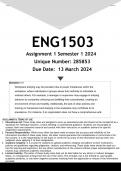
, ENG1503 Assignment 1 (COMPLETE ANSWERS)
Semester 1 2025 (769162) - DUE 24 March 2025; 100%
TRUSTED Complete, trusted solutions and
explanations…WE WISH YOU ALL THE BEST
ALL QUESTIONS ANSWERED
Read the text below and answer the following questions in short
paragraphs of not more than 150 words each. Teaching
Information Literacy in an Age of Misinformation Krista Black,
EdB February 28, 2024 The first time I encountered a student
who “just didn’t believe” the data I was using in my sociology
class, it caught me off guard. I don’t recall exactly how I
responded in the moment, but with the benefit of hindsight I
now know it was a tremor in what would become a seismic shift
in our educational landscape. Students who are in their late teens
or early twenties have spent their educational experiences
navigating misinformation, fake news, and alternative facts. I
didn’t realize until my student made the comment above on how
the broader shift in our society toward scientific skepticism
would bear out in the classroom. This unexpected moment in the
classroom alerted me to an opportunity to explore and expand
the scope of information literacy skills I incorporate in my
courses. I had started integrating information literacy skills into
my sociology classes with a narrow focus that built on research
method topics that were appropriate for an introductory course.
We talked about interpreting statistics like percent change,
visual representations of data, survey design, and sampling. My
goal was to support both students’ learning of sociology in the
course and their broader consumption of information outside of
Semester 1 2025 (769162) - DUE 24 March 2025; 100%
TRUSTED Complete, trusted solutions and
explanations…WE WISH YOU ALL THE BEST
ALL QUESTIONS ANSWERED
Read the text below and answer the following questions in short
paragraphs of not more than 150 words each. Teaching
Information Literacy in an Age of Misinformation Krista Black,
EdB February 28, 2024 The first time I encountered a student
who “just didn’t believe” the data I was using in my sociology
class, it caught me off guard. I don’t recall exactly how I
responded in the moment, but with the benefit of hindsight I
now know it was a tremor in what would become a seismic shift
in our educational landscape. Students who are in their late teens
or early twenties have spent their educational experiences
navigating misinformation, fake news, and alternative facts. I
didn’t realize until my student made the comment above on how
the broader shift in our society toward scientific skepticism
would bear out in the classroom. This unexpected moment in the
classroom alerted me to an opportunity to explore and expand
the scope of information literacy skills I incorporate in my
courses. I had started integrating information literacy skills into
my sociology classes with a narrow focus that built on research
method topics that were appropriate for an introductory course.
We talked about interpreting statistics like percent change,
visual representations of data, survey design, and sampling. My
goal was to support both students’ learning of sociology in the
course and their broader consumption of information outside of