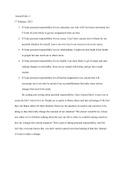
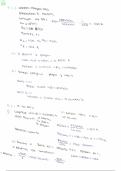
Lab 6: VSEPR and molecular shape “How does it look?”
Data Tables:
Part 1: Basic Shapes
Molecule Name Shape Predicted Bond angle Bond angle (Degrees)
PF6- Octahedral 90 89.4, 90.4, 89.8, 90, 90
BrF6 Octahedral 90 89.5, 90, 90,89.7
I3 Linear 180 180
In(CH3)3 Trigonal pyramidal 109.5 109.6, 109.4, 109.4
BeF42- tetrahedral 109.5 108.6, 109.7, 108.6,
109.7
NH4+ Tetrahedral 109.5 105.6,108, 109.5,114.9
SbF6- Octahedral 90 89,89.4,89.9,92.1,91.4
Part 2: Effects of lone pairs on molecular shape
Molecule Name Shape
XeF5 Square pyramidal
H 2O tetrahedral
CIF4 Square planar
SbBr52- Square pyramidal
Part 3: Effects of Lone pairs on bond angles
Molecule Predicted Actual Crystal Predicted angles Actual Angles
Geometry Structure
Di- seesaw seesaw 90 90.6,90.8,91.7
bromodimethylsel
enium
SO2 bent bent 120 113
NH3 Trigonal trigonal 109.5 101.3
Dichloro- Trigonal Trigonal 109.5 90.8, 100.4
diphenyl-selenium Bipyramidal Bipyramidal
Boric acid Trigonal planar Trigonal Planar 109.5 119.6,
119.9,120.4
Focus Questions:
1. What is VSEPR theory, and how can it be used to predict molecular shapes?
a. The VSEPR theory states that the atoms in a molecule will repulse each other.
Therefore, they will tend to assume the geometric shape that has the least
repulsion. The VSEPR theory helps us predict molecular shapes because it helps
Data Tables:
Part 1: Basic Shapes
Molecule Name Shape Predicted Bond angle Bond angle (Degrees)
PF6- Octahedral 90 89.4, 90.4, 89.8, 90, 90
BrF6 Octahedral 90 89.5, 90, 90,89.7
I3 Linear 180 180
In(CH3)3 Trigonal pyramidal 109.5 109.6, 109.4, 109.4
BeF42- tetrahedral 109.5 108.6, 109.7, 108.6,
109.7
NH4+ Tetrahedral 109.5 105.6,108, 109.5,114.9
SbF6- Octahedral 90 89,89.4,89.9,92.1,91.4
Part 2: Effects of lone pairs on molecular shape
Molecule Name Shape
XeF5 Square pyramidal
H 2O tetrahedral
CIF4 Square planar
SbBr52- Square pyramidal
Part 3: Effects of Lone pairs on bond angles
Molecule Predicted Actual Crystal Predicted angles Actual Angles
Geometry Structure
Di- seesaw seesaw 90 90.6,90.8,91.7
bromodimethylsel
enium
SO2 bent bent 120 113
NH3 Trigonal trigonal 109.5 101.3
Dichloro- Trigonal Trigonal 109.5 90.8, 100.4
diphenyl-selenium Bipyramidal Bipyramidal
Boric acid Trigonal planar Trigonal Planar 109.5 119.6,
119.9,120.4
Focus Questions:
1. What is VSEPR theory, and how can it be used to predict molecular shapes?
a. The VSEPR theory states that the atoms in a molecule will repulse each other.
Therefore, they will tend to assume the geometric shape that has the least
repulsion. The VSEPR theory helps us predict molecular shapes because it helps