

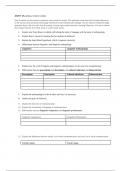
ANTH 354 FINAL STUDY GUIDE
Part A consists of short-answer questions, each worth five marks. The questions come from the Learning Objectives
in the various units and from terminology introduced in the textbook and readings. You are asked to respond to eight
questions from a list of twelve. Part B consists of essay topics taken from the Learning Objectives. You are to choose
three topics from the five listed. Each is worth twenty marks.
1. Explain why Franz Boas is credited with linking the study of language with the study of anthropology.
2. Explain Boas’s reason for insisting that his students do fieldwork.
3. Explain the Sapir-Whorf hypothesis. (AKA: Linguistic relativity)
4. Differentiate between linguistics and linguistic anthropology.
Linguistics Linguistic Anthropology
5. Explain how the work of linguists and linguistic anthropologists can be seen to be complementary.
6. Differentiate between prescription and description, and cultural relativism and ethnocentrism.
Prescription Description Cultural relativism Ethnocentrism
7. Explain the anthropological code of ethics and why it is necessary.
8. Outline the goals of fieldwork.
9. Explain the functions of communication.
10. Explain the relationship of language to communication.
11. Differentiate between linguistic competence and linguistic performance.
Linguistic Competence Linguistic Performance
12. Explain the difference between verbal, as in verbal communication, and vocal, as in vocal communication.
Verbal Comm. Vocal Comm.
, 13. Describe how the bee’s waggle dance displays productivity and in what ways the bee’s productivity differs
from that of human language.
14. List the design features that are universal for humans (those with speech and those without) and animals.
15. Differentiate between lexicon and grammar.
Lexicon Grammar
16. Discuss the faculty of language in the narrow sense (FLN) and its primary feature—recursion.
17. Comment upon the Clever Hans effect.
18. Review the studies of ape communication from Washoe to Nim Chimsky to Sherman and Austin.
19. Describe Kanzi’s language training.
20. Define each of Hockett’s design features of language.
21. Explain why a parrot’s “talk” is not considered to be language.
22. Describe the features of the primate brain that make it suitable for language.
23. Outline early theories for the origins of language.
24. Locate Broca’s area, and explain what damage to this area can mean for language use.
25. Locate Wernicke’s area, and explain what damage to this area can mean for language use.
26. Explain the goals of evolutionary linguistics.
27. Explain reverse engineering as it is used in linguistics.
28. Define proto-language.
29. Define linear grammar, and outline why Jackendoff and Wittenberg see pidgins as examples of linear
grammar.
30. Contrast a pidgin language with a creole language.
Pidgin Creole
Part A consists of short-answer questions, each worth five marks. The questions come from the Learning Objectives
in the various units and from terminology introduced in the textbook and readings. You are asked to respond to eight
questions from a list of twelve. Part B consists of essay topics taken from the Learning Objectives. You are to choose
three topics from the five listed. Each is worth twenty marks.
1. Explain why Franz Boas is credited with linking the study of language with the study of anthropology.
2. Explain Boas’s reason for insisting that his students do fieldwork.
3. Explain the Sapir-Whorf hypothesis. (AKA: Linguistic relativity)
4. Differentiate between linguistics and linguistic anthropology.
Linguistics Linguistic Anthropology
5. Explain how the work of linguists and linguistic anthropologists can be seen to be complementary.
6. Differentiate between prescription and description, and cultural relativism and ethnocentrism.
Prescription Description Cultural relativism Ethnocentrism
7. Explain the anthropological code of ethics and why it is necessary.
8. Outline the goals of fieldwork.
9. Explain the functions of communication.
10. Explain the relationship of language to communication.
11. Differentiate between linguistic competence and linguistic performance.
Linguistic Competence Linguistic Performance
12. Explain the difference between verbal, as in verbal communication, and vocal, as in vocal communication.
Verbal Comm. Vocal Comm.
, 13. Describe how the bee’s waggle dance displays productivity and in what ways the bee’s productivity differs
from that of human language.
14. List the design features that are universal for humans (those with speech and those without) and animals.
15. Differentiate between lexicon and grammar.
Lexicon Grammar
16. Discuss the faculty of language in the narrow sense (FLN) and its primary feature—recursion.
17. Comment upon the Clever Hans effect.
18. Review the studies of ape communication from Washoe to Nim Chimsky to Sherman and Austin.
19. Describe Kanzi’s language training.
20. Define each of Hockett’s design features of language.
21. Explain why a parrot’s “talk” is not considered to be language.
22. Describe the features of the primate brain that make it suitable for language.
23. Outline early theories for the origins of language.
24. Locate Broca’s area, and explain what damage to this area can mean for language use.
25. Locate Wernicke’s area, and explain what damage to this area can mean for language use.
26. Explain the goals of evolutionary linguistics.
27. Explain reverse engineering as it is used in linguistics.
28. Define proto-language.
29. Define linear grammar, and outline why Jackendoff and Wittenberg see pidgins as examples of linear
grammar.
30. Contrast a pidgin language with a creole language.
Pidgin Creole


