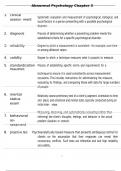
Abnormal Psychology Chapter 3
1. clinical
Systematic evaluation and measurement of psychological, biological, and
assess- ment
social factors in a person presenting with a possible psychological
disorder.
2. diagnosis Process of determining whether a presenting problem meets the
established criteria for a specific psychological disorder.
3. reliability Degree to which a measurement is consistent - for example, over time
or among ditterent raters.
4. validity Degree to which a technique measures what it purports to measure.
5. standardization Process of establishing specific norms and requirements for a
measurement
technique to ensure it is used consistently across measurement
occasions. This includes instructions for administering the measure,
evaluating its findings, and comparing these with data for large numbers
of people.
6. mental Relatively coarse preliminary test of a client's judgment, orientation to time
status and place, and emotional and mental state: typically conducted during an
exam initial inter- view.
Measuring, observing, and systematically evaluating (rather than
7. behavioral inferring) the client's thoughts, feelings, and behavior in the actual
as- problem situation or context.
sessment
8. projective test Psychoanalytically based measure that presents ambiguous stimuli to
clients on the assumption that their responses can reveal their
unconscious conflicts. Such tests are inferential and lack high reliability
and validity.
1/
15
, Abnormal Psychology Chapter 3
9. personality Self-reported questionnaire that assesses personal traits by asking
in- ventory respondents to identify descriptions that apply to themselves.
10. intelligence Score on an intelligence test estimating a person's deviation from
quo- tient (IQ) average test performance.
11.
2/
15
1. clinical
Systematic evaluation and measurement of psychological, biological, and
assess- ment
social factors in a person presenting with a possible psychological
disorder.
2. diagnosis Process of determining whether a presenting problem meets the
established criteria for a specific psychological disorder.
3. reliability Degree to which a measurement is consistent - for example, over time
or among ditterent raters.
4. validity Degree to which a technique measures what it purports to measure.
5. standardization Process of establishing specific norms and requirements for a
measurement
technique to ensure it is used consistently across measurement
occasions. This includes instructions for administering the measure,
evaluating its findings, and comparing these with data for large numbers
of people.
6. mental Relatively coarse preliminary test of a client's judgment, orientation to time
status and place, and emotional and mental state: typically conducted during an
exam initial inter- view.
Measuring, observing, and systematically evaluating (rather than
7. behavioral inferring) the client's thoughts, feelings, and behavior in the actual
as- problem situation or context.
sessment
8. projective test Psychoanalytically based measure that presents ambiguous stimuli to
clients on the assumption that their responses can reveal their
unconscious conflicts. Such tests are inferential and lack high reliability
and validity.
1/
15
, Abnormal Psychology Chapter 3
9. personality Self-reported questionnaire that assesses personal traits by asking
in- ventory respondents to identify descriptions that apply to themselves.
10. intelligence Score on an intelligence test estimating a person's deviation from
quo- tient (IQ) average test performance.
11.
2/
15