BTEC Level 3 Engineering
Engineering 2010 QCF
Unit 44 – Engineering Maintenance Practices & Techniques (P4)
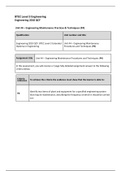
Qualification Unit number and title
Engineering 2010 QCF: BTEC Level 3 Extended Unit 44 – Engineering Maintenance
Diploma in Engineering Procedures and Techniques (P4)
Assignment title Unit 44 – Engineering Maintenance Procedures and Techniques (P4)
In this assessment, you will receive a 7 page fully detailed assignment answer to the following
criteria below.
Criteria To achieve the criteria the evidence must show that the learner is able to:
reference
Identify two items of plant and equipment for a specified engineering system
P4
that require maintenance, describing the frequency at which it should be carried
out.
, BTEC Level 3 Engineering
Unit 44 – Engineering Maintenance Procedures and Techniques (P4)
P4: Identify two items of plant and equipment for a specified engineering
system that require maintenance, describing the frequency at which it should
be carried out.
Frequency of maintenance issues of an engineering system
Boilers
Key Components of Boilers
In general, the critical components are those whose failure will directly affect the reliability
of the boiler. The critical components can be highlighted by the impact they have on safety,
reliability, and performance.
Component Description
Drums The steam drum is the single most expensive component
in the boiler. Consequently, any maintenance program
must address the steam drum, as well as any Other
drums, in the convection passes of the boiler. In general,
problems in the drums are associated with corrosion _ In
some instances, where drums have rolled tubes, rolling
may produce excessive stresses that can lead to damage
in the ligament areas. Problems in the drums normally
lead to indications that are seen on the surfaces—either
inside diameter (ID) outside diameter COD).
Assessment: Inspection and testing focus on detecting
surface indications. The preferred non-destructive
examination (NDE) method is wet fluorescent magnetic
panicle testing (WFMD. Because WFMT uses fluorescent
particles that are examined under ultraviolet light, it is
more sensitive than dry powder type magnetic particle
testing (MT) and it is faster than liquid dye penetrant
testing (PT) methods. WFMT should include the major
welds, selected attachment welds, and at least some of
the ligaments. If locations of corrosion are found, then
ultrasonic thickness testing (UTT) may be performed to
assess thinning due to metal loss. In rare instances,
metallographic replication may be performed.
Engineering 2010 QCF
Unit 44 – Engineering Maintenance Practices & Techniques (P4)
Qualification Unit number and title
Engineering 2010 QCF: BTEC Level 3 Extended Unit 44 – Engineering Maintenance
Diploma in Engineering Procedures and Techniques (P4)
Assignment title Unit 44 – Engineering Maintenance Procedures and Techniques (P4)
In this assessment, you will receive a 7 page fully detailed assignment answer to the following
criteria below.
Criteria To achieve the criteria the evidence must show that the learner is able to:
reference
Identify two items of plant and equipment for a specified engineering system
P4
that require maintenance, describing the frequency at which it should be carried
out.
, BTEC Level 3 Engineering
Unit 44 – Engineering Maintenance Procedures and Techniques (P4)
P4: Identify two items of plant and equipment for a specified engineering
system that require maintenance, describing the frequency at which it should
be carried out.
Frequency of maintenance issues of an engineering system
Boilers
Key Components of Boilers
In general, the critical components are those whose failure will directly affect the reliability
of the boiler. The critical components can be highlighted by the impact they have on safety,
reliability, and performance.
Component Description
Drums The steam drum is the single most expensive component
in the boiler. Consequently, any maintenance program
must address the steam drum, as well as any Other
drums, in the convection passes of the boiler. In general,
problems in the drums are associated with corrosion _ In
some instances, where drums have rolled tubes, rolling
may produce excessive stresses that can lead to damage
in the ligament areas. Problems in the drums normally
lead to indications that are seen on the surfaces—either
inside diameter (ID) outside diameter COD).
Assessment: Inspection and testing focus on detecting
surface indications. The preferred non-destructive
examination (NDE) method is wet fluorescent magnetic
panicle testing (WFMD. Because WFMT uses fluorescent
particles that are examined under ultraviolet light, it is
more sensitive than dry powder type magnetic particle
testing (MT) and it is faster than liquid dye penetrant
testing (PT) methods. WFMT should include the major
welds, selected attachment welds, and at least some of
the ligaments. If locations of corrosion are found, then
ultrasonic thickness testing (UTT) may be performed to
assess thinning due to metal loss. In rare instances,
metallographic replication may be performed.