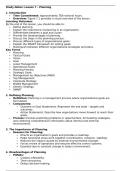
Study Notes: Lesson 7 - Planning
1. Introduction
Time Commitment: Approximately TEN notional hours.
Overview: Figure 7.1 provides a visual overview of the lesson.
Learning Outcomes
By the end of this lesson, you should be able to:
Define planning.
Explain the importance of planning in an organization.
Differentiate between a goal and a plan.
Provide the disadvantages of planning.
Discuss the steps in the planning process.
Discuss different types of organizational goals.
Explain the SMART framework for setting goals.
Distinguish between different organizational strategies and plans.
Key Terms
Planning
Tactical Goals
Vision
Goal
Lower Management
Operational Goals
Planning Process
Strategic Goals
Management by Objectives (MBO)
Top Management
Corporate Strategy
Middle Management
Generic Strategy
SMART
2. Defining Planning
Definition: Planning is a management process where organizational goals are
formulated.
Components:
Outcome or Goal Statements: Represent the end state – targets and
outcomes.
Action Statements: Describe how organizations move forward to reach their
goals.
Process: Involves predicting problems or opportunities, formulating strategies,
and collecting comprehensive information about internal and external
environments.
3. The Importance of Planning
Reasons for Planning:
Directs an organization's goals and provides a roadmap.
Helps functional areas work together (coordination, cohesion, stability).
Reduces the impact caused by external environmental changes.
Forces review of operations and ensures effective control systems.
Essential due to constant change in today's environment.
4. Disadvantages of Planning
Pitfalls:
Creates inflexibility.
Time-consuming.
Delays decision-making.
, Restrains creativity and innovation.
5. The Planning Process
Steps:
1. Establish Goals: Formulate goals for the organization.
2. Develop Alternative Plans: Suggest courses of action to achieve the
established goals.
3. Evaluate Alternative Plans: Determine the most favourable course of
action.
4. Implement the Plan: Put the chosen plan into action.
5. Reactive Planning: Evaluate the implemented plan and refine goals and
plans based on feedback.
Characteristics:
Dynamic: Continuously reviewed and adjusted to adapt to changing needs
and circumstances.
Foundation: Interlinked with other management tasks (organizing, leading,
controlling).
6. Organizational Goals
6.1 SMART Framework
Managers use the SMART framework when formulating goals:
Specific (S): Goals and outcomes should be clearly defined.
Measurable (M): Goals should be quantifiable.
Attainable (A): Goals should be challenging yet realistic.
Relevant (R): Goals should align with the vision, mission, and values of the
organization.
Time-bound (T): Specific time limits should be assigned to goals.
6.2 Types of Goals
6.2.1 Strategic Goals
Characteristics:
Long-term general goals for the entire organization.
Set by top-level management.
Future-oriented (3-10 years).
Elements:
Vision: Aspirations for the future.
Mission Statement: Purpose and reason for existence.
Long-term Strategic Goals: Cover the entire organization and focus on long-
term objectives.
6.2.2 Functional or Tactical Goals
Characteristics:
Shorter-term elements derived from long-term goals.
Determined by middle-level management.
Period: 1-3 years.
6.2.3 Operational Goals
Characteristics:
Current, narrow, and resource-focused.
Achieved by individuals or groups.
Formulated to direct and control the implementation of tactical goals.
7. Organizational Strategies and Plans
7.1 Strategic Plans
Generic Strategies:
Cost Leadership: Focuses on having the lowest cost of production.
Differentiation: Focuses on distinctiveness valued by customers.
Focus: Targets a specific segment or domain of activity.
Corporate Strategies:
1. Introduction
Time Commitment: Approximately TEN notional hours.
Overview: Figure 7.1 provides a visual overview of the lesson.
Learning Outcomes
By the end of this lesson, you should be able to:
Define planning.
Explain the importance of planning in an organization.
Differentiate between a goal and a plan.
Provide the disadvantages of planning.
Discuss the steps in the planning process.
Discuss different types of organizational goals.
Explain the SMART framework for setting goals.
Distinguish between different organizational strategies and plans.
Key Terms
Planning
Tactical Goals
Vision
Goal
Lower Management
Operational Goals
Planning Process
Strategic Goals
Management by Objectives (MBO)
Top Management
Corporate Strategy
Middle Management
Generic Strategy
SMART
2. Defining Planning
Definition: Planning is a management process where organizational goals are
formulated.
Components:
Outcome or Goal Statements: Represent the end state – targets and
outcomes.
Action Statements: Describe how organizations move forward to reach their
goals.
Process: Involves predicting problems or opportunities, formulating strategies,
and collecting comprehensive information about internal and external
environments.
3. The Importance of Planning
Reasons for Planning:
Directs an organization's goals and provides a roadmap.
Helps functional areas work together (coordination, cohesion, stability).
Reduces the impact caused by external environmental changes.
Forces review of operations and ensures effective control systems.
Essential due to constant change in today's environment.
4. Disadvantages of Planning
Pitfalls:
Creates inflexibility.
Time-consuming.
Delays decision-making.
, Restrains creativity and innovation.
5. The Planning Process
Steps:
1. Establish Goals: Formulate goals for the organization.
2. Develop Alternative Plans: Suggest courses of action to achieve the
established goals.
3. Evaluate Alternative Plans: Determine the most favourable course of
action.
4. Implement the Plan: Put the chosen plan into action.
5. Reactive Planning: Evaluate the implemented plan and refine goals and
plans based on feedback.
Characteristics:
Dynamic: Continuously reviewed and adjusted to adapt to changing needs
and circumstances.
Foundation: Interlinked with other management tasks (organizing, leading,
controlling).
6. Organizational Goals
6.1 SMART Framework
Managers use the SMART framework when formulating goals:
Specific (S): Goals and outcomes should be clearly defined.
Measurable (M): Goals should be quantifiable.
Attainable (A): Goals should be challenging yet realistic.
Relevant (R): Goals should align with the vision, mission, and values of the
organization.
Time-bound (T): Specific time limits should be assigned to goals.
6.2 Types of Goals
6.2.1 Strategic Goals
Characteristics:
Long-term general goals for the entire organization.
Set by top-level management.
Future-oriented (3-10 years).
Elements:
Vision: Aspirations for the future.
Mission Statement: Purpose and reason for existence.
Long-term Strategic Goals: Cover the entire organization and focus on long-
term objectives.
6.2.2 Functional or Tactical Goals
Characteristics:
Shorter-term elements derived from long-term goals.
Determined by middle-level management.
Period: 1-3 years.
6.2.3 Operational Goals
Characteristics:
Current, narrow, and resource-focused.
Achieved by individuals or groups.
Formulated to direct and control the implementation of tactical goals.
7. Organizational Strategies and Plans
7.1 Strategic Plans
Generic Strategies:
Cost Leadership: Focuses on having the lowest cost of production.
Differentiation: Focuses on distinctiveness valued by customers.
Focus: Targets a specific segment or domain of activity.
Corporate Strategies: