Lesson 4: The Business Environment
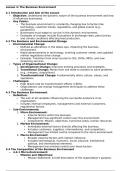
4.1 Introduction and Aim of the Lesson
Objective: Understand the dynamic nature of the business environment and how
it influences businesses.
Key Points:
The business environment is constantly changing due to factors like
technology, customer trends, regulations, and global events (e.g.,
pandemics).
Businesses must adapt to survive in this dynamic environment.
Examples of changes include fluctuations in exchange rates, petrol prices,
and climate conditions affecting food production.
4.2 The Business and Environmental Change
Environmental Change:
Defined as alterations in the status quo, impacting the business
environment.
Rapid advancements in technology, evolving customer needs, and updated
market regulations drive change.
Example: Transition from vinyl records to CDs, DVDs, MP3s, and now
streaming services.
Types of Organisational Change:
1. Development Change: Improves existing processes and strategies.
2. Transitional Change: Moves from one state to another to solve problems
(e.g., mergers, acquisitions).
3. Transformational Change: Fundamentally alters culture, values, and
operations.
Challenges:
High failure rate for transformation efforts (>60%).
Organizations use change management techniques to address these
challenges.
4.3 The Business Environment
Definition:
The sum of all variables influencing the successful existence of an
organization.
Includes internal (employees, management) and external (customers,
regulations) factors.
Sub-Environments:
1. Micro-Environment:
Internal factors within the business.
Management has significant control over this environment.
Components: Mission, objectives, functional areas, human resources.
2. Market Environment:
Immediate external factors directly affecting the business.
Includes customers, suppliers, intermediaries, and competitors.
Management has limited control compared to the micro-environment.
3. Macro-Environment:
Broader external factors with indirect influence.
Includes technological, economic, social, physical, institutional-
political, and international elements.
Management has minimal control over these factors.
4.4 The Composition of the Business Environment
4.4.1 Micro-Environment:
Mission and Objectives:
Mission Statement: A brief description of the organization’s purpose.
, Examples: Tesla ("To accelerate the world’s transition to
sustainable energy"), LinkedIn ("To connect the world’s
professionals").
Objectives: Specific goals aligned with the mission.
Examples: Profitability, productivity, customer service, employee
retention, core values, sustainable growth.
Organisational Functions:
Purchasing supplies, logistics, marketing, financial expertise.
Human Resources:
Essential assets requiring nurturing and development.
Challenges: Managing HIV/AIDS in the workplace through policies,
education, and support programs.
4.4.2 Market Environment:
Components:
1. Customers: Understanding their needs and preferences.
2. Suppliers: Providing materials, capital, and labour.
3. Intermediaries: Bridging gaps between manufacturers and consumers
(e.g., wholesalers, real estate agents).
4. Competitors: Rival businesses competing for customers.
Porter’s Five Forces: Analysing competition and profitability in the
market environment.
4.4.3 Macro-Environment:
Variables:
1. Technological Environment: Innovations replacing old technologies
(e.g., telegraph → email).
2. Economic Environment: Interest rates, inflation, unemployment
affecting consumer behaviour.
3. Social Environment: Urbanization, gender roles, health issues like
HIV/AIDS.
4. Physical Environment: Scarcity of natural resources (e.g., water
shortages in South Africa).
5. Institutional/Political Environment: Government policies, labour
laws.
6. International Environment: Global events like oil price fluctuations
impacting local economies.
4.5 Environmental Scanning
Definition:
Process of monitoring and analysing external environmental factors to
inform strategic decisions.
Importance:
Provides valuable insights into strengths, weaknesses, opportunities, and
threats.
Helps organizations stay competitive and avoid potential losses.
Techniques:
1. Research: Identifying industry trends and threats.
2. Expert Opinion: Consulting industry experts for analysis.
3. SWOT Analysis: Evaluating internal strengths/weaknesses and external
opportunities/threats.
4. PEST Analysis: Investigating political, economic, social, and technological
factors.
5. Industry Analysis: Understanding competitors’ strategies to develop
countermeasures.
4.6 Summary
Key takeaways:
The business environment is dynamic and consists of micro-, market, and
macro-environments.
4.1 Introduction and Aim of the Lesson
Objective: Understand the dynamic nature of the business environment and how
it influences businesses.
Key Points:
The business environment is constantly changing due to factors like
technology, customer trends, regulations, and global events (e.g.,
pandemics).
Businesses must adapt to survive in this dynamic environment.
Examples of changes include fluctuations in exchange rates, petrol prices,
and climate conditions affecting food production.
4.2 The Business and Environmental Change
Environmental Change:
Defined as alterations in the status quo, impacting the business
environment.
Rapid advancements in technology, evolving customer needs, and updated
market regulations drive change.
Example: Transition from vinyl records to CDs, DVDs, MP3s, and now
streaming services.
Types of Organisational Change:
1. Development Change: Improves existing processes and strategies.
2. Transitional Change: Moves from one state to another to solve problems
(e.g., mergers, acquisitions).
3. Transformational Change: Fundamentally alters culture, values, and
operations.
Challenges:
High failure rate for transformation efforts (>60%).
Organizations use change management techniques to address these
challenges.
4.3 The Business Environment
Definition:
The sum of all variables influencing the successful existence of an
organization.
Includes internal (employees, management) and external (customers,
regulations) factors.
Sub-Environments:
1. Micro-Environment:
Internal factors within the business.
Management has significant control over this environment.
Components: Mission, objectives, functional areas, human resources.
2. Market Environment:
Immediate external factors directly affecting the business.
Includes customers, suppliers, intermediaries, and competitors.
Management has limited control compared to the micro-environment.
3. Macro-Environment:
Broader external factors with indirect influence.
Includes technological, economic, social, physical, institutional-
political, and international elements.
Management has minimal control over these factors.
4.4 The Composition of the Business Environment
4.4.1 Micro-Environment:
Mission and Objectives:
Mission Statement: A brief description of the organization’s purpose.
, Examples: Tesla ("To accelerate the world’s transition to
sustainable energy"), LinkedIn ("To connect the world’s
professionals").
Objectives: Specific goals aligned with the mission.
Examples: Profitability, productivity, customer service, employee
retention, core values, sustainable growth.
Organisational Functions:
Purchasing supplies, logistics, marketing, financial expertise.
Human Resources:
Essential assets requiring nurturing and development.
Challenges: Managing HIV/AIDS in the workplace through policies,
education, and support programs.
4.4.2 Market Environment:
Components:
1. Customers: Understanding their needs and preferences.
2. Suppliers: Providing materials, capital, and labour.
3. Intermediaries: Bridging gaps between manufacturers and consumers
(e.g., wholesalers, real estate agents).
4. Competitors: Rival businesses competing for customers.
Porter’s Five Forces: Analysing competition and profitability in the
market environment.
4.4.3 Macro-Environment:
Variables:
1. Technological Environment: Innovations replacing old technologies
(e.g., telegraph → email).
2. Economic Environment: Interest rates, inflation, unemployment
affecting consumer behaviour.
3. Social Environment: Urbanization, gender roles, health issues like
HIV/AIDS.
4. Physical Environment: Scarcity of natural resources (e.g., water
shortages in South Africa).
5. Institutional/Political Environment: Government policies, labour
laws.
6. International Environment: Global events like oil price fluctuations
impacting local economies.
4.5 Environmental Scanning
Definition:
Process of monitoring and analysing external environmental factors to
inform strategic decisions.
Importance:
Provides valuable insights into strengths, weaknesses, opportunities, and
threats.
Helps organizations stay competitive and avoid potential losses.
Techniques:
1. Research: Identifying industry trends and threats.
2. Expert Opinion: Consulting industry experts for analysis.
3. SWOT Analysis: Evaluating internal strengths/weaknesses and external
opportunities/threats.
4. PEST Analysis: Investigating political, economic, social, and technological
factors.
5. Industry Analysis: Understanding competitors’ strategies to develop
countermeasures.
4.6 Summary
Key takeaways:
The business environment is dynamic and consists of micro-, market, and
macro-environments.