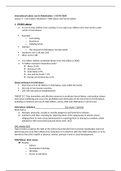
International Labour Law & Globalization || 03/03/2020
Lecture 4 – Core Labour Standards I: Child Labour and Forced Labour
I. Child Labour
It’s not to stop children from working, it’s to make sure children who work do this under
certain circumstances
Examples
o Coal mining
o Aluminium
o Colleting bricks
Statistics
o The amound of child labour has decreased
Standards: ILO C138 and C182
Other norms: CRC
152 million children worldwide (down from 246 million in 2000)
73 million involved in hazardous work!
Africa 19.6%
Americas 5.3%
Arab States 2.9%
Asia and the Pacific 7.4%
Europe and Central Asia 4.1%
Global estimates of child labour
More than 2/3 of all children in child labour work within the family
Not only in low-income countries
Link with educational marginalization
TARGET 8.7: Take immediate and effective measures to eradicate forced labour, end modern slavery
and human trafficking and secure the prohibition and elimination of the worst forms of child labour,
including recruitment and use of child soldiers, and by 2025 end child labour in all its forms
Child labour definition Too young + harmful
Work that is:
a) Mentally, physically, socially or morally dangerous and harmful to children
b) Interferes with their schooling by: depriving them of the opportunity to attend school;
obliging them to leave school prematurely or requiring them to attempt to combine school
attendance with excessively long and heavy work. (ILO)
CRC, Article 32(1)
States Parties recognize the right of the child to be protected from economic exploitation and from
performing any work that is likely to be hazardous or to interfere with the child's education, or to be
harmful to the child's health or physical, mental, spiritual, moral or social development.
Child labour: Root causes
Poverty
o Culture
o Development ideology
o HIV/AIDS
o Access to education
, Child labour: standards
ILO:
(1919: C05 Minimum age industrial work)
1973: C138 & R146
Minimum age convention
1999: C182 & R190
Worst Forms of Child Labour
UN:
1966: ICESCR (International covenant of Economic, Social and Cultural Rights)
1990: CRC (Convention on the Rights of the Child)
Minimum Age Convention C138
1973
Replacing a number of more specific conventions
Core convention: 171 ratifications
Flexible system for minimum age
C138: Preamble
Considering that the time has come to establish a general instrument on the subject, which would
gradually replace the existing ones applicable to limited economic sectors, with a view to achieving
the total abolition of child labour […]
C138: Article 1
Each member for which this convention is in force undertakes to pursue a national policy designed to
ensure the effective abolition of child labour and to raise progressively the minimum age for
admission to employment or work to a level consistent with the fullest physical and mental
development of young persons.
C138, Article 2: Basic Minimum Age Rule
2(1): […] no one under that age shall be admitted to employment or work in any occupation.
2(3): The minimum age specified in pursuance of paragraph 1 of this Article shall not be less than the
age of completion of compulsory schooling and, in any case, shall not be less than 15 years
C138, Article 2: Basic Minimum Age Exception
2(4): Notwithstanding the provisions of paragraph 3 of this Article, a Member whose economy and
educational facility are insufficiently developed may, after consultation with the organisations of
employers and workers concerned, where such exist, initially specify a minimum age of 14 years.
C138, Article 3: Hazardous Work Rule
3(1): The minimum age for admission to any type of employment or work which by its nature or the
circumstances in which it is carried out is likely to jeopardise the health, safety or morals of young
persons shall not be less than 18 years.
C138, Article 3: Hazardous Work Exception
3(3): Notwithstanding the provisions of paragraph 1 of this Article, national laws or regulations or the
competent authority may, after consultation with the organisations of employers and workers
concerned, where such exist, authorise employment or work as from the age of 16 years on
condition that the health, safety and morals of the young persons concerned are fully protected and
that the young persons have received adequate specific instruction or vocational training in the
relevant branch of activity.
C138, Article 7: Light Work Rule
Lecture 4 – Core Labour Standards I: Child Labour and Forced Labour
I. Child Labour
It’s not to stop children from working, it’s to make sure children who work do this under
certain circumstances
Examples
o Coal mining
o Aluminium
o Colleting bricks
Statistics
o The amound of child labour has decreased
Standards: ILO C138 and C182
Other norms: CRC
152 million children worldwide (down from 246 million in 2000)
73 million involved in hazardous work!
Africa 19.6%
Americas 5.3%
Arab States 2.9%
Asia and the Pacific 7.4%
Europe and Central Asia 4.1%
Global estimates of child labour
More than 2/3 of all children in child labour work within the family
Not only in low-income countries
Link with educational marginalization
TARGET 8.7: Take immediate and effective measures to eradicate forced labour, end modern slavery
and human trafficking and secure the prohibition and elimination of the worst forms of child labour,
including recruitment and use of child soldiers, and by 2025 end child labour in all its forms
Child labour definition Too young + harmful
Work that is:
a) Mentally, physically, socially or morally dangerous and harmful to children
b) Interferes with their schooling by: depriving them of the opportunity to attend school;
obliging them to leave school prematurely or requiring them to attempt to combine school
attendance with excessively long and heavy work. (ILO)
CRC, Article 32(1)
States Parties recognize the right of the child to be protected from economic exploitation and from
performing any work that is likely to be hazardous or to interfere with the child's education, or to be
harmful to the child's health or physical, mental, spiritual, moral or social development.
Child labour: Root causes
Poverty
o Culture
o Development ideology
o HIV/AIDS
o Access to education
, Child labour: standards
ILO:
(1919: C05 Minimum age industrial work)
1973: C138 & R146
Minimum age convention
1999: C182 & R190
Worst Forms of Child Labour
UN:
1966: ICESCR (International covenant of Economic, Social and Cultural Rights)
1990: CRC (Convention on the Rights of the Child)
Minimum Age Convention C138
1973
Replacing a number of more specific conventions
Core convention: 171 ratifications
Flexible system for minimum age
C138: Preamble
Considering that the time has come to establish a general instrument on the subject, which would
gradually replace the existing ones applicable to limited economic sectors, with a view to achieving
the total abolition of child labour […]
C138: Article 1
Each member for which this convention is in force undertakes to pursue a national policy designed to
ensure the effective abolition of child labour and to raise progressively the minimum age for
admission to employment or work to a level consistent with the fullest physical and mental
development of young persons.
C138, Article 2: Basic Minimum Age Rule
2(1): […] no one under that age shall be admitted to employment or work in any occupation.
2(3): The minimum age specified in pursuance of paragraph 1 of this Article shall not be less than the
age of completion of compulsory schooling and, in any case, shall not be less than 15 years
C138, Article 2: Basic Minimum Age Exception
2(4): Notwithstanding the provisions of paragraph 3 of this Article, a Member whose economy and
educational facility are insufficiently developed may, after consultation with the organisations of
employers and workers concerned, where such exist, initially specify a minimum age of 14 years.
C138, Article 3: Hazardous Work Rule
3(1): The minimum age for admission to any type of employment or work which by its nature or the
circumstances in which it is carried out is likely to jeopardise the health, safety or morals of young
persons shall not be less than 18 years.
C138, Article 3: Hazardous Work Exception
3(3): Notwithstanding the provisions of paragraph 1 of this Article, national laws or regulations or the
competent authority may, after consultation with the organisations of employers and workers
concerned, where such exist, authorise employment or work as from the age of 16 years on
condition that the health, safety and morals of the young persons concerned are fully protected and
that the young persons have received adequate specific instruction or vocational training in the
relevant branch of activity.
C138, Article 7: Light Work Rule